

The hidden assumption in every framework you are using
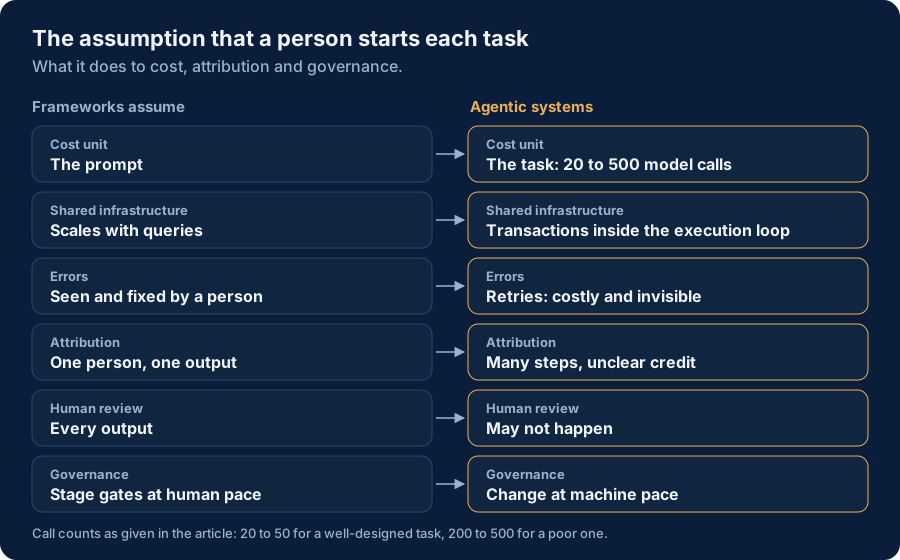
Go back to any AI economics framework you have used in the past two years. The AI TCO model, the ROI calculation, the FinOps cost attribution practice, the portfolio governance approach. Each of them contains an implicit assumption that is so fundamental it is almost invisible: there is a human on one end of the interaction, and a model on the other. Interpretation The human has a task. The human queries, prompts, or requests. The model responds. The human reviews. The cost is the cost of that exchange. The value is the value of what that exchange produces. The governance question is whether the exchange is happening enough, at sufficient quality, at acceptable cost. Interpretation This is a reasonable model for a world of AI assistants - tools that help knowledge workers do their jobs faster. It is not a useful model for agentic systems. Interpretation In an agentic system, the AI does not wait for a human to formulate a request. It receives an objective - summarise this set of contracts, process this backlog of applications, monitor these systems and respond to anomalies, complete this research task - and it plans and executes a series of steps to reach that objective. Those steps may involve dozens or hundreds of model calls. They may involve retrieving information from external systems, calling APIs, writing and executing code, reviewing intermediate outputs, revising plans, and making subsidiary decisions. The human may specify the objective and review the final output. Everything in between is autonomous. InterpretationAgentic deployment in practice: Klarna deployed an AI customer service agent in 2024 that handled the work equivalent of 700 full-time agents. The system operated autonomously across multiple conversation turns, accessing customer data, making policy decisions, and resolving issues without human intervention in the majority of cases. This represents a fundamentally different economic model from AI assistants that support human agents. However, by May 2025 Klarna had scaled back its AI customer service claims and resumed hiring human agents, illustrating how initial agentic deployments require ongoing validation and adjustment.
Why the cost model is wrong
The cost unit is no longer the prompt
In a request-response AI system, cost can be reasonably tracked per prompt or per interaction. Inference cost scales with the number of interactions and the average token depth of each one. This is predictable enough to forecast and govern. Interpretation In an agentic system, the cost unit is the task - and the relationship between task count and cost is non-linear. Interpretation A single business task assigned to an agentic system may involve: Interpretation- An initial planning call to decompose the objective into subtasks
- Retrieval calls to gather relevant context from internal systems
- Multiple reasoning calls as the agent works through sub-problems
- Tool invocations (API calls, code execution, database queries) and the resulting context that must be processed
- Verification calls to check intermediate outputs against quality or compliance criteria
- Error recovery calls when intermediate steps produce unexpected results or require revision
- A final synthesis call to produce the output
At a glance
model calls for a well-designed moderately complex task
model calls for a poorly designed version of the same task
cost variance between equivalent agent implementations
Analysis · Agentic AI Economics
How Agentic Systems Break the Cost Model
Every AI economics framework in use today assumes one human request generates one model response. Agentic systems break this assumption: one business objective can trigger 20–200 model calls, with cost variance up to 10× for equivalent output quality.
Side-by-side comparison showing traditional AI assistant with one request equals one API call versus agentic system where one task triggers 20 to 200 API calls through planning, retrieval, execution, tool calls, verification, error recovery, and synthesis steps.
The cost unit is no longer the prompt. It is the task. Agentic systems require a new cost model that tracks orchestration overhead, tool invocation cost, error recovery consumption, and verification loops separately. Two agent implementations producing equivalent outputs can differ by 900% in token cost, invisible to frameworks built for request-response AI.
Illustrative. Call counts are indicative ranges based on published AWS agentic workflow research and AI Economics Hub analysis. Error recovery estimates based on observed production agentic patterns. Sources: AWS ML blog (agentic optimisation), FinOps Foundation emerging guidance on agentic AI (2026), AI Economics Hub analysis.
Shared infrastructure cost changes character
In request-response AI, shared infrastructure - vector databases, retrieval systems, API orchestration - scales roughly proportionally with query volume. More users, more queries, more cost. The relationship is relatively predictable. Interpretation In agentic systems, shared infrastructure is under different pressure. Every agent action that touches an external system is a transaction: an API call, a database read, a file system operation, a web request. The cost of these transactions accumulates inside the agent's execution loop, often multiplied by the retries and refinements that are inherent to complex task execution. An agentic workflow that completes 1,000 business tasks may generate 100,000 infrastructure transactions, distributed across systems that were sized for much lower load. Interpretation This creates a new category of cost-scale risk: an agentic system that is performing as designed - completing tasks at the expected rate - can create infrastructure load that was not anticipated in any TCO model that was constructed with request-response patterns in mind. InterpretationError recovery is expensive and invisible
Humans retry tasks occasionally, and when they do, it is visible. An agentic system retries continuously as part of its normal operation. When a tool call fails, the agent retries. When an intermediate result fails a quality check, the agent revises and retries. When the plan hits an unexpected constraint, the agent replans and retries. All of this retry behaviour generates model calls, infrastructure transactions, and latency - and almost none of it is visible in the output the human sees. Interpretation In a production agentic system under realistic operating conditions, 20-40% of the total token consumption may come from error recovery, replanning, and verification loops rather than from the direct work of completing the task. In poorly designed systems with fragile tool integrations or inadequate planning logic, this fraction can be higher. Interpretation Most TCO models do not have a line for error recovery spend. Most FinOps dashboards do not surface it. It is consumed quietly, at scale, inside what looks like normal usage. InterpretationWhy the ROI model is wrong
Attribution breaks in multi-step autonomous systems
In a simple AI assistant case, attribution is imperfect but tractable. The AI helped write the report. The report contributed to winning the contract. The contract contributed to revenue. The chain of reasoning is speculative but bounded. Interpretation In an agentic system completing complex tasks autonomously, attribution becomes a genuinely difficult problem. Consider an agentic research system that analyses 500 regulatory filings, identifies a risk pattern, flags it for review, and provides supporting evidence. A lawyer reviews the output, makes a decision, and the organisation avoids a compliance failure. What is the value of the agentic system's contribution? Interpretation The autonomous system made the task possible at all - the volume of filings could not be reviewed manually within the available time. But the system also failed to identify three relevant filings, which the lawyer caught during review. And the risk pattern identified would have been caught by a different process in a longer timeframe, at greater cost. So the value is the difference between the outcome with the system and the outcome without it - under a counterfactual that can only be estimated, not observed. Interpretation This is a philosophically hard problem, and it gets harder as agentic systems become more deeply embedded in decision-making processes. When the agent is making thousands of micro-decisions per day - each individually small, collectively shaping business outcomes - the notion of attributing value to any one system or intervention becomes analytically untenable. Interpretation This does not mean that value measurement is impossible or that ROI frameworks are useless. It means that the existing frameworks, which assume a cleanly attributable human-AI interaction, need to be replaced with portfolio-level value measurement that assesses overall outcome improvement rather than initiative-level attribution. InterpretationThe human review assumption may not hold
Most AI ROI models implicitly assume that humans review AI outputs before consequential decisions are made. The value chain is: AI accelerates task completion → human reviews and decides → organisation benefits. Interpretation Agentic systems increasingly operate outside this model. When an agentic system is processing 10,000 customer communication responses per day, or executing 500 research tasks per week, or monitoring and routing 50,000 service events per day, the volume of AI outputs exceeds any realistic human review capacity. The governance model that supports a request-response AI interaction - human review at the point of output - does not scale to agentic operation. InterpretationScale beyond human review: Klarna's agentic customer service system handled 2.3 million conversations in its first month, equivalent to two-thirds of the company's total customer service volume. At this scale, individual transaction review is economically impossible. Value measurement shifted to aggregate metrics: resolution rate, customer satisfaction, escalation patterns, and error frequency. The subsequent scaling back of claims in 2025 underscores the importance of rigorous ongoing measurement at this scale.
Why the governance model is wrong
Stage gates were designed for human-paced change
The governance frameworks in this publication - stage gates, proof thresholds, portfolio reviews, stop-or-scale decisions - were designed for a world where AI capability changes are delivered in development cycles and released to users who interact with them at human speed. Interpretation Agentic systems can change the scale and character of their impact much faster than this. An agentic system deployed with one task type can be redirected to a different task type in hours. An agentic system that was generating low volume can be scaled to high volume without a release cycle. The governance cadence that is adequate for quarterly portfolio reviews is not adequate for systems that can materially change their economic and operational impact between meetings. Interpretation This is not an argument against portfolio governance - it is an argument for tighter operating loops. Agentic systems need operational governance at the task level (what objectives is the system allowed to pursue?) and at the tool level (what external systems can the agent interact with, and under what constraints?), not only at the portfolio level. InterpretationThe optimist's case
The FinOps Foundation's emerging guidance on agentic AI governance emphasises real-time cost monitoring and automated guardrails. Organisations that implement continuous governance - with automated alerts on cost anomalies, task-level authorisation controls, and tool access restrictions - can govern agentic systems effectively without slowing deployment. The technology exists to govern at machine speed.
The sceptic's case
Automated governance creates a false sense of security. Agentic systems can cause material harm through patterns that automated controls cannot detect: subtle bias in decision-making, gradual quality degradation, or inappropriate use of discretion within authorised boundaries. Human judgment at appropriate intervals remains essential. Organisations that rely entirely on automated governance will discover the limits when a significant failure occurs.
Synthesis · house view
Effective agentic governance requires both automated controls and human oversight, but at different layers. Automated controls should govern cost boundaries, tool access, and task authorisation. Human oversight should focus on outcome quality, ethical boundaries, and strategic alignment. The governance cadence should match the risk profile: high-risk agentic deployments require more frequent human review than low-risk ones. The key is designing governance that scales with deployment without creating bottlenecks.
Existing controls assume human-initiated risk
Almost all enterprise AI risk governance is built around the assumption that risk materialises because a human makes a bad decision using AI assistance. A model produces a hallucination; the human incorporates it uncritically; an error results. The control is human review quality. Interpretation In agentic systems, risk can materialise without a human decision point. An agent that is authorised to write and execute code can introduce a software vulnerability before any human has reviewed the code. An agent that is authorised to interact with external systems can send communications, trigger transactions, or access data before the consequence of those actions is visible to any oversight function. An agent that is authorised to book travel or commit resources can make commitments that create financial obligations before a human has validated that the commitment is appropriate. Interpretation These are not exotic failure scenarios. They are natural consequences of giving autonomous systems the capability to act rather than merely to advise. The governance frameworks that manage AI risk in the request-response world - output review, explainability requirements, human-in-the-loop design - require fundamental redesign for systems that act autonomously. InterpretationFramework · Agentic AI Economics
The Agent Autonomy Ladder
The economically optimal autonomy level minimises total cost: execution + review + delay + expected error and remediation. High oversight and no oversight both carry high total costs, for different reasons. The sweet spot is levels 4–5 for high-volume, reversible decisions.
Six-level agent autonomy ladder showing total economic cost for each level from L1 Recommend to L6 Autonomous with monitoring, with levels 4 and 5 highlighted as the optimal range where total cost is minimized at 6 to 6.2 relative units.
Total cost = Execution cost + Review cost + Delay cost + Expected error & remediation cost. Right autonomy = the level that minimises this sum for a given decision type, risk, and reversibility.
Illustrative framework by AI Economics Hub, based on Deloitte 2026 decision-making research (one-way/two-way door distinction), BCG AI Radar 2026 (58% of leading organisations expect agent autonomy to require governance changes), and AI Economics Hub analysis of agentic cost structures. Cost units are relative and scenario-dependent. Actual optimal level depends on decision volume, reversibility, error consequence, and value of speed.
What an agentic AI economics framework needs to include
The frameworks on this site remain useful starting points - but they require extension to address agentic deployment. InterpretationOn cost: The TCO model needs a layer for orchestration economics: the cost of planning loops, tool invocations, error recovery, and verification passes that occur inside the agent's execution. This is distinct from model inference cost and from infrastructure cost as traditionally defined. It should be tracked at the workflow level, with explicit measurement of the ratio between task-completion calls and overhead calls. Interpretation
On ROI: Attribution models need to shift from initiative-level to portfolio-level measurement. The question is not "what did this agentic system contribute to this outcome?" - that question will often be unanswerable. The question is "what is the quality and volume of outcomes in this domain, compared with what it was before agentic deployment, at what total cost?" This is a different measurement design, but it is a tractable one. Interpretation
On governance: Portfolio reviews need to be supplemented by operational governance at the task-authorisation and tool-access level. Before deploying an agentic system, the organisation needs to specify: what objectives is this system authorised to pursue? What systems can it access? What can it commit or communicate autonomously? What requires human approval? These are governance design questions, not technology questions - and they need to be answered before deployment, not after the first incident. Interpretation
On risk: Tail-risk exposure from agentic systems is higher than from request-response systems, because autonomous action can propagate errors faster and further than human-reviewed output. This exposure should be included in economic analysis. The expected cost of a significant agentic failure - in operational disruption, regulatory consequence, reputational damage, or financial commitment - should be estimated and weighted against the expected operating benefit. Interpretation
The autonomy ladder: matching economics to decision rights
Not all agentic systems require the same level of autonomy, and not all tasks justify the same governance overhead. The economic optimum depends on matching autonomy level to the value, reversibility, and risk of the decision. Interpretation BCG's 2026 AI Radar research found that around 58% of leading organisations expect agent autonomy to require changes in governance and decision rights. Deloitte's 2026 decision-making research emphasises that effective AI autonomy requires explicit classification of decisions, defined owners, clear escalation paths, and monitoring appropriate to risk. InterpretationSix levels of agent autonomy
Agentic systems can operate at different autonomy levels, each with distinct economic characteristics: Interpretation1. Recommend: The agent analyses the situation and proposes an action, but a human must approve before execution.
- Execution cost: Low (single recommendation generation)
- Review cost: High (human must evaluate every recommendation)
- Delay cost: High (queueing for human approval)
- Error cost: Low (human catches errors before execution)
- Best for: High-impact irreversible decisions, regulated actions, novel situations
2. Draft: The agent prepares complete work products (documents, code, communications) that humans review and approve before use.
- Execution cost: Medium (complete draft generation)
- Review cost: Medium-high (human reviews full output)
- Delay cost: Medium (review queue, but work is complete)
- Error cost: Low-medium (errors caught in review)
- Best for: Customer communications, regulatory filings, code commits, policy documents
3. Execute with approval: The agent completes the task and presents it for approval, but can execute immediately upon approval without rework.
- Execution cost: Medium (complete execution, held pending approval)
- Review cost: Medium (human approves or rejects)
- Delay cost: Medium (approval queue)
- Error cost: Medium (errors may execute if approval is cursory)
- Best for: Routine transactions with financial or operational consequence
4. Execute within limits: The agent acts autonomously within defined boundaries (spend limits, data access, communication scope) and escalates exceptions.
- Execution cost: Low (autonomous execution)
- Review cost: Low (exception review only)
- Delay cost: Low (no queue for routine cases)
- Error cost: Medium (errors execute but are bounded)
- Exception rate: Critical metric (high rate indicates poor boundary design)
- Best for: High-volume routine decisions with clear rules and bounded risk
5. Execute and report: The agent acts autonomously and reports actions for audit and pattern review, but does not require approval.
- Execution cost: Low (fully autonomous)
- Review cost: Very low (periodic audit only)
- Delay cost: None
- Error cost: Medium-high (errors execute and may compound)
- Override rate: Key metric (human intervention frequency)
- Best for: Low-risk reversible decisions, monitoring and alerting, data processing
6. Autonomous with monitoring: The agent operates continuously with automated monitoring for anomalies, cost thresholds, or quality degradation.
- Execution cost: Very low (no human involvement)
- Review cost: Very low (automated monitoring)
- Delay cost: None
- Error cost: High (errors may propagate before detection)
- Value of faster action: Must significantly exceed error risk
- Best for: Real-time systems, high-volume low-risk decisions, time-sensitive responses
Economics by autonomy level
The right autonomy level minimises total cost: execution cost + review cost + delay cost + expected error and remediation cost. InterpretationFor high-volume routine decisions with low error consequence, autonomous execution (levels 5-6) is economically optimal. The cost of human review exceeds the cost of occasional errors.
For high-impact irreversible decisions, recommendation or draft modes (levels 1-2) are economically optimal despite higher review and delay costs. The cost of a single significant error exceeds the cumulative cost of review.
For decisions in between, the optimal level depends on:
- Volume: Higher volume favours autonomy (review cost compounds)
- Reversibility: Easier reversal favours autonomy (error cost is bounded)
- Value of speed: Time-sensitive decisions favour autonomy (delay cost is high)
- Error consequence: Higher consequence favours human approval (error cost is high)
- Exception rate: High exception rate indicates boundaries are poorly defined (redesign before increasing autonomy)
Expected agent growth: In IBM's late-2025 Enterprise 2030 survey of 2,000 executives, respondents expected agentic AI to become embedded across finance, HR, sales, marketing, IT, manufacturing, supply chain, and R&D by 2030, with substantial increases from 2025 levels. However, these are executive expectations about future adoption, not observed deployment outcomes. Organisations should treat these as directional indicators of intent rather than validated forecasts.
Decision-rights module: who decides what
Autonomy level is meaningless without decision rights. Before deploying an agentic system, the organisation must specify: Interpretation- What objectives is this system authorised to pursue?
- What systems can it access?
- What can it commit or communicate autonomously?
- What requires human approval?
- Who is the escalation owner for exceptions?
- What monitoring is required?
- What triggers a stop or capability reduction?
The practical implication
Organisations deploying agentic systems now - coding agents, research agents, customer communication agents, process orchestration agents - are doing so with governance designed for their predecessors. Most of them know this. Most of them are proceeding anyway, for competitive or operational reasons that are genuinely compelling. Interpretation That is a defensible choice. It is not a safe one. The gap between agentic governance requirements and current agentic governance practice is where the next generation of AI economic failures will originate. Interpretation The organisations that get ahead of this will not be the ones that deploy agentic systems most aggressively. They will be the ones that pair aggressive deployment with honest assessment of what their current governance frameworks can and cannot adequately cover - and invest proportionately in closing the gap before scale forces the lesson on them. InterpretationReferences and further reading
Related reading
Case study of agentic AI handling 2.3 million conversations monthly, demonstrating scale beyond human review capacity
Analysis of token consumption variance in agentic systems, showing 5-10x cost differences for identical tasks based on implementation quality
Framework for real-time cost monitoring, automated guardrails, and operational governance for autonomous AI systems
Guidance on governing AI systems with autonomous decision-making capability, including risk assessment for systems that act without human review
Research on CEO ownership, agent autonomy expectations, and governance changes required for agentic deployment
Executive expectations for agentic AI adoption across business functions through 2030
Framework for decision rights, autonomy levels, and human-AI collaboration in decision-making systems