

Orientation
Start Here
Start with the task in front of you, or with your role. The map below shows how the rest of the site fits together.
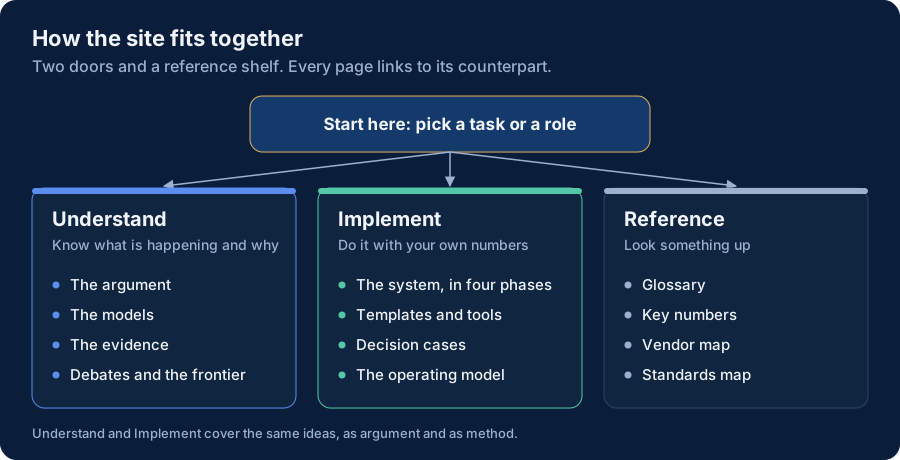
Two ways to use this site
You can switch at any point; every page links to its counterpart.
Start with what you need to do
Grouped by the phase of the AI Economics System each task belongs to. Each path is three or four pieces, in order.
Start from scratch
Work out what AI really costs
Compare models and hosting options
Set up showback or chargeback
Build an AI business case
Prove whether a use case created value
Run a portfolio review for the board
Review an AI supplier contract
Decide whether to scale or stop a pilot
Forecast next year's AI budget
Control agentic spend
Design the operating model
Or start with your role

Finance lens
CFO and finance transformation
AI spend is variable, often buried inside automated loops and SaaS renewals, and harder to trace than cloud. Much of the instrumentation built for cloud does not reach it.
Lead metric
Cost per successful outcome, and attribution coverage as the portfolio headline

Technology lens
CIO, CTO, CDO, Head of AI / CoE and Product
You are accountable for AI value across functions you do not control, with tooling that measures cost well and value barely. The fix is one accountable view, not another dashboard.
Lead metric
Attribution coverage, plus the portfolio value-versus-cost view that names winners and laggards

FinOps and practitioner lens
FinOps Leader and Procurement
FinOps for AI is FinOps plus a value layer, not a new world. Your visibility, allocation and culture playbook transfers; what is new is outcome attribution, agent governance and the meter going dark.
Lead metric
Attribution coverage as the extension of allocation; cost per successful outcome as the new unit economics

Governance and board lens
Risk/Legal, HR/People and Board
Three questions cover the whole estate: what share of our AI spend connects to a measured outcome; are we automating, redesigning or reinventing; and can we govern what we are scaling?
Lead metric
Attribution coverage, the redesign/reinvent mix, and the governance register
A path for CFOs
Six reads, in order, for a finance leader who needs to decide what to fund, hold or question.
- The AI Value Gap for why spend is visible and value is not.
- What AI actually costs for planning ranges and what sits behind the model invoice.
- What CFOs should ask of AI ROI claims for the questions that test a claim.
- The AI Value Ledger for one record per workflow, with an evidence level and a decision.
- Scale, hold, redesign, stop for the decision rules.
- When to stop an AI initiative for exit criteria written before the money is spent.
More specific roles
More specific roles

CTO / Engineering
Engineering gets measured on AI vanity metrics first and blamed for the bill second. The defence is measuring outcomes, not activity, with frameworks that resist gaming.
Lead metric
Cost per successful outcome, DORA and SPACE for the productivity layer

CDO / Data
Value telemetry is a data problem, and the enabling foundation, pipelines, lineage, readiness, is the largest unfunded line in most AI business cases. The cost taxonomy finally gives it a place to be costed.
Lead metric
Outcome telemetry coverage, and the Prepare-stage cost made visible

Head of AI / CoE
You have to scale past pilots, govern agents, and justify the budget, simultaneously. The value gap is your enemy and your argument: close it visibly and the budget defends itself.
Lead metric
Attribution coverage rising quarter on quarter, and the laggards you retired

Procurement
AI breaks the SaaS pricing model you negotiate against. Per-seat assumes people do the work; agents do not occupy seats. And AI cost is increasingly hidden inside renewals you already signed.
Lead metric
Cost per outcome in contracts; consumption exposure in renewals

Risk / Legal
The risk shifts from wrong answer to wrong action as AI gains autonomy, and liability needs an owner before the agent acts, not after. Value reported without netted-off risk is optimism, not measurement.
Lead metric
Share of AI features with an owner, a risk tier and evaluation coverage

HR / People
The binding constraint on AI value is human: habit, fear, incentives, redesigned work. The blockers are human, and so is the fix.
Lead metric
Genuine adoption depth (repeat use, not log-ins), and reskilling delivered against roles that change

Product
Every AI feature now has unit economics, and pricing is migrating from seats toward outcomes. Feature decisions are economic decisions.
Lead metric
Cost per session and value per outcome, per feature
Continue exploring
Most readers move between value, cost, governance and the operating model. These are the main sections.