

The evidence problem
AI spend is nearly universal. Provable ROI is not.
FinOps Foundation's 2026 State of FinOps reports that 98% of practitioners now manage AI spend - up from 31% just two years earlier. McKinsey's 2025 State of AI finds that 39% of respondents report any EBIT impact from AI and about 6% attribute 5% or more of EBIT to it. IBM's Institute for Business Value (an IBM-owned source) reports that only 25% of executives say their organisations consistently measure business value and AI ROI. These numbers describe the same problem from three directions: cost is becoming real faster than value is becoming governable.
Why AI needs value management
AI has moved from experimentation into financial, operating, and portfolio governance.
AI is no longer a model-selection problem or a cloud-cost problem. It is a management problem that cuts across SaaS, cloud, data platforms, labour models, software delivery, security, sovereignty, procurement, and strategic portfolio planning - simultaneously, in most large enterprises, with no single discipline responsible for the whole.
The structural consequence is that AI investment accumulates faster than the governance needed to evaluate it. BCG's 2025 study of more than 1,250 companies found only 5% achieving AI value at scale and 60% reporting no material value (BCG). Kyndryl's 2025 Readiness Report, based on 3,700 senior leaders, found 61% feeling more pressure to deliver a positive return on AI investment (Kyndryl). Both findings point to the same gap: the appetite to invest has outpaced the organisational capacity to govern.
The question has shifted accordingly. Leaders are no longer only asking how much the organisation spends on AI. They are asking which investments deserve to exist, which should scale, which should be optimised, and which are generating cost, risk, or dependency faster than value.
The five layers of AI value management
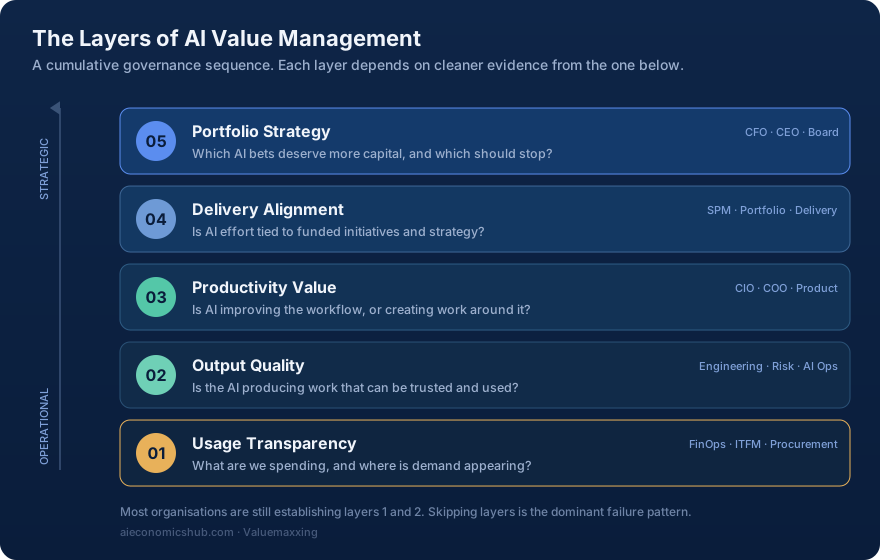
The layers are cumulative. Each one depends on cleaner evidence from the layers below it.
Usage Transparency
Question
What are we spending, where is demand appearing, and who is consuming AI capability?
Evidence Signal
AI cost can be normalised across SaaS, APIs, cloud platforms, private infrastructure, and shared services.
Decisions It Supports
Allocate, forecast, charge back, cap, investigate anomalies, and separate pilots from run-rate demand.
Output Quality
Question
Is the AI producing work that can be trusted, used, and improved?
Evidence Signal
Leaders can see useful output, discarded output, review burden, model fit, and quality risk rather than only call volume.
Decisions It Supports
Route models, tune prompts, strengthen evaluation, set human review thresholds, and stop low-quality use cases.
Productivity Value
Question
Is AI improving the workflow, or creating new work around the workflow?
Evidence Signal
Usage intensity is compared with delivery throughput, rework, cycle time, quality, and the human effort needed to manage AI.
Decisions It Supports
Redesign work, change enablement, compare alternatives, and distinguish capacity release from activity growth.
Delivery Alignment
Question
Is AI effort aligned to funded initiatives, product outcomes, and strategic portfolio commitments?
Evidence Signal
AI spend and effort can be mapped to epics, capabilities, products, value streams, PI objectives, or equivalent planning structures.
Decisions It Supports
Prioritise, sequence, fund, defer, remove duplication, and decide whether experimentation should become delivery.
Portfolio Strategy
Question
Does the total AI portfolio justify its cost, risk, dependency, and opportunity cost?
Evidence Signal
Executives can compare AI investments by strategic fit, value evidence, operating risk, vendor exposure, and human capability impact.
Decisions It Supports
Scale, optimise, contain, replatform, renegotiate, or stop initiatives based on evidence rather than enthusiasm.
The layers are a governance sequence, not a procurement checklist. A leadership team cannot make credible portfolio choices if it cannot see usage. It cannot prove productivity value if it does not know whether outputs are useful. It cannot align AI effort to strategy if delivery systems cannot connect AI activity to funded work.
This sequencing matters because skipping layers is the dominant failure pattern. Organisations that measure portfolio strategy before establishing output quality end up with investment decisions based on adoption stories rather than outcome evidence. Those that measure productivity value before building usage transparency cannot tell whether the productivity claim covers the full cost of the capability producing it. The FinOps Foundation's 2026 data shows governance and forecasting rank higher than optimisation as AI management priorities - which is the profile of an industry still working on layers 1 and 2 before reaching 4 and 5.
The broader operating model
The five layers operate within a larger organizational system that connects strategy, delivery, platform, and evidence.
The five-layer framework focuses on the evidence-based governance sequence that most organizations need to establish. However, McKinsey's 2026 Global Tech Agenda and IBM's Enterprise 2030 research emphasise that these governance layers operate within a broader organizational system. Understanding this fuller context helps leaders see how the five layers connect to strategy, delivery infrastructure, and organizational change.
The following capabilities describe the organizational system that supports effective AI value management:
Strategy and capital allocation
What it governs: AI investment thesis, risk appetite, capital allocation across exploration and scale, sovereignty requirements, vendor concentration limits
Primary owners: CEO, CFO, CIO, CAIO, board
Evidence needed: Total AI exposure, investment by stage (explore/prove/scale), vendor and model concentration, strategic alignment, scenario analysis
How it connects to the five layers: Portfolio strategy (Layer 5) requires this strategic context to make informed scale/stop/optimize decisions
Failure pattern: AI becomes strategic by narrative rather than by explicit capital choices and risk boundaries
Strategy involvement: McKinsey's Global Tech Agenda 2026 survey of 632 C-level executives and IT professionals, run from September to November 2025, found that nearly two-thirds of top-performing companies say their technology leaders are very involved in crafting enterprise strategy, compared with 52% of other organisations (McKinsey). This is an association, not proven causation.
Portfolio and sequencing
What it governs: Use-case prioritisation, funding decisions, stage gates, stop/scale/optimise decisions, capital reallocation, portfolio concentration
Primary owners: SPM, CAIO office, CIO office, portfolio leadership
Evidence needed: Value proof by initiative, time to evidence, scale or stop rate, reuse metrics, portfolio movement, capital released from stopped initiatives
How it connects to the five layers: This is the operational execution of Layer 5 (Portfolio Strategy) and Layer 4 (Delivery Alignment)
Failure pattern: Portfolio accumulates rather than curates. Organisations add AI investments faster than they remove underperforming ones.
Workflow product ownership
What it governs: AI capability as a managed product with named owners, adoption targets, quality standards, and lifecycle accountability
Primary owners: Product management, business process owners, workflow leaders
Evidence needed: Adoption rate, workflow coverage, user satisfaction, exception handling, escalation patterns, outcome quality
How it connects to the five layers: Supports Layer 3 (Productivity Value) by ensuring AI capabilities have clear owners and adoption accountability
Failure pattern: AI capabilities are deployed without clear product ownership, leading to orphaned systems and unclear accountability for adoption and value
Shared intelligence infrastructure
What it governs: Reusable data, models, orchestration, observability, security, and decision infrastructure that supports multiple use cases
Primary owners: Platform engineering, data engineering, AI operations, architecture
Evidence needed: Reuse rate, time to deploy new use cases, shared capability cost per use case, platform reliability, model portfolio complexity
How it connects to the five layers: Enables Layer 1 (Usage Transparency) and Layer 2 (Output Quality) by providing consistent instrumentation and governance
Failure pattern: Every use case builds custom infrastructure, creating duplication, inconsistent governance, and high marginal cost
Data, platform, and model lifecycle
What it governs: Data quality, model performance, infrastructure capacity, model retirement, platform evolution, technical debt management
Primary owners: Data engineering, ML operations, platform engineering, architecture
Evidence needed: Data quality metrics, model performance drift, infrastructure utilisation, model refresh cadence, decommissioning progress, technical debt
How it connects to the five layers: Directly supports Layer 2 (Output Quality) by maintaining model performance and data quality standards
Failure pattern: Models degrade silently, data quality erodes, infrastructure scales without optimisation, retired models continue consuming resources
Decision rights and trust
What it governs: Autonomy boundaries, human oversight design, escalation paths, audit trails, explainability requirements, control cost
Primary owners: Risk, compliance, legal, business process owners, AI ethics
Evidence needed: Decision classification, override rates, escalation patterns, audit coverage, control cost per decision, trust metrics
How it connects to the five layers: Informs Layer 2 (Output Quality) by defining what "trusted and used" means in different contexts
Failure pattern: "Human in the loop" becomes governance theatre without clear authority, information, or escalation design
Decision maturity: Effective AI autonomy requires explicit decision classification, defined owners, clear escalation paths, and monitoring appropriate to risk. See How Much Proof for How Much Autonomy.
Adoption and operating change
What it governs: Training, change management, workflow redesign, capacity conversion, role evolution, adoption measurement
Primary owners: HR, change management, business process owners, adoption leaders
Evidence needed: Training completion, workflow integration, capacity actioned, role changes, adoption barriers, user capability
How it connects to the five layers: Essential for Layer 3 (Productivity Value) - without adoption and change, productivity gains remain theoretical
Failure pattern: AI capabilities are deployed without the operating model changes needed to capture value. Theoretical productivity gains are not converted into realised outcomes.
Evidence and realised value
What it governs: Baseline measurement, outcome tracking, value attribution, benefit realisation, portfolio learning, stop/scale decisions
Primary owners: Finance, value management office, portfolio leadership, business owners
Evidence needed: Validated baselines, realised outcomes, cost-benefit analysis, value conversion rate, portfolio ROI, learning from failures
How it connects to the five layers: This is the measurement discipline that makes all five layers credible - particularly Layer 3 (Productivity Value) and Layer 5 (Portfolio Strategy)
Failure pattern: Value claims rely on projected benefits rather than measured outcomes. Organisations cannot distinguish successful from unsuccessful investments.
Cross-cutting dimensions
Behaviour, risk, and sourcing cut across all five layers rather than forming separate sequential stages.
The five layers describe a governance sequence. Three additional dimensions cut across all layers rather than forming a sixth, seventh, or eighth sequential stage.
Behaviour and workforce
What it addresses: Trust calibration, appropriate use, review behaviour, learning transfer, capability erosion, adoption patterns, workflow redesign
Cuts across:
- Layer 2 (Output Quality): Whether people trust outputs appropriately and review them effectively
- Layer 3 (Productivity Value): Whether time saved translates to captured capacity or merely shifts work
- Layer 5 (Portfolio Strategy): Whether AI investments build or erode organizational capability
Why it's cross-cutting: Behavioural effects appear at every layer. A person can use AI inappropriately in a well-governed portfolio, or use it thoughtfully in a chaotic one. The Behavioural P&L of AI provides a structured approach to measuring these effects.
Management question: Are we protecting judgement, learning, and resilience as we scale AI adoption?
Risk and trust
What it addresses: Decision authority, human oversight, escalation design, audit trails, control cost, autonomy boundaries, material exposure
Cuts across:
- Layer 1 (Usage Transparency): Visibility into where AI is making or influencing decisions
- Layer 2 (Output Quality): Whether outputs meet risk-appropriate quality thresholds
- Layer 4 (Delivery Alignment): Whether AI work aligns with risk appetite and compliance obligations
Why it's cross-cutting: Risk is not a separate governance stage. It is a constraint and design requirement at every layer. High-risk decisions require different quality standards, oversight models, and portfolio treatment than low-risk automation.
Management question: Do we know which AI systems are material to customers, operations, or regulatory obligations, and are they governed accordingly?
Sourcing and sovereignty
What it addresses: API versus owned capacity, vendor concentration, model portability, data residency, exit rights, capacity commitment, infrastructure decisions
Cuts across:
- Layer 1 (Usage Transparency): Cost structure and vendor exposure visibility
- Layer 3 (Productivity Value): Whether sourcing decisions affect quality, latency, or operating burden
- Layer 5 (Portfolio Strategy): Strategic dependency, concentration risk, and optionality
Why it's cross-cutting: Sourcing is not a one-time infrastructure decision. It is an ongoing portfolio question that affects cost, risk, quality, and strategic position. The Rent, Reserve or Own Intelligence article provides a decision framework.
Management question: Do we have deliberate optionality, or are we accumulating dependency without realizing it?
Relationship to the AI Economics Stack
The five AIVM layers and the AI Economics Stack solve different problems and should be used together.
The AI Economics Stack, now superseded by the AI Economics Map, was a three-level framework that traced how infrastructure and model consumption become useful work and enterprise value. It describes economic objects and conversion efficiency. The five AIVM layers describe a management sequence and governance questions.
The two frameworks are complementary:
How the AI Economics Stack maps to AI Value Management Layers
Intelligence Production Economics
- AI Economics Stack
- Intelligence Production Economics
- AIVM Layers
- Usage Transparency + part of Output Quality
- Focus
- What did intelligence cost to produce and consume? What capacity was used?
AI Application Economics
- AI Economics Stack
- AI Application Economics
- AIVM Layers
- Output Quality + Productivity Value
- Focus
- What work was attempted? Was output accepted? Did the workflow improve?
Enterprise Value Economics
- AI Economics Stack
- Enterprise Value Economics
- AIVM Layers
- Delivery Alignment + Portfolio Strategy
- Focus
- What changed for the enterprise? Who owns the benefit? Should this scale?
When to use the AI Economics Stack: Use it to diagnose where value is leaking in the conversion chain from tokens to enterprise outcomes. Use it to explain why optimizing one layer (e.g., cost per token) does not guarantee value at the layer above it (e.g., cost per successful outcome).
When to use the AIVM Layers: Use them to sequence governance work and identify which evidence gap to close next. Use them to connect existing disciplines (FinOps, SPM, risk, HR) to a shared operating question.
Use both: The Stack explains the economic system. The Layers explain the governance sequence. Organizations need both perspectives.
How the layers connect to existing disciplines
AI value management should connect established management systems rather than create another silo.
AI value management is best understood as a connecting discipline. It does not replace FinOps, ITFM, TBM, SPM, ITAM, security, or platform engineering. It gives them a shared operating question: is AI creating enough value to justify the full cost and risk of the capability?
How AI value management layers connect to enterprise management disciplines
Usage transparency
- Primary discipline
- FinOps, ITFM, procurement, SaaS management
- Evidence needed
- Spend, consumption, user, team, product, vendor, model, and environment data
- Failure pattern
- AI cost becomes visible only after demand is already embedded
Output quality
- Primary discipline
- AI operations, engineering, risk, product management
- Evidence needed
- Acceptance, rejection, rework, evaluation, incident, and review signals
- Failure pattern
- Cheap output is mistaken for valuable output
Productivity value
- Primary discipline
- CIO office, COO office, engineering leadership, HR
- Evidence needed
- Workflow baseline, cycle time, throughput, quality, supervision, and capacity data
- Failure pattern
- Hours saved are counted without showing what those hours become
Delivery alignment
- Primary discipline
- SPM, product operations, programme leadership, TBM
- Evidence needed
- Initiative, epic, value stream, PI objective, product, and funding alignment
- Failure pattern
- AI work grows outside the portfolio choices leaders thought they had made
Portfolio strategy
- Primary discipline
- CFO, CIO, CAIO, CEO, board, risk committee
- Evidence needed
- Value proof, risk posture, vendor exposure, sovereignty, scenario, and opportunity-cost data
- Failure pattern
- AI becomes strategic by narrative, but not by evidence
The full cost stack behind AI value
The value question is incomplete unless the cost model includes the operating burden around AI.
Most weak AI value cases begin with a narrow cost base: the licence fee or model bill, without the recurring burden needed to make the capability reliable, governed, and useful. IDC warns that large enterprises routinely underestimate AI infrastructure cost as estates scale. The FinOps Foundation finds that more than half of AI tool spending sits outside formal IT budgets. These are not edge cases - they describe the standard enterprise starting position.
A complete cost view covers software subscriptions, usage charges, model calls, embeddings, vector search, cloud and private infrastructure, data preparation, evaluation, security, legal review, change management, platform support, human oversight, energy, and opportunity cost. The AI TCO Framework organises this into seven layers and provides illustrative cost shares for each.
The cost stack changes the meaning of value. A low-cost model is not cheap if it increases review burden or produces unreliable outputs. A high-cost model may be justified if it eliminates human rework in a material workflow. A SaaS AI add-on at £25 per seat creates real economic exposure when no one tracks whether those seats are actively used.
Personal accountability: the human layer inside every layer
Enterprise AI value management also needs a human version: reflective habits that help people use AI deliberately.
AI value management usually starts at enterprise level, but it cannot stay there. AI changes individual work habits before it changes portfolio economics. If people use AI without reflection, the organisation may gain activity while losing judgement, learning, or quality control.
The useful analogy is not employee monitoring. It is personal habit visibility. Just as a person may track sleep, training, or recovery to understand whether a routine is helping them, knowledge workers need a way to see whether AI is improving their work or quietly changing their dependence on it.
This matters because the most valuable AI behaviour is not maximum usage. It is appropriate usage: knowing when to delegate, when to review, when to challenge the answer, when to learn from it, and when to do the thinking directly.
Questions every leadership team should be able to answer
At the highest layer, value management becomes a small number of repeatable executive questions.
- What is our total AI exposure across SaaS, cloud, data centre, private cloud, labour substitution, and shared platform services?
- Which AI investments have evidence of value, and which remain speculative?
- What happens to our economics if usage rises tenfold, quality thresholds require more expensive models, or vendors change price structures?
- Which AI systems are material to customers, employees, regulatory obligations, or operational resilience?
- Where are prompts, completions, embeddings, logs, and agent actions processed and governed?
- Which teams are gaining real capacity, and which are absorbing new review, security, or coordination burden?
- Are we redesigning work around AI, or simply layering AI tools on top of existing work?
- What is the stop, scale, optimise, or contain decision for each material AI initiative?
- Are we protecting the learning path for junior and entry-level roles as easier work becomes automated?
- Is AI improving trust, quality, accountability, and resilience, or weakening them in ways our metrics do not yet show?
How to use the framework
The practical value of the model is deciding what evidence is needed next.
Start by identifying the layer where the organisation is currently guessing. If leaders cannot see usage, start with instrumentation and allocation. If output quality is unclear, invest in evaluation and review signals. If productivity claims rely on sentiment, build workflow baselines. If AI work is not tied to funded initiatives, connect it to portfolio structures. If the executive team cannot compare investments, create a portfolio review cadence with stop, scale, optimise, and contain decisions.
The goal is not to build the most elaborate measurement system. It is to make the next management decision less dependent on narrative.
Related reading
The AI Value Gap
Start with the core diagnosis: why visibility, accountability, and proof drift apart.
AI Economics Maturity Model
Use the maturity model to assess how far the organisation has progressed beyond fragmented AI activity.
AI Economics KPIs
Choose practical metrics for cost, quality, value, ownership, and portfolio governance.
AI TCO Framework
Pair the value layers with a full view of the cost stack behind AI capability.
FinOps & AI
Understand how usage transparency and unit economics become operating disciplines.
SPM & AI
Connect the higher layers to portfolio sequencing, funding, and benefits realisation.