

What Cloud Taught Us About the Real Cost of AI Inference
Standfirst
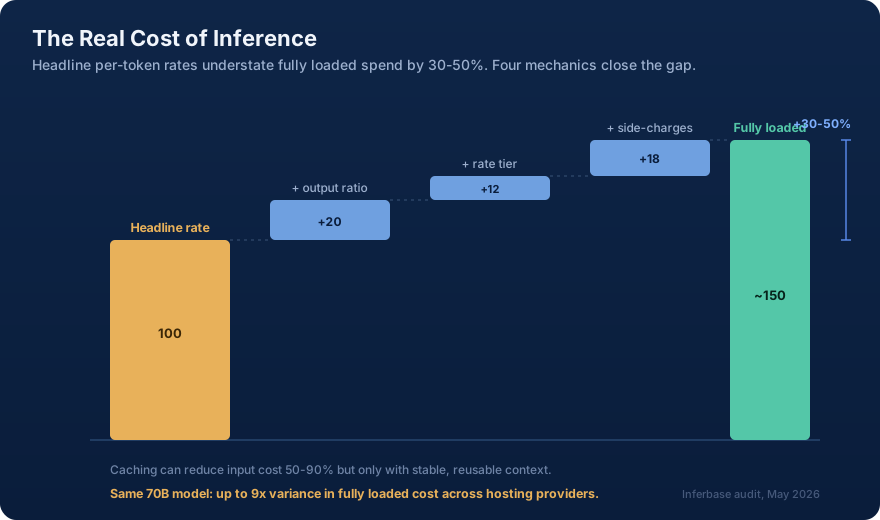
The headline per-token rate is a poor predictor of enterprise inference spend. In Inferbase's analysis, fully loaded bills ran roughly 30 to 50% above forecasts built from headline rates. The gap comes from four mechanics that rate cards do not show: caching behaviour, output-to-input ratios, rate-limit tiers, and side-charges. CFOs and FinOps leaders who model inference cost without these mechanics will systematically underestimate spend.
The 30-50% forecast gap
Enterprise AI buyers routinely discover that actual inference bills exceed their forecasts by 30 to 50%. This is not a rounding error. It is a structural gap between what rate cards show and what enterprises actually pay.
The pattern appears consistently across deployment models. API consumption, managed hosting, and self-hosted infrastructure all exhibit the same dynamic: headline rates understate fully loaded cost.
A May 2026 pricing analysis by Inferbase, a commercial inference-routing vendor, examined published provider rate cards across frontier APIs, open-source hosts and self-hosted GPUs, drawing on the firm's own enterprise engagements. It argues that cost models built only on headline per-token rates can understate fully loaded spend by roughly 30 to 50%. This is one vendor's analysis rather than an independent benchmark, and the figures vary by workload, model and provider.
The forecast gap in practice (May 2026): Inferbase's pricing analysis found that fully loaded bills ran roughly 30 to 50% above forecasts built from headline per-token rates. The gap is not random variance. It comes from four cost mechanics that rate cards do not surface: caching behaviour, output-to-input token ratios, rate-limit tier pricing, and side-charges including region uplift, context-tier surcharges, and tool-use fees.
This matters because most enterprise AI business cases are built on headline rates. If the forecast is systematically low by 30 to 50%, the ROI case that justified the investment may not survive contact with actual spend.
The four cost mechanics rate cards miss
The gap between headline rates and fully loaded cost comes from four mechanics that are largely invisible in provider pricing pages.
1. Caching behaviour
Prompt caching reduces cost by reusing previously processed context. But caching efficiency depends on workload design, not just provider capability.
If prompts vary slightly across requests, cache hit rates fall. If context windows grow large, cache write costs can exceed the savings from cache reads. If workloads are bursty rather than steady, cached content expires before it can be reused.
The result is that caching economics are workload-specific. Two enterprises using the same model with the same provider can see very different effective costs depending on how their workflows interact with the caching layer.
2. Output-to-input token ratios
Most inference pricing distinguishes between input tokens and output tokens, with output tokens typically costing 2-5x more than input tokens.
The ratio between output and input tokens depends on the task. Summarization produces fewer output tokens than input tokens. Code generation, analysis, and reasoning-heavy tasks produce more output tokens than input tokens. Agentic workflows with tool use and verification loops can produce many more output tokens than the original prompt.
If a business case assumes a 1:1 output-to-input ratio but the actual workload produces 3:1 or 5:1, the cost per task can be 2-3x higher than forecast.
Output ratio variance: Inferbase's audit found that output-to-input token ratios vary from 0.2:1 for summarization tasks to 5:1 or higher for agentic workflows with tool use and verification. A business case that assumes 1:1 ratios for a reasoning-heavy workload will underestimate cost by 2-3x.
3. Rate-limit tier pricing
Many providers offer multiple rate-limit tiers with different pricing. Higher tiers provide more requests per minute or higher throughput, but at a premium.
Enterprises often start on lower tiers during pilots, then discover that production workloads require higher tiers to meet latency or concurrency requirements. The tier upgrade can increase effective per-token cost by 20-40%.
This is particularly common for customer-facing or time-sensitive workloads where rate limits become a service-level constraint rather than a cost optimization variable.
4. Side-charges and surcharges
The headline per-token rate is often the base rate for a specific region, model size, and usage pattern. Real deployments accumulate side-charges:
- Region uplift: Deploying in non-US regions can add 10-30% to base rates
- Context-tier surcharges: Extended context windows (128K, 200K tokens) often carry surcharges above base pricing
- Tool-use fees: Agentic workflows with function calling or tool use may incur additional per-call fees
- Retrieval costs: RAG workloads pay for vector database queries, embedding generation, and retrieval infrastructure on top of model inference
- Guardrail costs: Safety checks, content filtering, and compliance controls add per-request overhead
These charges are real, recurring, and often invisible in initial cost models. They accumulate quietly until the first full billing cycle reveals the gap.
The 9x variance problem
Inferbase reports the same 70B open-source model varying up to 9x in fully loaded cost across hosting providers, drawing partly on Artificial Analysis provider data. This variance reflects real differences in how providers structure their offerings, how workloads interact with infrastructure, and how side-charges accumulate.
For enterprises comparing deployment options, this means that headline rate comparisons are insufficient. Fully loaded cost modeling requires understanding the four mechanics above and how they interact with the specific workload.
The 9x variance (May 2026): Inferbase's analysis, drawing partly on Artificial Analysis provider data, found that the same 70B open-source model varied up to 9x in fully loaded cost across hosting providers. The variance came from differences in caching efficiency, output-to-input pricing ratios, rate-limit tier structures, and side-charges. Headline rate comparisons missed most of this variance.
Self-host crossover economics
For enterprises considering self-hosted infrastructure, the crossover point where owned infrastructure becomes economically competitive with API consumption depends on fully loaded cost, not headline rates.
Inferbase's analysis found that self-host crossover for a 70B model occurs around 10 to 50 billion tokens per month of steady traffic, depending on infrastructure choices and whether side-charges are included in the comparison.
The wide range reflects differences in:
- Infrastructure efficiency and utilization
- Caching implementation quality
- Output-to-input ratios for the workload
- Whether region uplift, context surcharges, and tool-use fees are included in the API cost baseline
Enterprises that compare self-host infrastructure cost to headline API rates will overestimate the crossover point. The correct comparison is fully loaded API cost versus fully loaded self-host cost, including infrastructure, operations, and platform burden.
How to estimate fully loaded cost
CFOs and FinOps leaders should model inference cost using a four-layer framework that captures the mechanics rate cards miss.
Layer 1: Base inference cost
Start with the headline per-token rate for the model, region, and tier. This is the published rate card number.
Layer 2: Caching adjustment
Estimate cache hit rate based on workload design. If prompts are stable and reusable, assume 60-80% cache hit rate. If prompts vary significantly, assume 20-40%. If workloads are bursty, assume lower rates.
Apply the provider's cache pricing model (typically 10-20% of full inference cost for cache reads, 100% for cache writes).
Layer 3: Output ratio adjustment
Estimate the output-to-input token ratio for the workload. Use 0.2:1 for summarization, 1:1 for balanced tasks, 3:1 for reasoning-heavy tasks, 5:1 or higher for agentic workflows.
Apply the provider's output token premium (typically 2-5x input token cost).
Layer 4: Side-charges
Add region uplift (10-30% for non-US regions), context-tier surcharges (10-20% for extended context), tool-use fees (per-call charges for function calling), retrieval costs (vector database and embedding fees), and guardrail overhead (5-15% for safety and compliance checks).
The result is a fully loaded cost per task that reflects actual spend, not headline rates.
Governance implications
The 30-50% forecast gap has direct governance implications for CFOs, CIOs, and FinOps leaders.
For CFOs: AI business cases built on headline rates are systematically optimistic. Require fully loaded cost modeling before approving scale. Stress-test ROI cases against 1.5x the forecast cost.
For CIOs: Architecture and deployment decisions shape fully loaded cost more than provider selection. Caching design, output ratio management, and side-charge minimization are cost governance levers, not just technical optimizations.
For FinOps leaders: Inference cost governance requires workflow-level visibility, not just provider-level reporting. Track cache hit rates, output ratios, tier usage, and side-charge accumulation as operational KPIs.
For engineering leaders: Workload design determines caching efficiency and output ratios. These are not fixed properties of the model. They are design outcomes that engineering controls.
What this means for enterprise buyers
Enterprise AI buyers should treat headline per-token rates as a starting point, not a forecast.
The correct planning assumption is that fully loaded cost will be 30 to 50% higher than headline rates unless the organization has explicitly modeled and optimized the four cost mechanics.
This does not mean AI is uneconomic. It means that business cases must be built on realistic cost models, not optimistic rate cards.
Enterprises that model fully loaded cost from the start will make better deployment decisions, set better budgets, and avoid the ROI surprises that appear when actual bills arrive.
The lesson from cloud economics applies directly to AI: the invoice is not the rate card. The invoice is what you actually built, how you actually used it, and what you actually paid once all the mechanics are included.
References and further reading
Related reading
Inferbase: The Real Cost of Inference at Enterprise Scale
May 2026 pricing audit analyzing the gap between headline rates and fully loaded enterprise inference costs
FinOps & AI
How FinOps practices extend into model usage, orchestration, and inference cost governance
AI TCO Framework
The seven-layer cost model showing where inference sits within total enterprise AI spend
Inference Cost Crisis
Why inference has become the primary economic bottleneck in enterprise AI
AI Cost Benchmarks
Reference cost ranges across the main layers of enterprise AI spend