

Everything Cloud FinOps Taught Us About AI Value, and the One Thing It Did Not
AI value management is mostly transferable FinOps, plus one genuinely new layer that FinOps was never built to supply
On this page
Introduction
Most of the AI value problem has been solved before, under a different name. Evidence Cloud FinOps spent a decade learning to govern variable, decentralised spend without strangling the experimentation that made it valuable. AI value management inherits almost all of that discipline.
The FinOps Foundation formalised AI as a defined area within the framework in 2025. Interpretation The honest framing is this: AI value management is mostly transferable FinOps, plus one genuinely new layer that FinOps was never built to supply.
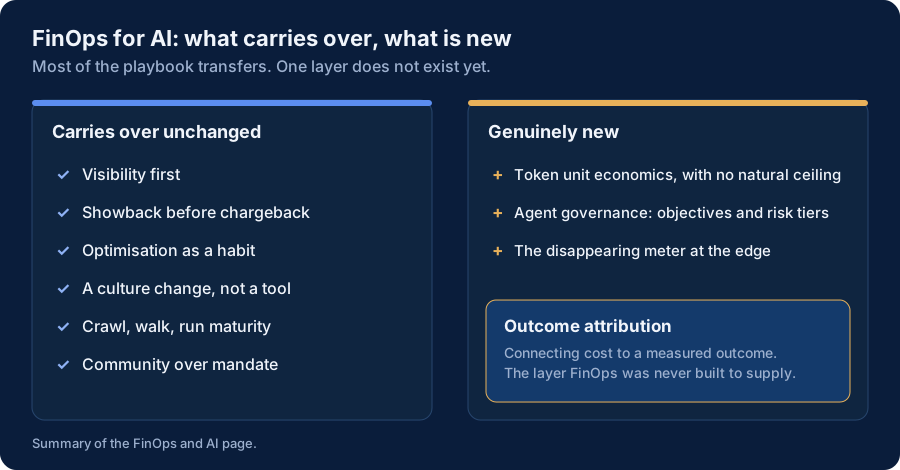
What Carries Over Unchanged
The core FinOps principles transfer directly to AI value management:
Visibility first
You cannot manage what you cannot see. Evidence This was the foundational FinOps lesson from cloud economics, and it applies unchanged to AI. Before optimisation, before chargeback, before governance, you need instrumentation.
Showback before chargeback
Make cost visible before making it punitive. Interpretation Chargeback without context breeds gaming. Showback builds shared understanding first, then accountability follows naturally.
Optimisation as a habit
Cost management is not a project with an end date. It is a continuous practice. The organisations that treat optimisation as a one-time exercise fail when usage patterns change.
It's a culture change, not a tool
Evidence FinOps Foundation research consistently shows that successful FinOps programmes are defined by cross-functional collaboration, not by tooling sophistication. The same applies to AI value management.
Crawl, walk, run maturity
Do not skip stages. Organisations that try to implement advanced optimisation before establishing basic visibility fail predictably. Maturity is earned, not declared.
Community over mandate
Top-down mandates without practitioner buy-in create compliance theatre. Real change comes from communities of practice that share learnings and build shared standards.
What Is Genuinely New
Three things are genuinely new in AI value management, and one of them is load-bearing:
Token unit economics
Token-based pricing has no natural ceiling in the way provisioned infrastructure does. Interpretation This makes demand forecasting harder and creates new risks around runaway consumption.
Agent governance
Speculation As AI becomes agentic, governance stops being only about people. Agents need objectives, guardrails, and risk tiers. This is a management problem, not only a technical one.
Outcome attribution (the big one)
Interpretation This is the genuinely new layer. FinOps measures cost well. It measures value barely at all. Cloud FinOps could get away with that because the value case for cloud was infrastructure efficiency, which is relatively straightforward to demonstrate.
AI value is different. The cost shows up in one function, the value shows up in another, and the causal link is contested. Evidence MIT NANDA research found that 95% of enterprises report no measurable P&L impact from AI investments, not because AI does not work, but because attribution is genuinely hard.
This is the layer FinOps was never built to supply. Cost visibility is necessary but not sufficient. The real work is connecting cost to outcome.
The disappearing meter
Speculation As AI moves toward on-device and edge deployment, the consumption meter that FinOps relies on starts to disappear. This creates a new problem: how do you govern value when you cannot see cost?
The Operating-Model Question: Who Owns AI Value?
AI cost crosses every function. AI value shows up in business units that did not incur the cost. This creates an ownership problem that FinOps alone cannot solve.
The functions that must be in the room:
- Finance: Owns the cost number, demands proof of value, sets investment thresholds
- Technology/Engineering: Owns the architecture, controls the levers that shape unit economics
- Product: Owns the use cases, defines what success looks like
- Procurement: Owns vendor relationships, negotiates pricing, manages contracts
- Risk/Security/Legal: Owns compliance, sets guardrails, defines acceptable use
- HR: Owns workforce impact, manages change, defines training needs
Interpretation The disciplines that must combine: cost management (FinOps) + business-value management (product/strategy) + portfolio management (SPM). No single function owns all three.
A RACI Sketch for Value Attribution
Here is a simplified RACI for AI value management. The load-bearing rows are “attribute cost to outcome” and “decide fund, hold or kill”. Notice that accountability for the coverage number is shared between CIO and CFO.
| Activity | CFO | CIO | Product | CoE |
|---|---|---|---|---|
| Set investment thresholds | A | C | I | I |
| Instrument cost visibility | I | A | C | R |
| Define outcome metrics | C | C | A | R |
| Attribute cost to outcome | A | A | R | R |
| Decide fund, hold or kill | A | A | C | I |
| Report attribution coverage | A | A | I | R |
R = Responsible, A = Accountable, C = Consulted, I = Informed
The Argument: Centralised CoE Versus Federated Ownership
There are two competing models for AI value ownership:
The centralised CoE model
Strengths: Consistent standards, shared infrastructure, economies of scale, clear accountability, easier to govern.
Weaknesses: Becomes a bottleneck, disconnected from business context, slow to respond to local needs, risks becoming governance theatre.
The federated ownership model
Strengths: Faster experimentation, closer to business value, better context for trade-offs, more innovation.
Weaknesses: Inconsistent standards, duplicated effort, harder to govern, shadow AI risk, attribution becomes nearly impossible.
The synthesis: hub-and-spoke
Interpretation The model that works is hub-and-spoke: a central hub sets standards, provides shared infrastructure, and maintains the attribution framework. Federated spokes own their outcomes, make their own trade-offs, and report back to the hub.
This mirrors how FinOps itself matured. Early FinOps was centralised and slow. Mature FinOps is federated with central standards. AI value management will follow the same path.
The Maturity Journey
AI value management maturity follows a predictable path. Each stage is earned, not skipped.
Stage 1: Visibility
What it looks like: You can see AI spend. You know which teams are consuming, which vendors are being used, and roughly what the monthly bill is.
What you cannot do yet: You cannot connect spend to outcomes. You cannot optimise effectively. You cannot forecast with confidence.
The work: Instrument everything. Tag consistently. Build the data foundation.
Stage 2: Accountability
What it looks like: Teams know their AI spend. Showback is working. There is shared understanding of unit economics.
What you cannot do yet: You cannot prove value. You cannot make confident fund/kill decisions. Attribution is still mostly guesswork.
The work: Define outcome metrics. Build attribution methods. Start measuring coverage.
Stage 3: Optimisation
What it looks like: Teams are actively managing unit economics. Model routing is working. Caching is deployed. Prompt efficiency is improving.
What you cannot do yet: You cannot prove that optimisation is not degrading value. You are optimising cost, but you are not yet optimising value.
The work: Connect optimisation to outcomes. Measure quality alongside cost. Build feedback loops.
Stage 4: Value-led
What it looks like: Investment decisions are driven by attributed value, not activity. Attribution coverage is high and rising. The portfolio is actively managed. Laggards are being retired.
What you can do: Make confident fund/kill decisions. Prove value to the board. Scale what works, stop what does not.
The work: Maintain discipline. Keep coverage high. Do not let measurement decay.