

Why traditional ROI models fail for AI
Most classic ROI models assume fixed scope, stable cost curves, and direct benefit paths. AI rarely offers those conditions.
Traditional ROI logic works best when leaders can define a bounded investment, estimate a finite operating benefit, and compare the two with reasonable confidence. Enterprise AI makes that harder. Its cost base is layered rather than singular (see AI TCO Framework). Its benefits depend on workflow redesign, data quality, adoption, governance, and organisational learning. McKinsey's 2025 State of AI shows widespread AI use, but only a small share of companies reporting clear financial return. IBM's executive research points to the same measurement challenge.
This is why many AI business cases become either too narrow or too optimistic. Narrow models miss strategic and capability effects that matter. Overconfident models treat early productivity signals as realised economic proof. Both lead to weak capital allocation and contribute to the AI Value Gap.
The ROI timeline reality
Time horizon is one of the biggest reasons AI ROI conversations go wrong.
AI rarely behaves like a short-payback software investment. Deloitte's 2025 survey of 1,854 executives in Europe and the Middle East found that most reported satisfactory ROI on a typical AI use case within two to four years. Only 6% reported payback in under a year, and even among the most successful projects just 13% saw returns within twelve months (Deloitte). That is one reason to think in portfolio terms. As a house heuristic, not a published benchmark, we suggest most investment goes to cases with predictable returns, a smaller share to strategic innovation, and a small share to higher-risk exploration, for example in a 70, 20 and 10 split.
By April 2026, a Bain survey found that 44% of enterprises were funding the next AI wave from savings that had not yet materialised. This pattern-spending ahead of proven return-creates significant portfolio risk when combined with extended payback periods.
Benefits also tend to emerge in cycles. Optimisation benefits often appear first in the first twelve months. Reinvention benefits tend to emerge over one to two years as workflows and roles change. Disruption benefits, where they exist at all, usually arrive after two years and depend on stronger operating capability than most organisations initially expect.
A multi-dimensional ROI framework
A stronger model evaluates the forms of return AI can create without collapsing them into one generic promise.
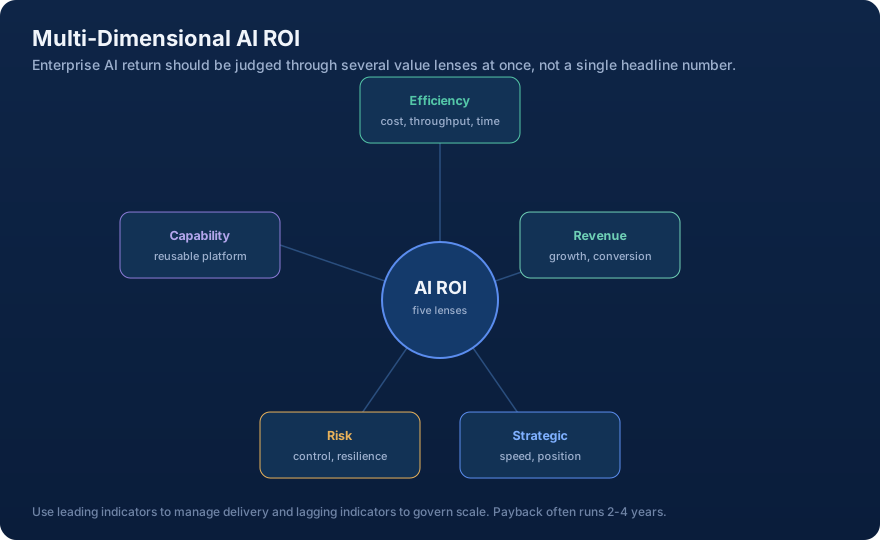
Efficiency ROI
Return created through lower cost-to-serve, reduced cycle time, throughput gains, and productivity improvement.
Leading indicators
- workflow adoption in target teams
- task completion time reduction
- automation rate by process step
- deflection or handling-rate improvement
Lagging indicators
- lower operating expense
- reduced cost per transaction
- improved team capacity utilisation
- measurable productivity uplift
Revenue ROI
Return created through higher conversion, retention, pricing improvement, or new AI-enabled offers.
Leading indicators
- engagement lift in target journeys
- sales-assist adoption quality
- pipeline velocity in AI-supported motions
- new feature usage
Lagging indicators
- incremental revenue growth
- higher win rate or deal value
- better retention or expansion
- new revenue-stream contribution
Strategic ROI
Return created through stronger responsiveness, faster planning cycles, and improved strategic execution.
Leading indicators
- faster decision cycles
- greater reuse of AI assets
- better planning confidence
- faster movement from insight to action
Lagging indicators
- shorter time-to-market
- stronger resilience in priority markets
- faster strategic execution
- sustained competitive differentiation
Risk ROI
Return created through lower exposure to operational error, fraud, compliance failure, or service disruption.
Leading indicators
- higher detection precision
- faster exception identification
- better policy adherence
- fewer unresolved control breaches
Lagging indicators
- lower loss events
- reduced remediation cost
- fewer material incidents
- lower volatility in risk-sensitive processes
Capability ROI
Return created by building reusable organisational capability that improves the economics of future AI work.
Leading indicators
- reuse of prompts, pipelines, and evaluation assets
- shorter build cycles for new use cases
- higher platform adoption across teams
- improved governance quality
Lagging indicators
- lower marginal cost of future deployments
- higher portfolio throughput
- greater delivery consistency
- stronger institutional ability to scale AI safely
From proof of concept to proof of value
Technical feasibility is only the first of four proofs required before an AI initiative deserves production funding.
Most AI pilots demonstrate that a model can perform a task. Fewer prove that the task matters, that the workflow will improve, that the full production cost is acceptable, or that the organisation can capture the benefit.
A stronger approach uses four sequential proofs:
- Proof of feasibility: Can the system technically perform the task with acceptable integration, latency, and data access?
- Proof of performance: Does it perform at the required standard for accuracy, consistency, robustness, and error handling?
- Proof of operating viability: Will people and systems use it in the real workflow with appropriate trust, review, and adoption?
- Proof of value: Did a meaningful outcome change, and can the organisation capture it?
Each proof requires different evidence and should have explicit decision gates. A pilot that completes only Proof 1 is a technical experiment, not an investment case.
Stage gates and capture status
Strong governance uses stage gates to control capital release:
- Gate 0: Permission to experiment (small budget, baseline plan, risk boundary, decision date)
- Gate 1: Technical viability (integration feasible, minimum performance met, no disqualifying risk)
- Gate 2: Operating viability (workflow fit, repeat adoption, review burden known, production cost range)
- Gate 3: Value evidence (outcome movement, credible attribution, benefit owner, value-capture plan)
- Gate 4: Portfolio scale (comparison with competing investments, strategic fit, vendor assessment, funding source)
Every claimed value item should be tagged with its capture status:
- Potential: A modelled opportunity
- Observed: An operating measure changed
- Attributed: Evidence supports an AI contribution
- Captured: Financial, capacity, service, or risk benefit was acted upon
- Sustained: Benefit persists through a defined period
This prevents weak attribution from inflating portfolio value claims.
Production-scale bridge
Pilot economics are structurally favourable: small volumes, motivated users, limited integration, manual support, subsidised vendor access, reduced controls, selected data, and hidden engineering effort.
Production introduces higher and less predictable volume, integration and observability, identity and access, evaluation, incident response, support, compliance, change management, data pipelines, vendor commitments, resilience, model drift, and human oversight.
The cost per successful outcome at pilot scale is rarely a reliable predictor of production economics. A production-scale bridge should model volume scenarios, quality requirements, review burden, infrastructure, governance, and behavioural effects.
See the AI Proof of Value article and AI Proof of Value Scorecard for detailed implementation guidance.
Portfolio investment categories
Not every AI initiative needs direct short-term financial ROI. Different investment types require different evidence standards and time horizons.
A rigid ROI process can kill strategic learning prematurely. The remedy is not to abandon proof-it is to label the investment honestly and apply the appropriate evidence standard.
Commercial return
Expected to produce measurable financial benefit within a defined period. Requires baseline, attribution method, benefit owner, and capture plan. Should be compared with other commercial investments for capital priority.
Operational value
Expected to improve service, quality, throughput, or resilience without direct revenue or margin impact. Requires operating baseline, outcome metric, and operational owner. May be justified by risk reduction, regulatory necessity, or service-level obligation.
Risk obligation
Required to meet regulatory, compliance, security, or audit requirements. May not produce positive financial ROI but avoids material exposure or penalty. Requires risk assessment, control evidence, and residual risk owner.
Capability building
Builds reusable organisational capability that improves the economics of future AI work: platforms, evaluation assets, governance processes, skills, or architectural patterns. Requires capability roadmap, reuse plan, and portfolio benefit hypothesis. Should be evaluated on marginal cost reduction for future deployments and portfolio throughput improvement.
Strategic option
Creates learning, market position, or future optionality without immediate financial return. Requires explicit strategic hypothesis, learning objectives, decision date, and stop criteria. Should be time-bounded and funded separately from commercial portfolio.
Each category can coexist in a balanced portfolio. The error is treating all AI investment as one undifferentiated category or allowing strategic experiments to consume commercial capital without evidence discipline.
Leading and lagging indicators
Strong governance treats early operating signals and later financial proof as related but distinct parts of the same evidence chain.
Leading indicators show whether the mechanism of value is beginning to work. Lagging indicators show whether the business outcome has actually appeared. Good governance uses leading indicators to manage delivery and lagging indicators to govern scale.
The common mistake is to collapse them. Time saved, user adoption, and model quality may all matter, but none of them is equivalent to realised margin improvement, lower loss rates, or revenue uplift. That distinction becomes even more important when AI payback runs longer than many boards expect.
High performer profile
What separates stronger AI portfolios from weaker ones is rarely enthusiasm. It is disciplined leadership, workflow redesign, and clearer proof.
McKinsey's 2025 State of AI describes its high performers, about 6% of respondents, as more likely to redesign workflows, scale faster, follow transformation practices and invest more. That does not mean high spend guarantees performance. It means high performers tend to commit seriously and govern seriously.
Deloitte adds an important correction. Organisations that take a purely technology-focused approach are materially more likely to underperform expectations. The strongest cases redesign workflows rather than simply adding AI tools to existing work. That matters because only a minority of organisations have meaningfully redesigned workflows around AI. The more durable return model is what Deloitte describes as Humans x Machines convergence, not a simple Humans plus Machines layering of new tools on top of old processes.
By June 2026, the challenge of attribution coverage had become more visible. Even tier-1 enterprises struggled to demonstrate value at scale-Uber's experience of exhausting annual AI budgets in four months illustrated how consumption can outpace both planning and proof systems. The UK government's Copilot trial found no robust evidence that time savings translated to productivity gains, reinforcing the need for rigorous baseline methodology.
High-performer habits:
- Define the primary return dimension before deployment.
- Capture baseline measures before adoption scales.
- Assign a named owner for realised value, not only implementation.
- Review AI as a portfolio using predictable ROI, strategic innovation, and breakthrough bets.
- Raise the proof threshold as spend, dependency, and reputational exposure increase.
The CFO's AI ROI checklist
A reusable set of questions finance leaders can use before approving investment or accepting ROI claims.
ROI by function
Some functions have a stronger evidence base than others, which should shape portfolio confidence.
- Software engineering: the strongest evidence base is currently in code generation, test automation, and incident resolution, where workflow metrics and adoption data are easier to capture.
- Customer operations: assisted resolution, knowledge surfacing, and next-best-action models have clearer links to handling time, deflection, and service quality.
- Supply chain and procurement: reported cost savings in the high twenties are among the more credible functional gains in the broader research base.
- Finance and accounting: invoicing, forecasting support, and expense auditing often show faster-cycle benefits, including materially shorter close processes.
- Sales and marketing: personalised messaging, proposal assembly, and pipeline hygiene can create value, but attribution is often weaker and must be handled carefully.
Boardroom implications
Boards and executive committees need a cleaner set of questions than 'show me the ROI'.
At executive level, AI ROI should be treated as a portfolio problem rather than a sequence of isolated use cases. The question is not simply whether one initiative can show positive return. It is whether the organisation has a disciplined model for comparing multiple forms of return with different time horizons, proof standards, and governance needs.
By May 2026, corporate America had begun rationing AI access (paywalled) as costs outpaced budgets and value proof remained elusive. This market behaviour signals that boards should expect clearer attribution coverage before approving further scale, particularly when enterprises are funding expansion from savings not yet realised.
Related reading
The AI Value Gap
Understand why weak proof standards and fragmented accountability cause AI programmes to scale spend without scaling value.
Token Economics
Understand how token-level metering shapes cost per outcome calculations and value attribution.
AI TCO Framework
Pair return models with a full view of the seven-layer cost stack behind enterprise AI deployment.
FinOps for AI
Apply operational governance to manage consumption patterns and prove value at scale.
SPM & AI
Connect ROI logic to portfolio sequencing, funding mix, and benefits realisation cycles.
What CFOs Should Ask of AI ROI Claims
Use the finance-led article version of the checklist when testing board papers and investment cases.