

Why the token matters
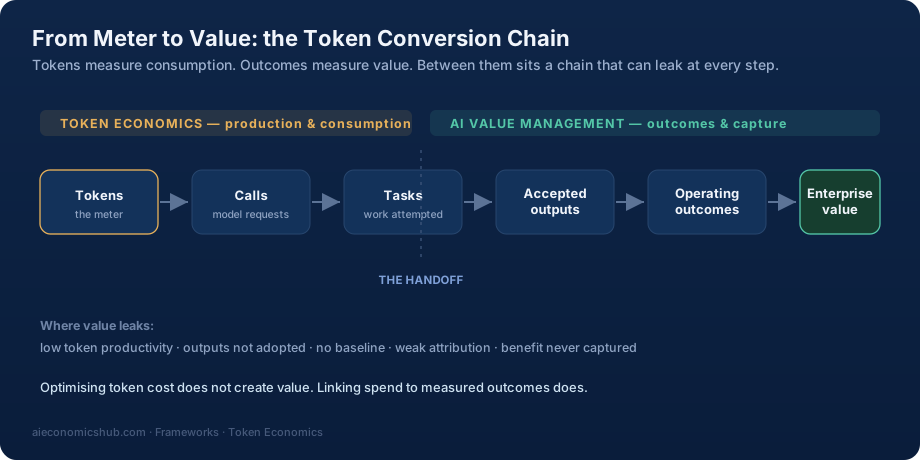
The token is a fundamental unit of metered AI consumption. It is the smallest measurable unit of AI compute, the basis for model pricing, and the common denominator for operational demand. Every AI interaction—whether a chatbot response, a code generation, or a document analysis—consumes tokens. The token count determines the cost.
But the token is a meter, not the value itself. On one side, tokens represent compute: energy consumed, hardware utilised, model inference performed. On the other side sits work: questions answered, documents processed, decisions supported. Between them lies a conversion chain where tokens become calls, calls become tasks, tasks become accepted outputs, and outputs become operating outcomes that may or may not create enterprise value.
This is why token economics matters. It makes AI work measurable, priceable and governable. It does not, by itself, tell an organisation whether that work was useful, adopted, trusted, profitable or strategically important. That requires connecting tokens to tasks, tasks to accepted outputs, outputs to actions, and actions to measured operating outcomes.
The three dimensions of token economics
Token economics operates across three dimensions: production, consumption, and the handoff to value management. Each dimension has its own dynamics, metrics, and optimisation strategies. Understanding all three is essential for connecting infrastructure cost to business outcomes.
Production: The cost of generating tokens
Production economics covers the infrastructure cost of generating model outputs. This includes energy consumption, hardware efficiency, inference infrastructure, and model optimisation. Production cost is determined by model architecture, hardware choice, and operational efficiency.
Key production levers include model selection (frontier vs smaller models), inference optimisation (quantisation, pruning, distillation), hardware efficiency (GPU utilisation, batch processing), and infrastructure design (on-premise vs cloud, reserved vs on-demand capacity).
Consumption: How tokens are used
Consumption economics covers how tokens are allocated and used to complete tasks. This includes prompt engineering, model routing, caching strategies, agent orchestration, and context management. Consumption patterns determine total token volume and cost.
Key consumption levers include prompt optimisation (shorter, more precise prompts), intelligent routing (matching task complexity to model capability), caching (reusing repeated content), context management (minimising unnecessary context), and agent design (reducing redundant model calls).
The handoff to value management: What tokens enable
Token economics provides the cost and capacity foundation. AI Value Management connects that foundation to business outcomes. This includes defining success, measuring output quality, tracking adoption, attributing outcomes, capturing benefits, and making portfolio decisions. The handoff requires a shared work unit that links tokens to tasks, tasks to outputs, and outputs to measured value.
Key handoff requirements include: outcome definition (what counts as success), baseline measurement (what changed), attribution method (how AI contributed), benefit ownership (who captures the value), and evidence confidence (how strong is the proof). Without this handoff, token efficiency becomes an end in itself rather than a means to worthwhile outcomes.
These three dimensions are interdependent. Production efficiency enables consumption scale. Consumption patterns determine value potential. Value realization justifies production investment. Managing token economics means optimising across all three dimensions simultaneously.
Not all tokens are equal
A common misconception is that token productivity is constant: that 1,000 tokens always produce the same amount of work. This is false. Token productivity varies dramatically based on workflow design, model choice, context quality, and orchestration logic.
The same token count can produce vastly different business outcomes. A well-designed prompt with precise context might generate a high-quality output in 500 tokens. A poorly designed prompt with excessive context might consume 5,000 tokens to produce a lower-quality output. The token count is the same order of magnitude, but the value produced is not.
Token productivity can vary dramatically depending on system design. High-productivity systems use precise prompts, intelligent routing, effective caching, and minimal agent loops. Low-productivity systems use verbose prompts, single-model routing, no caching, and excessive agent iterations. The variance can be substantial—often an order of magnitude or more between well-optimized and poorly-optimized implementations.
High-productivity token usage
A customer support system routes simple queries to a small model (50 tokens per response), uses caching for common questions (90% cache hit rate), and reserves the frontier model for complex cases (200 tokens per response). Average token cost per resolved query: 60 tokens. Customer satisfaction: 92%.
Low-productivity token usage
A similar customer support system routes all queries to a frontier model (200 tokens per response), does not use caching, and includes excessive context in every prompt (additional 100 tokens per call). Average token cost per resolved query: 300 tokens. Customer satisfaction: 89%.
The low-productivity system consumes 5x more tokens for marginally worse outcomes. This is the token productivity gap. It is not visible in the token bill—both systems show token consumption and cost. But the value produced per token is radically different.
The anatomy of token billing
A token bill has six mechanics that shape the cost. Understanding them is necessary for managing AI spend at scale.
1. Input vs output tokens
Input tokens (the prompt) are cheaper than output tokens (the response). The ratio varies by model, but output is typically 2-5x more expensive. A long prompt with a short response is cheaper than a short prompt with a long response.
Implication: Optimising for shorter outputs can save more than optimising for shorter prompts.
2. Caching
Some providers cache repeated prompt content and charge less for cached tokens. If your prompt includes a large system message or reference document that does not change between calls, caching can reduce input token cost by 50-90%.
Implication: Structuring prompts to maximise cacheable content can significantly reduce cost for high-volume use cases.
3. Context length
Models have a maximum context window (e.g., 128k tokens). Longer context windows cost more, even if you do not use the full window. Some providers charge based on the context window size, not the actual tokens used.
Implication: Using a model with a larger context window than you need can inflate cost unnecessarily.
4. Model routing
Different models have different token prices. A frontier model might cost 10-50x more per token than a smaller model. Routing simple tasks to cheaper models and complex tasks to expensive models can reduce blended cost.
Implication: Model routing is a cost optimisation strategy, but it requires classification logic and adds operational complexity.
5. Agent loops
Agentic AI systems make multiple model calls to complete a task: planning, tool use, reflection, error correction. Each call consumes tokens. A single user request can trigger 5-20 model calls, multiplying the token cost.
Implication: Agentic systems can have 10-50x higher token cost per user action than single-call systems. The cost is harder to predict and control.
6. Batch vs real-time
Some providers offer batch pricing for non-urgent workloads, typically 50% cheaper than real-time inference. Batch jobs are queued and processed when capacity is available.
Implication: Separating urgent from non-urgent workloads and using batch pricing for the latter can halve cost for those workloads.
The scissors: why the bill rises while prices fall
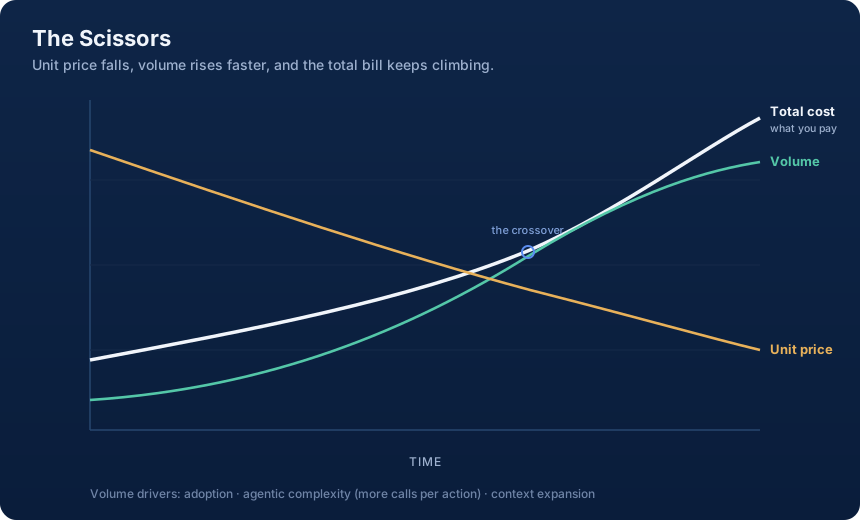
Token prices are falling. OpenAI, Anthropic, Google and others have cut prices multiple times. But enterprise AI bills are rising. This is the scissors: unit price down, volume up, total cost up.
The volume increase comes from three sources:
- Adoption: More users, more use cases, more sessions
- Agentic complexity: More model calls per user action
- Context expansion: Longer prompts, larger context windows, more retrieval
The result is that token consumption is growing faster than token prices are falling. Enterprise AI bills are rising despite unit price reductions, driven by increased adoption, agentic complexity, and context expansion.
The scissors pattern—unit price down, volume up, total cost up—appears structural rather than temporary. As AI becomes cheaper per token, organizations find more uses for it, expanding total consumption faster than efficiency gains can offset.
SaaS as a token aggregator
Most enterprise AI is consumed through SaaS applications, not direct API calls. Microsoft Copilot, Salesforce Einstein, ServiceNow AI, and hundreds of other products bundle AI features into subscription pricing. The underlying token consumption is hidden from the buyer.
This creates a visibility gap. The SaaS vendor pays for tokens. The enterprise pays a subscription fee. The relationship between token consumption and subscription cost is opaque. The enterprise cannot see how many tokens are consumed per user, per action, or per outcome. The vendor controls the token economics, and the buyer has no insight.
This matters for three reasons:
Procurement cannot assess unit economics
Without visibility into token consumption, procurement cannot evaluate whether the subscription price represents good value. A vendor might be charging £40/user/month for 10,000 tokens of consumption (expensive) or 1,000,000 tokens (cheap). The buyer cannot tell.
Finance cannot forecast cost scaling
Subscription pricing appears linear: double the users, double the cost. But token consumption is not linear. Heavy users might consume 50x more tokens than light users. If adoption skews toward heavy users, the vendor's cost increases faster than revenue, which creates pricing pressure and potential price increases.
Business cannot optimise consumption
Without token-level visibility, the enterprise cannot identify inefficient usage patterns, optimise workflows, or educate users on cost-effective practices. The SaaS vendor controls optimisation, and the buyer is passive.
The SaaS aggregation model is convenient for buyers—no infrastructure to manage, no token bills to reconcile. But it creates a strategic dependency. The buyer outsources token economics to the vendor, which means outsourcing cost control, efficiency optimisation, and value measurement.
The Tokenomics Foundation
On 3 June 2026, the Linux Foundation announced the intent to launch the Tokenomics Foundation to develop open standards, benchmarks and best practices for AI cost management. The goal is to make token bills comparable across providers, similar to what the FinOps Foundation did for cloud billing.
Source: Linux Foundation press release, 3 June 2026. The foundation's work is ongoing. Check the official announcement for current status and deliverables.
A standardized approach to token billing would create a shared language for token cost. Currently, every provider has different billing structures, different definitions of input and output, and different caching rules. Standardization would not solve the cost problem, but it would make cost visible and comparable across providers.
Where the meter ends
The token meter measures model inference cost. It does not measure the full cost of AI. Here is the seven-category taxonomy of what the meter does not show:
1. Orchestration and agent runtime
The compute cost of running the agent framework, tool execution, state management, and workflow orchestration. Not metered by the model provider.
2. Retrieval and vector search
The cost of embedding generation, vector database queries, and retrieval-augmented generation (RAG) infrastructure. Separate from the model inference bill.
3. Data pipelines and preparation
The cost of ingesting, cleaning, transforming and storing the data that feeds the AI system. Often larger than the inference cost.
4. Fine-tuning and model customisation
The cost of training custom models or fine-tuning base models. Billed separately from inference, often as a one-time or periodic charge.
5. Integration and API management
The cost of API gateways, rate limiting, authentication, logging, and connecting AI to enterprise systems. Infrastructure cost, not model cost.
6. Governance and compliance
The cost of monitoring, audit logging, bias testing, explainability tooling, and compliance reporting. Operational cost, not metered.
7. Human-in-the-loop and operations
The cost of human review, exception handling, model retraining, incident response, and ongoing operations. Labour cost, not infrastructure cost.
8. Outcome evidence
The cost of defining baselines, measuring outcomes, attributing results, and building evidence chains. This is management work, not infrastructure cost.
9. Behavioural consequences
The cost of review debt, rework, training, trust calibration, and capability effects. These are real economic consequences that do not appear in token bills.
10. Benefit capture
The work required to turn potential value into realised value: redeploying capacity, changing processes, capturing margin, or reducing cost. Tokens create potential; capture creates value.
11. Opportunity cost
The value of alternative investments. Every token spent on one use case is a token not spent on another. Portfolio decisions require comparing options, not just measuring one initiative.
The token meter is useful for managing inference cost. But inference cost is often a minority of total AI cost—and cost is only half the equation. The full picture includes orchestration, retrieval, data pipelines, integration, governance, operations, outcome evidence, behavioural effects, benefit capture, and opportunity cost. Managing token cost without managing the full conversion chain is optimising the wrong thing.
This is where token economics hands off to AI Value Management. Token visibility is necessary but not sufficient. To manage AI at scale, you need frameworks for AI TCO, AI ROI, value gap analysis, and outcome metrics.
The handoff to value management
Token economics tells you what intelligence costs to produce and consume. AI Value Management tells you whether that intelligence produced worthwhile outcomes.
The handoff requires connecting tokens to an AI work unit: a repeatable task, workflow, product feature or agent objective that links consumption to output quality, human effort, outcome evidence and value. Without this connection, you have cost telemetry but no value telemetry.
The handoff question is: can you link token spend to measured business outcomes with credible attribution? If you can, you have the foundation for portfolio decisions. If you cannot, you have a cost number without proof of return.
Tokenomics makes intelligence accountable as spend. AI Value Management makes it accountable as an investment. Both disciplines are necessary. Neither is sufficient alone.
Sources
Related reading
AI Value Gap
Why token spend does not guarantee value capture
AI ROI Models
From token cost to business outcome
AI TCO Framework
The full cost stack beyond the token meter
FinOps for AI
Applying FinOps principles to token economics
The Inference Cost Crisis
Why token bills are rising despite falling prices
All frameworks
Back to the toolkit