

Standfirst
The most dangerous AI budget assumption is that falling model prices will solve the cost problem. They may do the opposite.
1. The comforting forecast
AI buyers are repeatedly told that models and hardware will become more efficient. That is likely.
The conclusion usually follows automatically: AI will become cheaper.
At the level of an individual model call, this may be true. At the level of an enterprise budget, it is not guaranteed.
Deloitte frames the problem through Jevons' paradox: efficiency lowers the cost of using a resource, which can expand consumption enough to increase total demand.1 This is not a law that mechanically predicts every AI budget. It is a warning about behaviour and system design.
Both halves of the pattern are visible at market level. Epoch AI estimates that the cost of reaching a fixed benchmark score has fallen about 47% a quarter since 2023, and the combined annualised revenue of OpenAI and Anthropic rose from about US$30 billion to about US$105 billion during 2026 by late summer (State of AI Report 2026). The revenue figures are company-reported run rates and include consumer subscriptions, so they are not enterprise invoices. They show prices and spend moving in opposite directions at the same time.
The relevant equation is simple:
Total AI cost = unit cost × volume × workflow complexity × operating overhead
A fall in the first term can be overwhelmed by growth in the others.
Analysis · Inference Economics
The Jevons Paradox in Enterprise AI
Per-token prices have fallen dramatically. Enterprise AI budgets have not fallen. They have risen as cheaper access triggered more use cases, wider deployment, and agentic integration that multiplies consumption.
Dual-axis line chart showing AI budget index rising from 100 to 900 while token costs fell from $30 to $0.10 per million tokens between Q1 2023 and Q1 2026, illustrating the Jevons Paradox where efficiency gains lead to increased total consumption.
Illustrative, AI Economics Hub analysis. Token cost trajectory based on publicly reported commercial model pricing changes (GPT-4 class models, 2023–2026). Budget index is indicative of observed enterprise AI spend trajectories, not a survey benchmark. Agentic workloads increase consumption per task 5–30×, accelerating the Jevons effect. Sources: Gartner (2025), WSJ May 2026 (corporate rationing), AI Economics Hub inference.
2. Five demand multipliers
1. More users
Lower prices reduce the friction of giving more employees and customers access to AI.
2. More use cases
Tasks that failed a cost threshold become viable. Summarisation expands into document analysis, then into continuous monitoring and autonomous action.
3. More calls per task
Agentic systems plan, retrieve, call tools, verify, retry and reflect. One user request can create a chain of model interactions.
4. More context and memory
Systems ingest larger documents, histories, customer records and multimodal inputs. The unit of demand expands even when the user count stays flat.
5. Higher quality expectations
As AI becomes embedded in material workflows, organisations may move from cheap models to better reasoning, verification and redundancy. The cost per successful outcome can rise even while list prices fall.
3. Human demand and machine demand are different
Traditional SaaS demand is anchored to people:
- users
- seats
- sessions
- working hours
Agent demand is anchored to objectives and permissions.
An agent can:
- monitor continuously
- retry automatically
- delegate to other agents
- generate its own subtasks
- operate outside human working hours
- respond to machine-generated events
This changes the forecasting denominator.
A 10% increase in employee adoption may not mean a 10% increase in cost. A small increase in agent autonomy can create a much larger increase in calls.
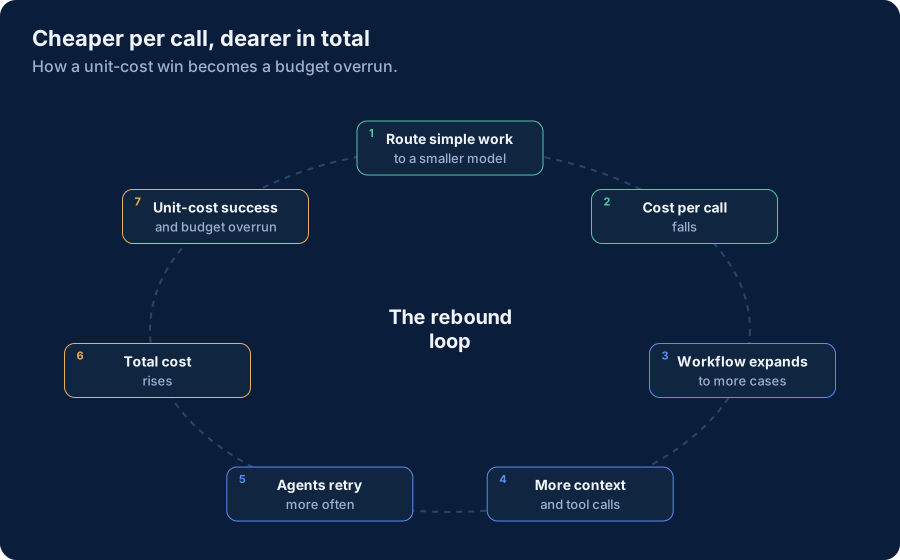
4. The rebound loop
A typical enterprise optimisation programme may work like this:
- Engineering routes simple work to a smaller model.
- Cost per call falls.
- The business expands the workflow to more cases.
- More context and tool calls are added.
- The agent is allowed to retry more often.
- Total cost rises.
- The programme reports successful unit-cost optimisation and a budget overrun at the same time.
Neither result is contradictory.
This is the AI rebound loop.
5. Why savings do not save themselves
A model-routing improvement may reduce the cost of an existing workflow.
Three things can happen.
Savings are banked
Budget or capacity is removed. The financial benefit is realised.
Savings are reinvested deliberately
The organisation funds additional high-value work. Cost stays flat or rises, but expected value rises faster.
Savings disappear into consumption
Usage expands without a portfolio decision. The unit-cost improvement is real, but no financial or strategic value is captured.
Most organisations do not distinguish these outcomes clearly.
6. Forecast demand as a range
A single annual AI budget is too fragile. Use scenarios. The AI budget stress test checks whether a case still meets its hurdle under higher prices and demand.
Baseline scenario
- current users and workflows
- expected adoption
- known provider pricing
- current model mix
Expansion scenario
- more functions onboarded
- longer context
- more agent loops
- increased multimodal use
- higher quality requirements
Autonomy scenario
- event-driven agents
- agent-to-agent delegation
- continuous monitoring
- retries and verification
- tool execution
Constraint scenario
- capacity shortage
- vendor price change
- premium model requirement
- regulation or sovereignty requirement
- human review increase
Each scenario should show:
- total tokens or equivalent capacity
- full cost
- cost per successful outcome
- quality and service level
- value at risk
- breakpoints for architecture or contract change
7. Service levels for intelligence
Not every task needs frontier reasoning, immediate response or exhaustive verification.
Define intelligence service levels.
Bronze
- low-cost model
- batch where possible
- limited context
- lower assurance
- non-material work
Silver
- balanced model
- standard latency
- evaluation and fallback
- normal enterprise workflows
Gold
- high-capability model
- verification
- strong provenance
- human review
- material decisions
Critical
- redundant checks
- constrained actions
- auditable evidence
- explicit human authority
- risk and resilience controls
This makes cost a design choice rather than a surprise.
8. Portfolio governance for abundance
When intelligence becomes cheaper, prioritisation becomes more important, not less.
Scarcity once limited demand. Abundance removes that discipline.
Portfolio reviews should ask:
- Which new demand was planned?
- Which demand is machine-generated?
- Which unit-cost savings were banked or reinvested?
- Which workflows have rising cost per successful outcome?
- Which agents are creating calls without corresponding outcomes?
- What should be throttled, redesigned or stopped?
- Has lower cost enabled strategic value or merely more activity?
9. Price structure, not just price level
A separate argument says today's prices are subsidised and must rise. The evidence on that is mixed. Leading model providers have run at heavy losses and some reportedly missed their own margin targets in 2025, but reporting in 2026 points to improving margins on inference, and the price of a fixed level of capability is still falling. This site does not forecast higher list prices.
What is changing, and what buyers should plan for, is the structure of pricing:
- Premium tiers. The newest frontier and reasoning models launch at a premium and have not fallen in price as fast as older capability levels.
- Metering in place of flat fees. Subscriptions that once bundled AI are moving to credits, consumption bands and charges per action.
- Scheduled increases and withdrawn discounts. Introductory prices end, as the Gemini example above shows.
- Rationing. Some large companies have started to ration AI access (paywalled) as costs outran budgets.
Three scenarios to run before calling a case validated
Scenario one: your effective price rises. Not because list prices rise, but because the work moves to premium models, a discount ends or a flat fee becomes metered. Test the case at one and a half to two times today's effective cost per call. If it fails, it is priced on favourable terms rather than on value.
Scenario two: demand doubles, then doubles again. A capability that works gets expanded. Run the unit economics at two and four times current demand before treating pilot economics as a stable baseline.
Scenario three: the capability is embedded before terms change. Once a workflow depends on a model, switching costs rise and the buyer's leverage falls. Keep architectural and commercial flexibility: routing that can change models, contract terms with volume bands and exit rights, and an owner who watches the terms.
If the case fails a scenario, that is not automatically a reason to stop. It is a reason to redesign the workflow, build in flexibility, or state openly that the justification depends on current conditions.
10. Where Jevons may not apply
Total spend can fall when:
- demand is saturated
- budgets are hard capped
- models become efficient faster than use expands
- on-device inference displaces paid capacity
- workflows are simplified rather than expanded
- competition transfers efficiency gains to buyers
- organisations deliberately bank savings
The correct claim is not "AI will always cost more".
It is:
Falling unit prices are not a cost-control strategy.
11. Management actions
CFO
Require volume and complexity scenarios, not only provider price assumptions.
FinOps
Separate price variance, volume variance, model-mix variance and workflow-complexity variance.
Engineering
Track calls per successful outcome, retry rates, context growth and agent fan-out.
Product and operations
Define where increased intelligence depth has measurable value.
Procurement
Negotiate visibility, volume bands, commitment flexibility and exit rights.
Board
Distinguish rising cost caused by successful value expansion from rising cost caused by uncontrolled demand.
Conclusion
AI can become dramatically cheaper per unit and materially more expensive in total.
That is not a paradox once demand is visible.
The enterprise problem is no longer only the cost of intelligence. It is the ability of humans and agents to create demand for intelligence faster than governance can judge its value.
Related reading
- Token Economics
- The Token Is the Meter, Not the Value
- AI TCO Framework
- Agentic AI Economics
- What Cloud Taught Us About the Real Cost of AI Inference
Sources
Footnotes
-
Deloitte, The pivot to tokenomics: Navigating AI's new spend dynamics, p. 12 and pp. 16-19. The report discusses Jevons' paradox in the context of AI efficiency improvements potentially increasing total consumption. ↩