

Purpose
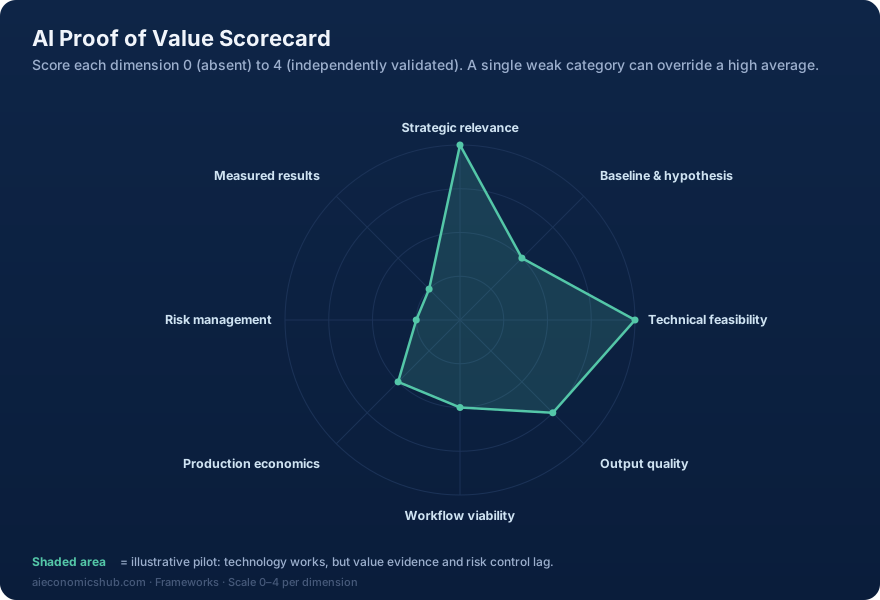
This scorecard evaluates whether an AI initiative has sufficient evidence to proceed from experimentation to production investment. It tests strategic relevance, baseline quality, technical feasibility, output performance, workflow viability, production economics, risk management and measured outcomes.
The scorecard is designed to be used iteratively across decision gates, not as a one-time approval checklist.
Scoring Method
Score each item:
- 0: absent – no evidence exists
- 1: assumed – claimed but not demonstrated
- 2: partially evidenced – some supporting data or observation
- 3: evidenced – clear, documented evidence
- 4: independently validated or repeatable – verified by multiple sources or reproducible
Section A: Strategic Relevance
The problem is material
The use case supports a funded priority
The target outcome is explicit
Alternative non-AI options were considered
Opportunity cost is understood
Gate: Continue only if the problem is worth solving and AI is a plausible option.
Section B: Baseline and Value Hypothesis
Every value claim requires a baseline, named owner, and explicit capture mechanism.
Value Dimensions
Select one or more:
- Revenue
- Margin
- Operating cost
- Capacity
- Quality
- Risk
- Resilience
- Customer outcome
- Employee outcome
- Strategic capability
Decision Framework
Choose one decision at each gate:
- Scale – proceed to full production
- Limited scale – expand cautiously with continued monitoring
- Redesign – modify approach based on evidence
- Continue evidence collection – extend pilot to gather more data
- Contain – maintain current scope without expansion
- Stop – terminate initiative and reallocate resources
Decision Rationale Template
Evidence supporting continuation
—
Evidence against continuation
—
Critical unknowns
—
Next decision date
—
Capital requested
—
Conditions attached
—
Minimum Publication-Quality Evidence
A case study should not be described as “value proven” unless it includes:
- Baseline measurement
- Named outcome owner
- Full cost or explicit cost boundary
- Measured outcome with time period
- Attribution method
- Capture statement (how benefit was realised)
- Limitations and caveats
How to Use This Scorecard
Before the pilot
Complete Sections A and B to ensure strategic alignment and baseline readiness. Identify owners and agree on evidence methods before work begins.
During the pilot
Update Sections C through G as evidence emerges. Use monthly reviews to track progress and identify gaps early.
At the funding decision
Complete Section H with measured results. Review all sections to ensure no critical gaps remain. Document the decision rationale explicitly.
Download
A downloadable markdown version of this scorecard is available for teams to complete during pilot evaluation.
Related reading