

Key takeaways
- Most AI business cases fail board scrutiny not because the technology is wrong, but because the benefit claim is vague, the cost model is incomplete, and the proof standard is undefined.
- A CFO-grade AI business case must answer three questions: what does it cost in full, what return is expected and when, and how will we prove it happened.
- Productivity claims need a realisation assumption - capturing time freed up is not the same as capturing value.
- Stage-gate structures and exit criteria should be built into the approval, not added later when investment is already at stake.
Why most AI business cases fail
The characteristic failure mode of an AI business case is not dishonesty. It is optimism combined with structural incompleteness. Interpretation The person presenting the case typically believes the technology will work. What they have not done is apply the same rigour to the cost model, the benefit realisation path, or the proof standard that they would apply to a capital expenditure request in any other category. Interpretation The result is a case that looks compelling in a slide deck and unravels in the first quarterly review. Investment continues while the evidence base stays thin. The organisation ends up in a familiar position: substantial AI spend, no clear proof of return, and increasing reluctance to authorise the next round of funding without something changing. InterpretationReal-world pattern: In 2026, Marc Benioff said Salesforce expected to spend about $300 million on Anthropic tokens in 2026, largely for coding-related work. This pattern-where the CFO's first task is simply establishing what is already happening-is common across enterprises with distributed AI adoption.
The three questions a credible AI business case must answer
A business case that can survive scrutiny must do three things: quantify the full cost, specify the expected return with a realistic realisation path, and define in advance what evidence will count as proof. InterpretationWhat does it cost in full? The model invoice, API fees, or vendor contract is typically the most visible cost. It is rarely the dominant one. Interpretation A more complete cost picture includes engineering time to integrate and maintain the workflow, data infrastructure and security changes, user enablement and training, ongoing governance and oversight, and the productivity cost of imperfect outputs during the learning period. Interpretation See the AI TCO Framework for a structured approach to building this estimate.
What return is expected and when? Benefit claims in AI cases tend to fall into three categories: productivity gains (time saved), capability gains (things now possible that were not before), and strategic optionality (positioning for future opportunity). Interpretation All three are legitimate. But each requires a different realisation model. Interpretation Time savings only become economic value if the released capacity is redeployed or if headcount grows more slowly. Capability gains require a link to revenue or cost outcomes. Strategic optionality requires a stage at which the option is exercised or abandoned. Interpretation
How will we know it happened? This is the question most business cases skip entirely. Interpretation Without a pre-agreed proof standard - a specific metric, measurement method, and baseline - no review process can determine whether the investment is delivering. The result is that positive stories circulate while unfavourable evidence goes uncaptured. Interpretation
The productivity claim problem
Productivity is the most common AI benefit claim. It is also the one most likely to fail realisation. Interpretation The underlying mechanism is real. AI tools do reduce the time to produce a first draft, search a dataset, generate code, or summarise a document. In controlled testing, time savings are frequently measurable. Interpretation The difficulty is that measured time savings in a task do not automatically translate into economic value for the organisation. Interpretation A knowledge worker who completes a task twenty per cent faster does not automatically deliver twenty per cent more output - particularly if the task they completed faster was not the binding constraint on their productivity. Interpretation If the bottleneck is decision-making, coordination, or access to information rather than execution time, then the AI intervention may improve the experience of doing the task without improving the outcome that matters. InterpretationEvidence from controlled studies: Market observations in early 2026 indicated significant enterprise Copilot subscription cancellations, with organisations citing low adoption and unclear value as primary reasons. Many enterprises discovered that time savings in individual tasks did not translate to measurable productivity gains at the team or department level-the classic realisation gap.
Structuring the benefit case
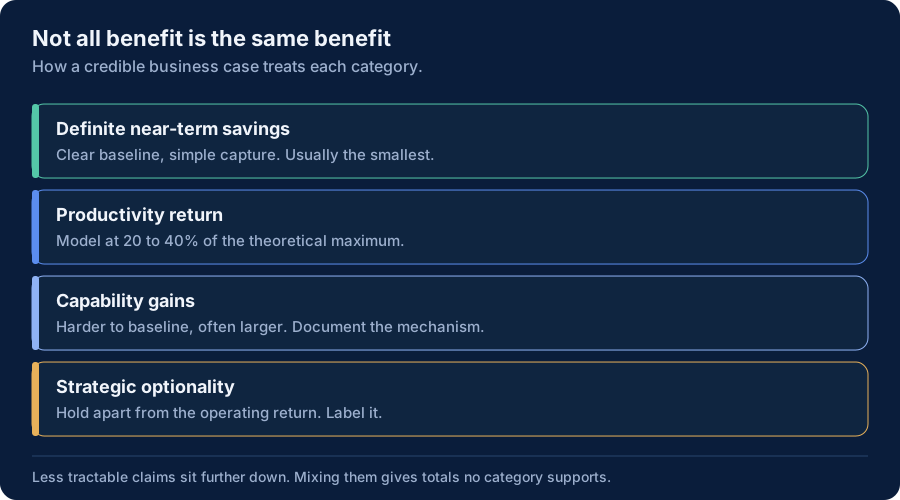
A rigorous benefit case separates claims into categories and disciplines each one differently. InterpretationDefinite near-term savings are cases where AI removes a specific activity that currently has a direct cost: a vendor contract, a headcount role, or a defined volume of outsourced work. These claims are the most tractable because the baseline is clear and the capture mechanism is simple. They are also usually the smallest category. Interpretation
Productivity return covers the use of freed time. The conservative approach is to model realisation at a fraction of the theoretical maximum - typically between twenty and forty per cent for well-managed deployments - and tie the estimate to a specific redeployment assumption. Interpretation Unmeasured time savings should be excluded from the expected return. Interpretation
Capability gains are returns that depend on AI making something possible that was not previously done. These are harder to baseline but often more material. Interpretation A legal team that can now review contract volumes previously beyond their capacity, or a finance team that can produce scenario analyses at a cadence previously impractical, are generating returns that time-saving models do not capture. Interpretation Document the enabling mechanism and the downstream impact it should produce. Interpretation
Strategic optionality should be held separately from the operating return. It reflects the value of being positioned to scale if the technology proves out, or to integrate with capabilities that are not yet mature. Interpretation Boards can assess optionality arguments, but they need to be labelled as such. Mixing optionality arguments with productivity claims produces benefit totals that neither category supports. Interpretation
The optimist's case
BCG's research on the AI value gap shows that organisations with rigorous benefit categorisation and measurement discipline close the gap faster than those using aggregated ROI claims. Separating productivity, capability, and optionality returns allows each to be governed appropriately. The discipline of categorisation itself improves investment quality.
The sceptic's case
Excessive categorisation can paralyse decision-making and create false precision. Many AI benefits are emergent and cannot be cleanly separated into predefined buckets. Organisations that demand perfect benefit categorisation before approving investment may miss opportunities where the value is real but difficult to model in advance. Sometimes the right answer is to run a time-boxed experiment rather than building an elaborate business case.
Synthesis · house view
The right balance depends on investment scale and organisational maturity. For material investments (typically above £500k or $750k), benefit categorisation is essential for governance and proof. For smaller experiments, a lighter proof standard may be appropriate. The key is that the proof standard matches the investment scale and that it is defined before approval, not after the first review. Categorisation should clarify accountability, not create bureaucracy.
The cost model in detail
A business case that understates cost is not conservative - it is misleading. It also tends to produce cost overruns that undermine confidence in future proposals. Interpretation Build the cost model in three horizons. Year one costs are typically the highest because they include integration engineering, enablement, and change management in addition to the ongoing run cost. Year two costs reflect the stabilised operating position, usually lower than year one but often higher than the vendor contract alone. Year three costs introduce the first indication of total cost of ownership at scale: what happens when the use case expands, the model is upgraded, or governance requirements increase. Interpretation Costs to include in full: Interpretation- Model or platform fees (including potential volume tiers if adoption grows)
- Integration engineering (initial build and ongoing maintenance)
- Infrastructure changes (data pipelines, security controls, access management)
- User enablement (training, support, adoption management)
- Governance and oversight (prompt review, output auditing, compliance documentation)
- Contingency for transition costs (productivity dip during rollout, rework of AI-assisted outputs)
A particular challenge with SaaS-based AI tools is that subscription pricing often obscures underlying token consumption, making it difficult to model true unit economics or predict cost at scale. Interpretation For more on this visibility gap, see SaaS Token Opacity: The Hidden Economics of AI Subscriptions. For usage-priced AI, the inference cost estimator builds the run cost from the rate card, and the AI budget stress test checks the case against higher prices and demand.
Stage-gate and exit criteria
One of the most useful structural elements in an AI business case is an explicit stage-gate: a defined decision point at which the organisation evaluates whether to proceed, scale, redesign, or stop. Interpretation Stage-gate approval forces the benefit case to specify interim proofs rather than only a final return. It also creates a legitimate exit path, which makes the original investment more credible. Interpretation Boards are more likely to approve investment with a defined stop condition than investment with no exit, because the former demonstrates that the case has been stress-tested. Interpretation An exit criterion should specify: the proof standard that would trigger a redesign or stop decision, the timeframe in which that evidence should be available, and who owns the decision. Without these elements, the stage-gate becomes a reporting milestone rather than a genuine decision gate. InterpretationWhat board-ready looks like
A business case ready for board-level approval has the following characteristics: Interpretation The cost model is complete, includes year-one integration costs, and shows the stabilised run cost in year two. The benefit case separates categories by type and includes a realisation assumption for productivity claims. Expected return is stated as a range with a central estimate, not a single optimistic figure. The proof standard is defined before approval, not after the first review. A stage-gate structure is included with explicit decision criteria and an owner. Interpretation None of this requires more complexity than the investment deserves. A cost estimate built on incomplete assumptions will be more precise than one built on honest ranges - but it will also be wrong. The objective is not a number that looks compelling in a presentation. It is a commitment the organisation can actually hold. Interpretation The CFO's role in this process is not to make the case more conservative. It is to make it more honest: to ask where the benefit assumption requires future decisions that have not yet been made, where the cost model excludes categories that will still have to be paid for, and where the proof standard would actually change the investment decision if it were not met. Interpretation That is the standard that allows AI investment to scale without accumulating an unaccountable tail of stranded spending. InterpretationReferences and further reading
Related reading
Research on why organisations with rigorous benefit categorisation and measurement discipline close the value gap faster
Analysis of the structural factors that prevent AI investments from delivering expected returns
Guidance on the seven cost categories CFOs should track in AI investments, extending beyond infrastructure to governance and enablement
Case study of budget overrun when proof standards and ownership are unclear
Report on the $300M unbudgeted AI spend discovery that forced visibility and governance