

Definition
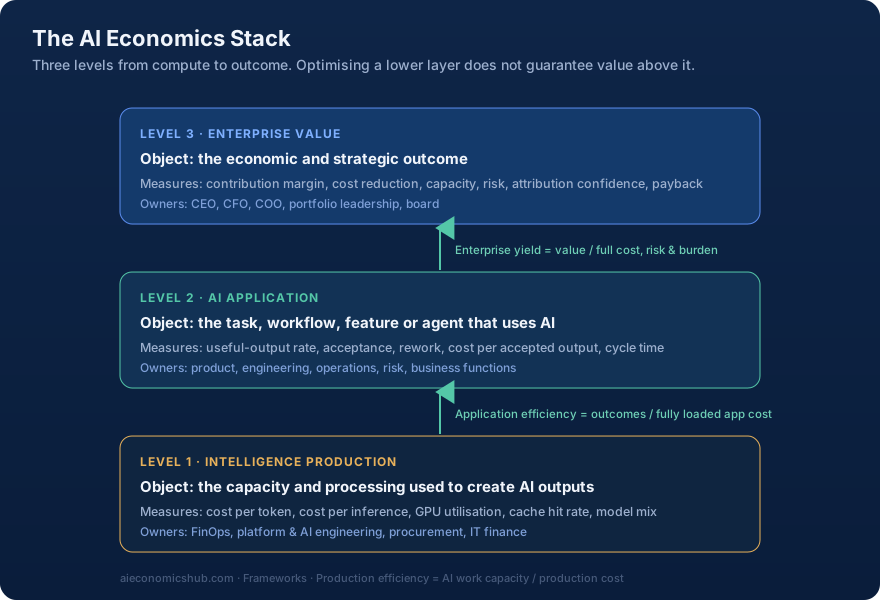
The AI Economics Stack is a three-level framework for tracing how infrastructure and model consumption become useful work and enterprise value.
It answers three questions:
- What did intelligence cost to produce and consume?
- What did the AI-enabled application accomplish?
- What changed for the enterprise?
The three levels
The stack organises AI economics into three distinct but connected layers. Each layer has its own economic logic, measurement challenges and ownership.
Level 1: Intelligence Production Economics
Object
The capacity and processing used to create AI outputs.
Includes
- Energy and facilities
- Accelerators, CPU, memory
- Storage and network
- Model access and tokens
- Throughput and caching
- Routing and reserved capacity
- Engineering and operations
Core questions
- What are we consuming?
- What determines unit cost?
- Where is demand appearing?
- Which workloads are efficient?
- Should capacity be rented, reserved, managed or owned?
- What is the provider and sovereignty exposure?
Measures
- Cost per input, output and cached token
- Cost per inference
- Tokens per second
- GPU utilisation
- Batch rate and cache hit rate
- Model mix
- Cost by workload
- Forecast variance
- Capacity commitment utilisation
- Energy and carbon where relevant
Primary owners
- FinOps
- Infrastructure and platform engineering
- AI engineering
- Procurement
- IT finance
Failure mode
The organisation optimises cost per token while ignoring whether output is usable.
Level 2: AI Application Economics
Object
The task, workflow, product feature or agent that uses AI.
Includes
- Prompt and context
- Retrieval and tool calls
- Orchestration and model output
- Evaluation and human review
- Correction and escalation
- Workflow integration
- Adoption and behavioural effects
Core questions
- What work is being attempted?
- What counts as success?
- Is output accepted and acted upon?
- What is the full cost per successful outcome?
- Is AI removing work or moving it?
- Are quality, latency and risk appropriate?
Measures
- Task completion and useful-output rate
- Acceptance and correction rates
- Rework and review time
- Escalation and latency
- Cost per accepted output
- Cost per successful outcome
- Workflow cycle time
- Agent calls per outcome
- Adoption and appropriate-use rate
Primary owners
- Product and engineering
- Operations and process owners
- Risk and compliance
- Business functions
Failure mode
The application produces impressive outputs but no net workflow improvement.
Level 3: Enterprise Value Economics
Object
The economic and strategic outcome.
Includes
- Revenue and contribution margin
- Operating cost and capacity
- Quality and customer outcome
- Risk and resilience
- Compliance and strategic option
- Capability and opportunity cost
Core questions
- What changed?
- Who owns the benefit?
- Was capacity or value captured?
- What evidence supports attribution?
- Is the outcome durable?
- Is this the best use of capital?
- Should the initiative scale, change or stop?
Measures
- Incremental contribution margin
- Realised cost reduction
- Redeployed capacity
- Throughput and loss avoided
- Risk exposure and customer retention
- Strategic milestone
- Attribution confidence
- Payback and economic yield
- Portfolio value at risk
Primary owners
- CEO and CFO
- COO and business unit executives
- Portfolio leadership
- Board
Failure mode
The organisation claims strategic value without a credible evidence chain.
Conversion between levels
Production efficiency
AI work capacity / production cost
Useful for engineering and sourcing decisions.
Application efficiency
Successful application outcomes / fully loaded application cost
Useful for product and operations decisions.
Enterprise yield
Measured enterprise value / full cost, risk and operational burden
Useful for capital allocation decisions.
Core principle
Examples of this principle in action:
- Cheaper inference can increase rework
- Higher token throughput can generate unused output
- Faster task completion can move a bottleneck downstream
- Higher adoption can increase risk
- Lower human effort can reduce learning and resilience
- A valuable use case can still be a poor portfolio investment
Relationship to AI Value Management Layers
The AI Economics Stack and the AI Value Management Layers solve different problems and should coexist.
| AI Economics Stack | AI Value Management Layers |
|---|---|
| Economic objects and conversion | Management sequence and questions |
| Production | Usage Transparency and part of Output Quality |
| Application | Output Quality and Productivity Value |
| Enterprise | Delivery Alignment and Portfolio Strategy |
Do not replace the five AIVM layers. Use both frameworks together: the Stack for economic analysis, the Layers for governance progression.
Diagnostic questions
For a material use case, ask:
Level 1: Production
- Can we allocate full production cost?
- Do we know model, provider and workload?
- Can we forecast demand?
- Do we know the sourcing alternatives?
Level 2: Application
- Is success defined?
- Do we measure accepted output and review?
- Can we calculate cost per successful outcome?
- Do we understand behavioural effects?
Level 3: Enterprise
- Is there a baseline?
- Is an owner accountable?
- Is value captured?
- Is attribution credible?
- Has the portfolio decision changed?
Worked example: Customer support
Production (Level 1)
- Model calls and retrieval
- Token cost and caching
- Routing efficiency
Application (Level 2)
- Resolved query rate
- Escalation and review burden
- Response quality
- Repeat contact rate
Enterprise (Level 3)
- Cost to serve
- Customer retention
- Customer satisfaction
- Agent capacity redeployment
- Risk exposure
Related reading
Token Economics
The meter and production system for AI, covering Level 1 of the stack in detail.
The Token Is the Meter, Not the Value
Why tokens measure consumption, not business value, and the full conversion chain.
AI Value Management Layers
The five-layer governance progression that complements the Economics Stack.
Metrics Framework
Outcome measures and attribution coverage for connecting spend to results.
AI TCO Framework
Seven-layer cost model showing where production, application and governance costs accumulate.
AI Value Attribution
The commitment to maximise worthwhile outcomes across all three levels of the stack.