

AI Value Attribution
Connect every unit of AI work to measured outcomes
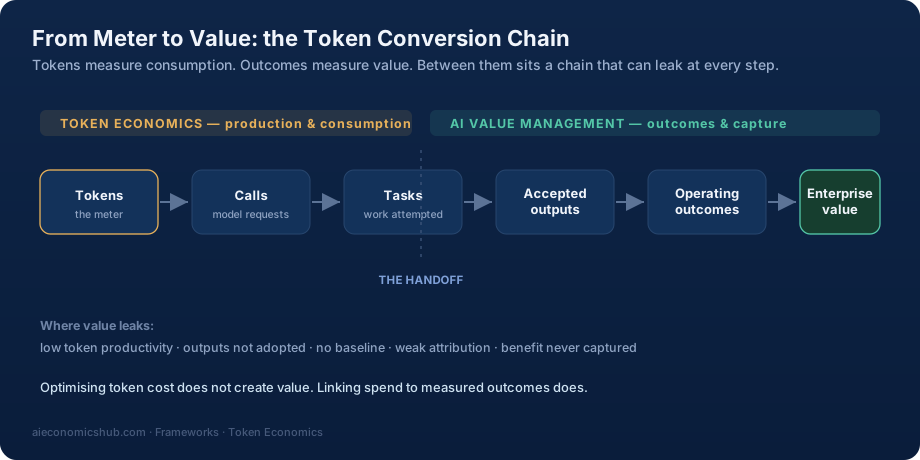
Organisations are spending real money on AI and cannot yet prove what it is worth. AI Value Attribution is the discipline of connecting every unit of AI work, every token, GPU-hour, licence, agent action and human-in-the-loop hour, to a team, a use case and a measured outcome, and governing the whole so value can be proved, defended and scaled responsibly. The spine is a chain, not a number: tokens lead to calls, calls to sessions, sessions to actions, actions to outcomes, outcomes to a business result. The unit of AI work is an input. The outcome is the point.
Tokens, calls, seats and agent actions are all units of input or activity. AI Value Attribution follows the conversion chain until it reaches a measured outcome and asks whether the enterprise captured it.
Three Principles
1. Maximise worthwhile outcomes, not usage
More tokens, more prompts, more agent actions do not automatically create more value. The goal is better outcomes, not higher consumption.
2. Optimise the whole conversion chain, not one cost meter
Reducing token cost while increasing review burden, rework or risk exposure is not optimisation. Value emerges from the full chain: production, consumption, quality, adoption, workflow integration and benefit capture.
3. Treat quality, risk, behaviour and human capability as economic variables
AI changes how people work, what they trust, what they learn and what risks they accept. Those effects have real economic consequences and belong in the value equation.
The Name
The discipline is AI Value Management: the term used throughout this site’s methodology, and the one that belongs in board papers and operating models.
An early version of this page used the informal word ‘valuemaxxing’, as the opposite of tokenmaxxing. It is retired: the method is AI value attribution, and nobody needs to adopt a slogan to use it.
Why Now
MIT NANDA study (2025)
KPMG (2025)
The distance between those numbers is the value gap
The clearest documented case of the alternative is Uber: internal leaderboards ranking AI tool usage, an annual budget consumed in four months, and a COO unable to connect the spend to shipped customer value. Usage-maximising culture, tokenmaxxing, optimises the meter, not the outcome. The full case file shows where that leads.
The Lead Metric
What share of your AI spend can you connect to a measured outcome?
That is attribution coverage, the lead metric of the discipline. The unattributed remainder is the value gap. One number to lead with, one gap to close, measured across the full cost of AI, not just the metered part.