

Claim labels
Material claims carry one of five labels so readers can weigh them.
- Evidence
- A sourced fact or on-the-record statement, traceable to a primary source.
- Reported finding
- A survey or research result, stated with its sample, population and caveats. Not independent proof of a universal claim.
- Interpretation
- The site's synthesis of evidence. Reasonable, but open to challenge.
- House position
- A stated view of the publication, dated and falsifiable where possible.
- Speculation
- A clearly labelled forward view, concentrated in The Frontier.
Source tiers
- Tier 1. Primary: the report, filing, regulator or vendor documentation itself.
- Tier 2. Reputable secondary: credible analysis or reporting that cites the primary source.
- Tier 3. Commentary: useful for context, never the sole source for a number.
Reading a claim on six dimensions
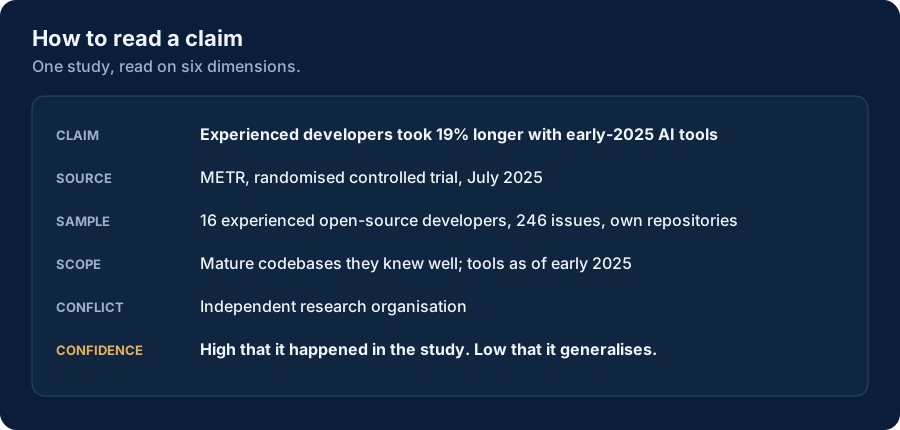
A source tier says how close a claim is to its origin. It does not say whether the claim applies to you. Material claims are read on six separate dimensions:
- Source proximity. Primary, secondary, or this site’s own analysis.
- Research design. Experiment, observational study, survey, forecast or anecdote.
- Applicability. How far the finding stretches beyond the people and setting studied.
- Freshness. Whether the tools, prices or market it describes still exist.
- Conflict. Independent, vendor, or linked to the author.
- Confidence. The editorial judgement that results from the other five.
A vendor’s price list is an excellent primary source for its own price. The same vendor’s survey is not strong evidence for a claim about the whole market. Both are primary sources; they differ on design, applicability and conflict.
When a claim is labelled Evidence
A claim is labelled Evidence only when it links to its source. Claims without a cited source are labelled Interpretation, even where we believe them to be true. Every statistic we rely on is listed with its source on the key numbers page.
Maintained and archived pieces
The library shows the date each piece was last reviewed against its sources. Pieces that have not been reviewed and are no longer maintained are moved to an archive. They stay online so links keep working, carry a banner, and are not indexed by search engines.
How statistics are verified
Each statistic is traced to a primary source and logged in an evidence register. A figure that can only be found in secondary sources is labelled as such or dropped. Survey figures travel with their sample and population. Vendor research is labelled as vendor research.
Dates and review cycles
Pages show Published always. Updated appears only when the substance changed. Last reviewed appears only when a review has been carried out and logged; it is never set automatically. Perishable pages, such as the vendor map, billing API references, cost ranges, and pricing and ownership statements, are reviewed on a 90 day cycle. Evidence-heavy flagship pages are reviewed at each quarterly evidence review.
Framework status and versions
Every model and tool on the frameworks page carries one of four labels, shown on the card and at the top of its page.
- Hub proposal. A model this site puts forward. It carries a version number. It stays below 1.0 while it is a proposal, and moves to 1.0 only when two conditions are met: at least one documented use outside this site, and a published response to the strongest challenge received. Until then, treat it as an argument to test, not a method to adopt.
- Adapted concept. An established idea applied to AI, such as the productivity J-curve or a maturity model. Its lineage is cited on the page.
- Reference explainer. A description of industry subject matter, such as token economics, written to be accurate rather than original.
- Tool. A calculator, worksheet, template or library.
Where a term comes from someone else’s work, such as the Tokenomics Foundation’s quality floor or its Observe, Net, Convert, Book chain, the source is named at first use on each page that uses it.
Corrections
Substantiated corrections are made on the page. Where a correction is material to the argument, the page says what changed and the change is logged on the corrections page. All changes are recorded in the changelog.
Use of AI tools
AI tools are used in research, drafting and production under editorial direction and review. Critique produced with AI assistance is a drafting aid. It is not evidence and does not represent expert consensus.
Licensing of third-party material
Material from sources published under open licences, such as CC BY 4.0, is paraphrased, attributed and linked rather than copied.
Author and disclosure
I'm Ed Epstein, an enterprise account executive at IBM in the Apptio portfolio (Apptio, Cloudability, Turbonomic), and I write and edit AI Economics Hub. IBM sells products in several areas this site covers, including FinOps, technology business management and AI value measurement, and is a member of industry bodies the site discusses, including the Tokenomics Foundation. This is an independent personal publication. The postings on this site are my own and don't necessarily represent IBM's positions, strategies or opinions. No IBM, client or partner confidential information is used. IBM-owned products are marked wherever they appear, and the vendor map describes products without rating them.