

The standards tell you what AI cost and what it produced. The hub's models sit above them and address what to decide next. The hub's models are proposals of an emerging discipline, not standards. Status and version are shown with the date they were read. Plans can move.
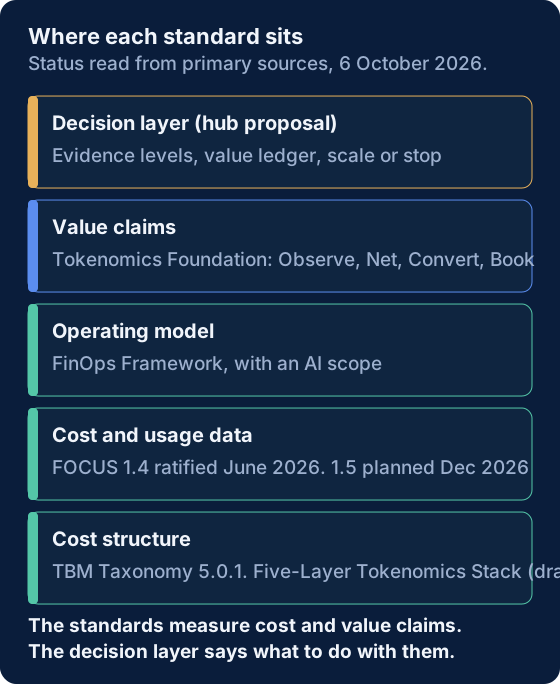
Cost and usage data
FOCUS (FinOps Open Cost and Usage Specification)
FinOps Foundation (Linux Foundation) · 1.4 ratified 4 June 2026. 1.5 (AI and token costs) planned for December 2026. (read 4 June 2026)
- Covers:
- A common data format for billing and usage across cloud, SaaS, data centre and other technology vendors, so cost data can be compared and combined.
- Does not cover:
- Value, outcomes or decisions. It describes what was billed and used, not what it produced.
- How it fits:
- Supplies the cost side of the AI TCO Framework and the cost inputs to a value ledger line.
TBM Taxonomy
TBM Council · 5.0.1 is the latest version listed by the TBM Council. (read 6 October 2026)
- Covers:
- A standard way to describe cost sources, technologies, IT resources, solutions and consumers, with a solution type for artificial intelligence in version 5.
- Does not cover:
- How to evidence the value of an AI initiative or decide whether to fund it.
- How it fits:
- The structure behind the hub's TBM and AI page. Download is for TBM Council members.
Five-Layer Tokenomics Stack
Tokenomics Foundation (Linux Foundation project) · Draft Paper, 4 August 2026. (read 4 August 2026)
- Covers:
- A layered account of AI cost: what AI costs is decided in the lower layers and how much AI spend is decided in the upper ones.
- Does not cover:
- Evidence thresholds for value claims or investment decisions.
- How it fits:
- Complements the seven-layer AI TCO Framework. Different cut of the same cost question.
Operating model
FinOps Framework
FinOps Foundation (Linux Foundation) · Current framework with scopes. Licensed CC BY 4.0. The Foundation's mission now refers to the value of technology. (read 19 February 2026)
- Covers:
- The operating model for FinOps: principles, personas, phases, maturity, domains and capabilities, organised by scopes that include AI, public cloud, SaaS, data platform, private cloud, licences and data centre.
- Does not cover:
- An AI-specific value measurement method or investment decision rules.
- How it fits:
- The operating discipline that the hub's FinOps and AI page applies to AI cost.
Value claims
Classifying and Measuring Realized Value from AI
Tokenomics Foundation (Linux Foundation project) · Release Candidate 2, last updated 16 September 2026. (read 16 September 2026)
- Covers:
- A method for classifying outcomes and producing a value claim through four steps: Observe, Net, Convert and Book, with a quality floor and a record of how each input was known.
- Does not cover:
- Return on investment, which also needs total cost of AI (stated as work in progress). It sets no standard threshold for how many estimation steps a claim may carry, and does not decide what to fund.
- How it fits:
- The AI Value Ledger records a claim built this way and adds an evidence level, a decision and a review date.
Evidence
State of Tokenomics
Tokenomics Foundation (Linux Foundation project) · Release Candidate 1.0, 23 September 2026. (read 23 September 2026)
- Covers:
- A survey of 472 responses across 11 industries on AI cost, proof of ROI, model routing, open weights and pricing.
- Does not cover:
- A representative sample: it is self-selected and 40% technology and software.
- How it fits:
- Independent survey evidence for the AI Value Gap.
AI Economics Hub proposals
AI Economics Maturity Model, AI TCO Framework, Value Management Layers
AI Economics Hub · Site pages, unversioned. (read 6 October 2026)
- Covers:
- Hub models for maturity, the full cost of AI, and the layers of value management.
- Does not cover:
- Industry standards. These are proposals of an emerging discipline.
- How it fits:
- Map onto the standards above as described on each page.
AI Abundance constructs: evidence levels, AI value ledger, decision rules
AI Economics Hub · Proposal, version 1.0, October 2026. (read 6 October 2026)
- Covers:
- Evidence levels E0 to E4, a ledger record ending in a decision, return on scarce capacity, and scale, hold, redesign or stop rules.
- Does not cover:
- Measurement of cost or usage, and a standard value method. They sit above those and use them.
- How it fits:
- The decision layer above the measurement standards.
Material from the Tokenomics Foundation and the FinOps Foundation is licensed under CC BY 4.0 and is paraphrased and attributed here. This map is reviewed quarterly.