

Key takeaways
- A hundred days is enough to go from no inventory to a first portfolio review and board paper, if each stage has one artefact and one decision.
- The sequence follows the four phases: measure, prove, decide, operate. Do not skip ahead. A board pack built on a thin register will not survive a challenge.
- It is a proposal and a plan, not a guarantee. Timings depend on how much data you can get and how much authority the owner has.
Who it is for
An AI value lead, a CAIO, a finance partner or a CIO starting the discipline, with an executive sponsor and no mandate to buy tooling. Month one is set out week by week below, because it is where most programmes stall.
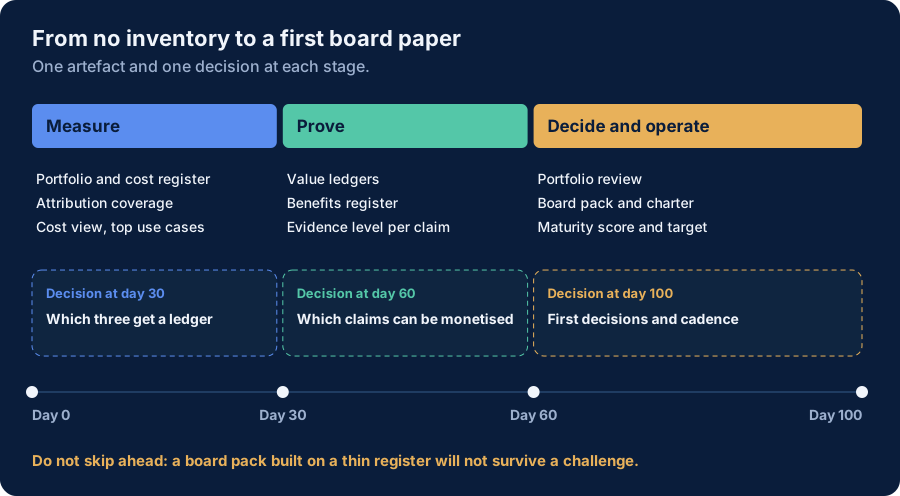
Days 1 to 30: measure
Artefacts: the portfolio and cost register, a first attribution coverage figure, and a cost view for the top use cases using the TCO worksheet.
What happens: name one accountable owner. Find the money across invoices, cloud accounts and expense lines. Map each item to a team and a use case, and record where no business case exists. Capture baselines for the three largest use cases before they age out of the systems that hold them.
Decision at day 30: which three initiatives deserve a full ledger, and which have no owner and need one or an end date.
Month one, week by week
Everything in month one is doable with finance extracts, vendor portals and a spreadsheet. No tooling purchase is needed.
Week 1: Find the money
Day 1-2. Name an owner. One person accountable for AI economics across the estate, with a mandate letter from the CFO or CIO. Not a committee. The rest of this playbook fails without this step, because every later action needs someone empowered to ask awkward questions across budget lines.
Day 2-5. Build the spend inventory. Every AI cost, in one register, in four categories:
- Direct consumption - API and token spend, by provider and team
- Licensed seats - copilots, coding assistants, AI tools with per-seat pricing
- Embedded tiers - AI components inside SaaS contracts (ask vendors for the AI-attributable share in writing; log refusals as "opaque")
- Infrastructure - GPU, hosting, model platform costs inside the cloud bill
Expect this to be harder than it sounds and revealing in itself: duplicate tools, departmental contracts finance has never categorised as AI, embedded tiers nobody chose. The total is your first published number. Most organisations have never seen it.
Real-world pattern: In 2026, Marc Benioff said Salesforce expected to spend about $300 million on Anthropic usage, largely for coding-related work.
Day 5. Pull the consumption telemetry. Provider dashboards, seat-activity reports, cloud cost tags. You are establishing what is measurable today, not building anything yet.
Week 2: Find the usage and the owners
Day 6-8. Map spend to teams and use cases. For each register line: who uses it, for what workflow, and who claimed it would deliver what. Where there was a business case, attach it. Where there wasn't, record "no business case" without ceremony - the gaps are findings, not accusations.
Day 8-10. Measure real adoption. Active users versus paid seats per tool. Repeat use, not log-ins. Flag every contract where adoption is under 40% of seats - renewal leverage later.
Adoption reality check: Microsoft reported continued growth in paid Microsoft 365 Copilot seats in early 2026, so the issue is not commercial collapse but value realisation. Independent evaluations, including the UK government trials, found self-reported time savings that did not translate into measured productivity. Seats are bought on potential and kept, or dropped, on measured reality.
Day 10. Identify the overlap. Tools answering the same job (general assistant ×2, coding assistant ×2, embedded copilot doing both). Don't consolidate yet; just establish the duplicate-spend number.
Week 3: Baselines and unit costs
Day 11-15. Capture baselines for the top three use cases by spend. Whatever pre-AI history exists - cycle times, tickets resolved per FTE, drafting turnaround - capture now, before it ages out of systems. For use cases already past rollout with no baseline, record that the productivity claim is untestable and decide whether a control-group comparison is still possible.
Without a pre-rollout baseline, "maybe implicitly there's more that is getting shipped" - the Uber COO's reported phrasing - becomes the strongest claim available. A company that measures almost everything about a ride still struggled to measure this because the value instrumentation was not designed in.
Day 15-18. Define one unit cost per major use case. Examples: cost per accepted code change; cost per resolved ticket (resolved, not deflected); cost per document processed, fully loaded with review time; cost per workflow completed for agentic processes. Imperfect definitions are fine; consistency matters more than precision in month one.
The hidden costs: At Uber, the visible invoice reportedly ran about $500-$2,000 per engineer per month. The hidden costs - review time of engineers checking agent-generated code, rework when agent-committed code needs correction, orchestration engineering, and the opportunity cost of attention shifting to prompt-wrangling - never appeared on the vendor invoice but belong in cost per unit of shipped work.
Day 18-20. Compute attribution coverage, version one. Classify every register line: outcome-linked (a measured result exists), activity-linked (usage data only), unattributed (neither). Publish the three percentages. This is the headline metric the whole discipline improves over time, and version one is allowed to be embarrassing.
Attribution coverage is the lead metric because it measures the organisation's ability to connect AI spend to measured outcomes, which is precisely what the AI value gap describes.
Week 4: Forecast, controls, and the first decisions
Day 21-24. Build the first consumption forecast. Monthly, by category, ninety days out, with stated assumptions about adoption and agentic intensity. Set variance triggers: at 15% over forecast, the owner investigates; at 30%, spend approval tightens automatically.
Agentic workflows multiply tokens per task - an agent iterating on a codebase resends growing context with every step, so the marginal task is more expensive than the average task. This is why static annual budgets fail: per-token prices may fall, but agentic systems consume so many more tokens per task that total spend rises anyway.
Day 24-26. Set guardrails where consumption is unbounded. Per-task and per-run budgets on any autonomous agent, with automatic halt. Per-user anomaly alerts on coding tools (investigate the top decile before capping it - your best users and your wasteful ones both live there).
A standing rule: no consumption-based leaderboards or usage targets, anywhere, ever.
The leaderboard trap: Uber reportedly ran internal leaderboards ranking AI coding tool usage competitively. Once usage is ranked, usage data stops telling you much about productivity, which is exactly the data the company then needed to justify the spend it had encouraged. Some share of consumption may have become performative, buying status rather than value. Uber has since dropped the leaderboards and moved to a fixed monthly token allowance per employee with a usage dashboard (Fortune, August 2026).
Day 26-28. Fix the procurement posture. Standard clauses from now on: AI-attributable price component stated in every SaaS contract; notice period for pricing-model changes (Cursor's June 2025 repricing is the cautionary precedent); usage data export rights; no auto-renewal of AI tiers with sub-40% adoption.
Day 28-30. Hold the first value review and publish the pack. One hour, CFO or delegate in the room. Contents: total AI spend and trend; adoption versus seats; duplicate-spend estimate; attribution coverage v1; top-three unit costs; forecast with triggers; three decisions (typically: one tool to consolidate, one use case to baseline properly, one contract to renegotiate).
Schedule it monthly. The pack is the discipline; the meeting is just where it becomes visible.
What you have at day 30: a named owner, a total spend number, an adoption-versus-paid map, baselines for the biggest use cases, three unit costs, attribution coverage version one, a forecast with tripwires, agent guardrails, procurement clauses and a monthly review with decision authority. Chargeback, tooling selection and portfolio reprioritisation come later, once the data can bear them.
Days 31 to 60: prove
Artefacts: an AI Value Ledger for each of the three initiatives, the benefits register, and the evidence level for each claim.
What happens: agree a quality floor and a measure for each initiative with its business owner. Rate the evidence honestly, on the E0 to E4 scale. Separate claimed from realised value, and record where each benefit is booked or that it is not. Use the investment decision memorandum for any new request that arrives in this window.
Decision at day 60: which claims may be monetised (E2 or above) and which need a proof plan. Which initiatives lack a baseline and cannot be proved without one.
Days 61 to 100: decide and operate
Artefacts: a first portfolio review, a first board pack, an AI Value Office charter, and a maturity assessment. Review the main suppliers with the supplier economics review.
What happens: run the portfolio review and make scale, hold, redesign or stop decisions on each material initiative, each with a funded next action and an owner. Write a stopped initiative review for anything that ends. Agree the monthly and quarterly cycle and the decision rights. Score the maturity assessment and set a target.
Decision at day 100: the first set of portfolio decisions, the first board paper, and whether the office and cadence are confirmed or adjusted.
What you should have at day 100
| Artefact | Owner |
|---|---|
| Portfolio and cost register | AI value lead |
| Ledgers for the top initiatives | Business owners |
| Benefits register | Finance partner |
| First portfolio review and decisions | Executive sponsor |
| First board pack | CFO or CIO |
| Charter and cadence | Executive sponsor |
| Maturity score and target | AI value lead |
What can go wrong
- No owner with authority. Every stage needs someone who can ask awkward questions across budget lines. Without one, the plan stalls at day 30.
- A register that is incomplete. Embedded and shadow AI will surface late. Treat the register as a living document.
- Scoring the claim, not the evidence. The temptation at day 60 is to accept the owner's estimate. The evidence level is the discipline.
- A month-one inventory that waits for completeness. Ship the 80% version in the first week; the register is a living document.
- A policing project. The owner's posture is economist, not auditor. Teams that fear the data will starve it.
- Measurement as the deliverable. Each review must make real decisions, or the organisation learns that AI value management produces packs rather than consequences.
- A board pack too early. If the register and ledgers are thin, say so. Report what is measured and what is not.
Status: Proposal, version 0.5. A proposed plan from this publication, not a standard. Change history: 0.5, 8 October 2026, first release; the same day, absorbed the week-by-week guide previously published as "The First 30 Days of AI Value Management".