

Key takeaways
- You cannot value, review or stop what you cannot list. The register comes first, and every other artefact refers to its IDs.
- The cost register uses the seven layers of the AI TCO Framework, so the model invoice is shown as one slice of the cost and not as the whole.
- It is a proposal, version 0.5, supplied as an Excel template.
The decision this helps make
What AI do we actually have, who owns it, and what does it fully cost? Most organisations can answer part of this from invoices. The register puts the whole answer in one place, so that the ledger, the portfolio review and the board pack all start from the same list.
Best for: the first month of an AI value programme, or a tidy-up before a first portfolio review. It is the artefact behind the "build the spend inventory" step in the first 100 days.
Not for: a configuration database, a model inventory for regulators, or a replacement for a TBM cost model. It records what is needed to manage economics.
The register
One row per initiative, tool or agent. The fields are:
- an ID that every other sheet and artefact reuses;
- the name, the function and a named business owner and technology owner;
- lifecycle status: idea, pilot, production, scaling or stopped;
- the supplier or platform, and the budget holder;
- risk tier, and autonomy level on the six-step autonomy ladder, from Recommend to Autonomous with monitoring;
- a next review date.
The workbook flags items with no cost row, items with no named business owner, and reviews past their date. An item with no owner is the commonest finding, and the most useful.
The cost register
One row per initiative, with the fully loaded annual cost in each of the seven layers: infrastructure and platform, data and context, models, integration and workflow redesign, people and capability, governance, safety and compliance, and operations and portfolio oversight. The workbook totals them, shows the model's share of the total and names the largest layer.
If you have used other cost lines, they map to the layers like this:
| Common cost line | Layer |
|---|---|
| Platform, infrastructure, packaged-tool licences | 1 Infrastructure and platform |
| Retrieval, data preparation, context | 2 Data and context |
| Model and API consumption | 3 Models |
| Engineering, integration, workflow redesign | 4 Integration and workflow redesign |
| Review and verification, training, adoption, change | 5 People and capability |
| Security, legal, assurance, governance | 6 Governance, safety and compliance |
| Supplier management, support, portfolio administration | 7 Operations and portfolio oversight |
Packaged-tool licences are the one judgement call. Put them in layer 1, unless the model is the product, in which case use layer 3. Pick one rule and keep it.
An illustrative register
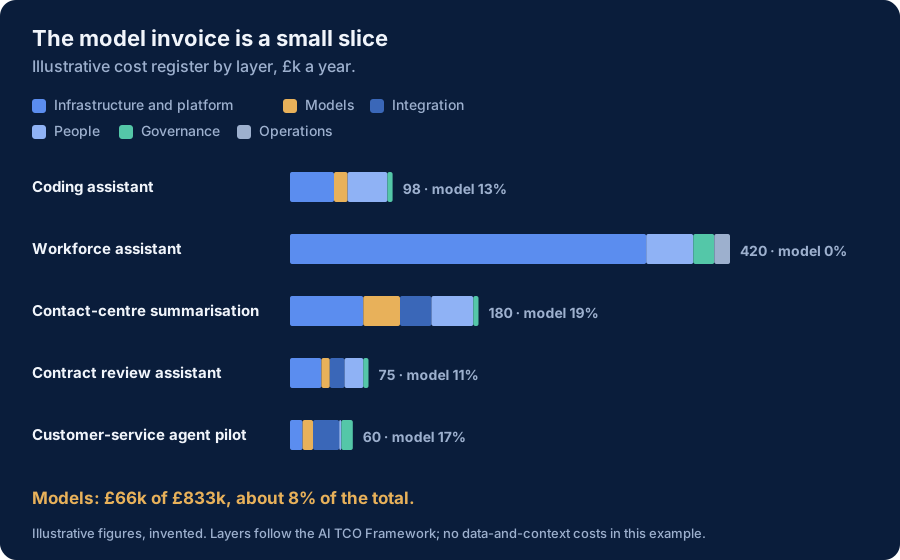
This example is hypothetical. Every figure and supplier is invented. It uses the same five initiatives as the portfolio review pack and the decision cases, so the costs reconcile. Money is in £ thousands a year.
| Initiative | L1 | L3 Models | L4 | L5 | L6 | L7 | Total | Model share |
|---|---|---|---|---|---|---|---|---|
| Coding assistant | 42 | 13 | 0 | 38 | 5 | 0 | 98 | 13% |
| Workforce assistant | 340 | 0 | 0 | 45 | 20 | 15 | 420 | 0% |
| Contact-centre summarisation | 70 | 35 | 30 | 40 | 5 | 0 | 180 | 19% |
| Contract review assistant | 30 | 8 | 14 | 18 | 5 | 0 | 75 | 11% |
| Customer-service agent pilot | 12 | 10 | 25 | 2 | 11 | 0 | 60 | 17% |
| Total | 66 | 833 | 8% |
In this invented portfolio the model is 8% of the cost, and people and platform are most of the rest. That is the point of the exercise, not a finding about real organisations: check your own. The pilot has no named business owner, which the workbook flags.
Using the workbook
The Excel workbook has a Register sheet, a Costs sheet linked by ID, a Summary sheet and the version sheet. Input cells are cream and formula cells are locked. Set the as-at date on the Summary sheet and replace the blue illustrative rows.
Limitations
- The register is only as complete as the discovery behind it. Shadow AI, embedded features in SaaS and personal subscriptions will be missed at first. Embedded AI and hidden tokens explains why.
- Shared cost needs an allocation basis. Agree it once and write it down.
- It records cost, not value. Use the ledger and the benefits register for that.
Status: Proposal, version 0.5. Hub proposals stay below 1.0 until they have survived outside challenge. Change history: 0.5, 8 October 2026, first release.
Download: AI portfolio and cost register, version 0.5, 8 October 2026 (.xlsx). Sample data is invented.