

Key takeaways
Why this matters
The hidden cost multiplier: At Uber, the visible API invoice for AI coding tools ran $500-$2,000 per engineer per month. The hidden costs - review time of engineers checking agent-generated code, rework when agent-committed code needs correction, orchestration engineering, opportunity cost of attention shifting to prompt-wrangling - never appeared on the Anthropic invoice but belong in cost per unit of shipped work.
The seven-sheet structure
Sheet 1: Use case header
| Field | Notes | |---|---| | Use case name and owner | One named person accountable for economics | | Workflow description | What the AI does, who consumes the output | | Stage | Pilot / scaling / production | | Business case reference | Link, or "none" recorded as a finding | | Baseline captured? | Y/N, date, where stored | | Unit of work | The denominator everything divides by: ticket resolved, change merged, document processed, workflow completed |
Sheet 2: Direct AI costs (monthly)
Model and API consumption:
- Input tokens, output tokens, blended £/unit by provider
Seat licences and SaaS tiers:
- Tool licences for this workflow
Training and hosting:
- Fine-tuning or training runs, amortised over expected life
- GPU, hosting, vector store, orchestration platform share
Sheet 3: The costs business cases forget
Human review and rework:
When review costs exceed model costs: Starbucks retired its inventory management AI agent after discovering the system's recommendations were being routinely overridden by store managers who understood local context the model missed. The agent consumed resources but delivered no measurable improvement over human judgement. The retirement decision came only after establishing baseline performance metrics and full-stack cost accounting, including the manager review time that exceeded the model API cost.
Quality gates and governance:
- Senior sign-off, compliance review steps that didn't exist pre-AI
- Security and compliance assessments (one-off and recurring)
Integration and enabling infrastructure:
Organisational costs:
- Change management and training
- Vendor management overhead (meaningful once tool count grows)
Failure-state consumption:
Sheet 4: Unit economics
Calculations:
- Fully loaded monthly cost (Sheets 2+3) ÷ units of work = fully loaded unit cost
- Same calculation with Sheet 2 only = naive unit cost
Comparators:
- Pre-AI unit cost from the baseline, or the human-only alternative at its full loaded cost
Sheet 5: Pilot-to-production bridge
For each assumption, pilot value → production value → reason it changes:
Volume and case mix:
Consumption patterns:
- Tokens per unit (retrieval depth, context growth, agentic intensity)
Edge cases and build costs:
- Edge-case share and cost
- One-off build costs not incurred in pilot
Output:
Sheet 6: Forecast and variance
Forecast structure:
- 12-month consumption forecast by line, with stated adoption and intensity assumptions
- Actual versus forecast, monthly, with variance triggers
Sensitivity analysis:
- Agentic intensity ×2
- Adoption ±20%
Sheet 7: Value side (paired, so the sheet never ships cost-only)
Value tracking:
- The measured outcome metric for this use case and its current value versus baseline
- Value realised versus business case, quarterly
Net position:
Worked example: Customer service AI agent
This example uses a customer service AI agent handling tier-1 support queries.
Use case header (Sheet 1)
- Use case: Customer service AI agent for tier-1 support
- Owner: Head of Customer Operations
- Workflow: Agent handles incoming support tickets, escalates complex cases to human agents
- Stage: Scaling (pilot complete, moving to full production)
- Baseline: Pre-AI resolution time 4.2 hours, cost per ticket £18.50
- Unit of work: Ticket resolved
Direct AI costs (Sheet 2) - Monthly
- Model consumption: 2.5M input tokens, 800K output tokens at £0.015/1K tokens = £49.50
- Agentic multiplier: 3.2× tokens per ticket versus interactive chat (agent retrieves context, checks knowledge base, formats response)
- Orchestration platform: £2,400/month (shared across 8 use cases, allocated 15% = £360)
- Vector database: £180/month
- Total Sheet 2: £589.50/month
Hidden costs (Sheet 3) - Monthly
- Human review: 12% of tickets reviewed, 8 minutes per review, 2,400 tickets/month × 12% × 8 min × £45/hour loaded rate = £1,728
- Rework: 4% of tickets require human correction, 15 minutes per correction = £270
- Quality gate: Weekly QA sampling, 4 hours/week × £55/hour = £880
- Integration build: £24,000 one-off, amortised over 24 months = £1,000/month
- Data preparation: Ongoing knowledge base curation, 20 hours/month × £50/hour = £1,000
- Monitoring and evaluation: £400/month
- Change management: Training and adoption support, 10 hours/month × £60/hour = £600
- Total Sheet 3: £5,878/month
Unit economics (Sheet 4)
- Volume: 2,400 tickets/month
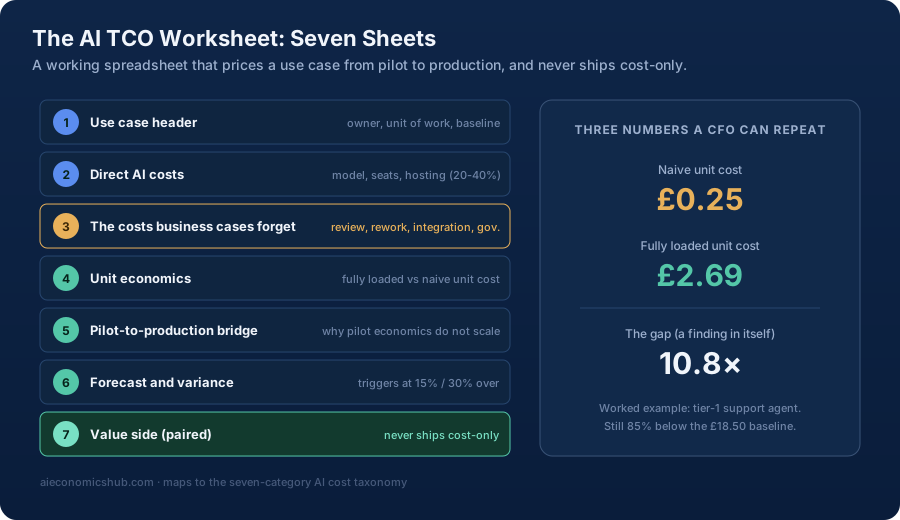
- Fully loaded unit cost: (£589.50 + £5,878) ÷ 2,400 = £2.69 per ticket
- Naive unit cost: £589.50 ÷ 2,400 = £0.25 per ticket
- Gap: 10.8× (the naive cost understates the true cost by a factor of 11)
- Pre-AI baseline: £18.50 per ticket
- Savings: £15.81 per ticket (85% reduction)
Pilot-to-production bridge (Sheet 5)
- Volume: Pilot 200 tickets/month → Production 2,400 tickets/month (12× increase)
- Case mix: Pilot handled curated easy cases → Production includes full case mix (hard 20% drives review rate from 5% to 12%)
- Review rate: Pilot 5% → Production 12% (quality gate requirement)
- Tokens per ticket: Pilot 2.1× → Production 3.2× (deeper context retrieval at scale)
- Production multiplier: Fully loaded unit cost increased 2.4× from pilot to production
Forecast and variance (Sheet 6)
- 12-month forecast: £77,616 (assumes 2,400 tickets/month steady state)
- Sensitivity: Vendor price +25% = £84,993; agentic intensity ×2 = £91,344
- Variance trigger: Investigate if monthly cost exceeds £7,100 (15% over forecast)
Value side (Sheet 7)
- Outcome metric: Customer satisfaction score (CSAT)
- Baseline CSAT: 3.8/5.0
- Current CSAT: 4.1/5.0 (8% improvement)
- Resolution time: 4.2 hours → 0.8 hours (81% improvement)
- Attribution: Outcome-linked (measured before/after with control group)
- Net position: £37,944/month value (£15.81 savings × 2,400 tickets) minus £6,468 cost = £31,476/month net value (high confidence)
Design rules for implementation
1. Label every input cell with provenance
2. Produce three numbers a CFO can repeat
- Fully loaded unit cost
- Naive-versus-loaded gap
- Attribution status
3. Ship with a worked example
Mapping to the AI TCO Framework
Seven-layer TCO mapping:
- Infrastructure → Sheet 2 (GPU, hosting, vector store, compute capacity)
- Data and context → Sheet 3 (data preparation, retrieval infrastructure, indexing)
- Models → Sheet 2 (model consumption, API calls, fine-tuning)
- Integration and workflow redesign → Sheet 3 (integration build, workflow changes, API work)
- People and capability → Sheet 3 (review time, rework, training, platform engineering)
- Governance, safety, and compliance → Sheet 3 (quality gates, security assessments, monitoring, compliance)
- Operations and portfolio oversight → Sheet 3 (monitoring, vendor management, portfolio review)
Lifecycle stage mapping:
- Prepare: Sheet 1 (baseline capture, unit of work definition)
- Build: Sheet 3 (integration build, data preparation, one-off costs)
- Run: Sheets 2, 3, 4, 6 (operating costs, unit economics, variance tracking)
- Scale/Retire: Sheet 5 (pilot-to-production bridge), Sheet 7 (value validation for continuation decisions)
- Govern (cross-cutting): Sheet 3 (governance costs), Sheet 7 (attribution and value evidence)
What to do next
For finance leaders:
For platform and engineering leaders:
For operating-model leaders:
References and further reading
FinOps Foundation, FinOps for AI: Scopes and Capabilities, 2025
Canonical guidance on AI cost management and value measurement
BCG, The Widening AI Value Gap: Build for the Future, 2025
Research on why AI value gaps persist and how to close them
AWS, Closing the AI Value Gap, 2024
Practical guidance on measuring and improving AI value realisation
AI TCO Framework
The seven-category framework this worksheet implements
Enterprise AI Cost Basics
Foundational primer on where enterprise AI costs accumulate