

Key takeaways
- Autonomy is a decision about authority. It should follow the impact of being wrong, how reversible the action is, and the evidence that the system performs.
- A newer model is not evidence. Proof from the workflow is.
- Pair each autonomy rung with a minimum evidence level, and let evidence, not enthusiasm, move work up the ladder.
- The pairing below is this publication's proposed default, version 0.5. It is a house position and will be revised as evidence arrives.
Authority follows consequence
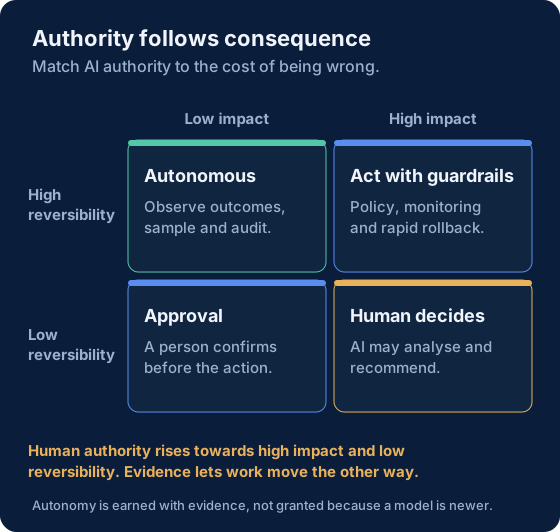
Do not govern all AI the same way. Match authority to the consequence of being wrong. Two questions do most of the work:
- Impact. How much does it matter if the output is wrong?
- Reversibility. How easily can the action be undone?
High-impact, hard-to-reverse decisions stay with people, with AI limited to analysis and recommendation. Low-impact, reversible work can run with guardrails or autonomously, with outcomes observed and sampled.
| Low impact | High impact | |
|---|---|---|
| High reversibility | Autonomous: observe outcomes, sample and audit | Act with guardrails: policy, monitoring and rapid rollback |
| Low reversibility | Approval: a person confirms before action | Human decides: AI may analyse and recommend |
The ladder
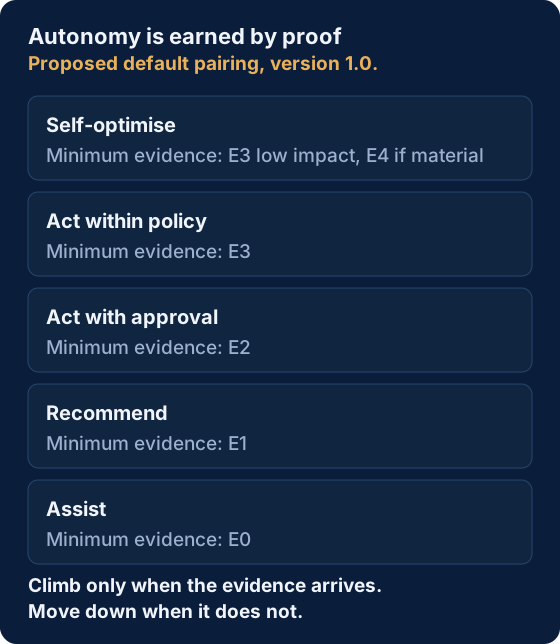
Autonomy matures in five rungs:
- Assist. A human creates and AI helps.
- Recommend. AI proposes and a human decides.
- Act with approval. AI prepares the action and a human confirms.
- Act within policy. AI acts within explicit bounds.
- Self-optimise. AI tunes routine decisions, with audit by exception.
Proposed pairing with evidence
Evidence levels E0 to E4 are defined in The AI Abundance Paradox. The pairing below is this publication's proposed default, a house position. It is a judgement about what proof each rung warrants, not an established standard, and organisations will reasonably set it differently.
| Rung | Minimum evidence to hold the rung | Notes |
|---|---|---|
| Assist | E0 | Exploration only. |
| Recommend | E1 | A before and after baseline for an early operational case. |
| Act with approval | E2 | Adjusted baseline or matched cohort, with the approver's detection rate tested. |
| Act within policy | E3 | Holdout or quasi-experiment, plus monitoring and rollback in place. |
| Self-optimise | E3 for low-impact work, E4 for anything material | Independent validation, audit by exception, and tested drift detection. |
Two rules sit on top of the table. First, the level is a gate: no monetised claim below E2. Second, reversible work under a materiality threshold can take a fast lane at E0 or E1 with a capped budget, a named owner and a review date, so low-risk experiments are not blocked.
Evidence has to keep arriving
Autonomy is not granted once. Drift, new models, price changes and risk events can all move the optimum. Treat each rung as a standing decision with a review date, and keep indicators that tell you review is slipping: queue age, review minutes per item, approval rates near 100 per cent, escaped defects and seeded-error detection.
Others are reaching the same rule
Gartner makes the governance version of this argument. It warns that applying the same governance to every AI agent fails in both directions, slowing simple agents and under-controlling autonomous ones, and recommends classifying agents by autonomy level, with controls that tighten as autonomy rises (Gartner, May 2026). BCG's survey data shows how far practice is behind intent: 42% of companies expect to grant agents genuine autonomy by 2030, while 5% have the full set of controls in place today (BCG Applied AI Index, 30 September 2026). This page applies the same principle to evidence: the proof required rises with the authority granted. For how this bears on measuring value by the share of work done without people, see Automation Share Is Not Value.
Where this meets maturity
In the maturity model, the move from Level 3 to Level 4 is the move from managing cost to setting proof thresholds. An autonomy ladder tied to evidence levels is one practical way to set those thresholds for agentic work.
What a CFO or CIO should do
- List the agents and automated workflows now acting, and place each on the ladder.
- Ask what evidence level supports its current rung.
- Move nothing up without evidence. Move anything with no evidence down.
Status: Proposal, version 0.5. The pairing in the table is a house position and a starting default.