

Beyond the Chatbot: The Six-Level Form-Factor Spectrum
Value, risk and difficulty all rise together as AI moves from chat window toward autonomous processes
Introduction
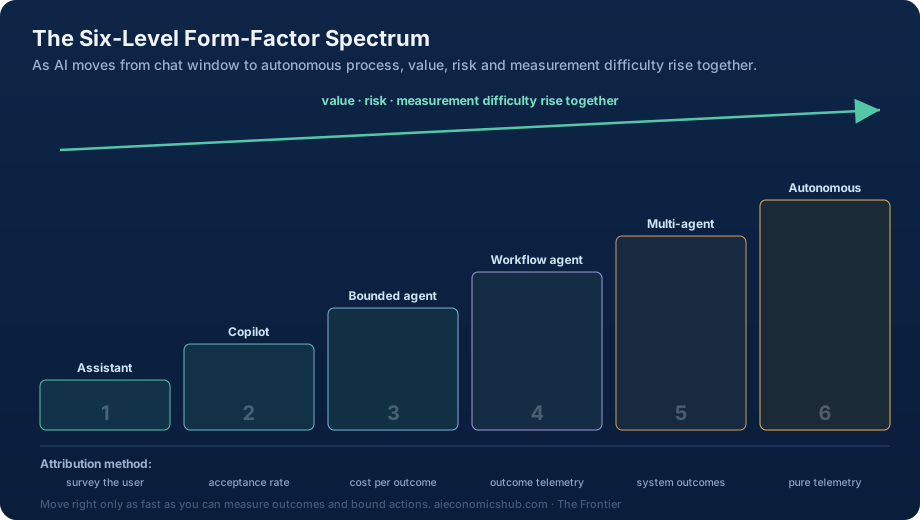
The value attribution methods that work for an assistant break as you move along the stack. This essay maps the six-level form-factor spectrum and explains why measurement must evolve with it.
The Six-Level Form-Factor Spectrum
Level 1: Assistant / Chatbot
Human asks, AI answers, human judges. The simplest form. Value attribution: survey the user. Did it help? How much time saved?
Level 2: Copilot
AI suggests, human accepts or rejects. Still interactive, but AI is more proactive. Value attribution: track acceptance rate, measure time to completion with and without copilot.
Level 3: Bounded Agent
AI acts within defined boundaries. Human sets the task, AI executes, human reviews outcome. Value attribution: cost per successful outcome. The cost hides inside the agent loop.
Level 4: Workflow Agent
AI orchestrates multi-step processes. Human defines the workflow, AI manages execution. Value attribution: outcome telemetry required. Cannot survey the user for every sub-action.
Level 5: Multi-Agent, Governed
Multiple AI agents coordinate. Human sets objectives and constraints. Value attribution: system-level outcomes, governance metrics, cost per successful workflow.
Level 6: Autonomous / Headless Process
AI runs without human in the loop. Scheduled, triggered, or continuous operation. Value attribution: pure outcome telemetry. No user to survey.
How Value Attribution Changes
Left side (assistant, copilot): Human productivity metrics. You can survey the user. Time saved, quality improved, satisfaction scores.
Middle (bounded agent, workflow agent): Task outcomes. Cost hides inside the agent loop. You need cost per successful outcome, not cost per token.
Right side (multi-agent, headless, autonomous): No human user to survey. Must use outcome telemetry. The system must instrument its own value.
Headless Example: AI in a Billing Application
Consider an AI agent that runs nightly, reviewing invoices for errors, flagging anomalies, and auto-correcting obvious mistakes.
No human sits at a keyboard. No one to survey. The value attribution must be built into the system:
- Errors caught (outcome)
- Corrections applied (outcome)
- False positives (risk)
- Processing cost (cost)
- Time to resolution (efficiency)
Interpretation This is outcome telemetry. The system reports its own value. If you do not build this in, the value is invisible.
How Risk Shifts
Chatbot worst case: Wrong answer that a human catches immediately.
As autonomy rises: Wrong action taken at scale before anyone notices. Evidence This is the pattern from previous automation waves: the risk moves from individual error to systemic failure.
Governance must be designed into the system. It cannot be added as an afterthought.
The Debate: Go Headless or Keep Humans in the Loop Longer?
The efficiency case for headless: Marginal cost approaches zero. Latency disappears. Scale is unlimited. The economic pressure is real.
The governance case for keeping humans in the loop longer: Accountability is clearer. Errors are caught earlier. The blast radius is smaller.
Synthesis: Interpretation Move right on the spectrum only as fast as your ability to measure outcomes and bound actions. Speed without measurement is recklessness.
Why This Matters Now
The stack is moving right whether measurement is ready or not. Evidence Agent frameworks are shipping. Workflow orchestration is maturing. Headless AI is already running in production at scale.
If value measurement does not keep up, the gap between AI deployed and AI governed widens. That gap is where the risk lives.