

Key takeaways
- The Tokenomics Foundation's first value measure is the share of work completed without human involvement, set against what the process costs today. It is easy to count and comparable across organisations, and it measures cost substitution well.
- On its own it measures removal, not value. Work that is completed without a person but fails the quality floor, creates downstream rework, or produces rare costly errors still counts as automated.
- Once it becomes a target, it rewards removing review steps that are controls. Review that moves downstream to a colleague or a customer looks like automation.
- This publication suggests reporting it with four companions: the quality-floor pass rate of automated work, the cost of downstream correction, the evidence level behind the comparison, and whether the freed capacity was released or redeployed.
What the Foundation proposes
On 4 August 2026 the Linux Foundation launched the Tokenomics Foundation to set open standards for the economics of AI. Its launch roadmap includes a value-measurement framework "for relating AI spend to outcomes, starting with the share of work completed without human involvement, measured against what the process costs today" (Linux Foundation).
This site welcomes the effort. The market needs shared definitions, and much of the Foundation's roadmap matches positions argued here: tokens as a unit of usage rather than of value, a reference model for the full cost of AI beyond the token line, and cost to serve expressed per call. The word "starting" also matters. A first measure is not meant to be the only one. What follows is offered as a comment on how that first measure should be read and what should sit beside it.
What automation share measures well
Automation share answers a clear question: of the work that flows through a process, how much now finishes without a person? Set against the current cost of the process, it gives a first estimate of cost substitution. It has real strengths:
- It is countable. Most workflow systems already record whether a case was touched by a person.
- It is comparable. Two organisations, or two vendors, can be compared on the same basis.
- It is grounded in an operating fact, not in a survey of perceived time saved.
For high-volume, well-defined work with a clear definition of done, such as routing, extraction or standard replies, it may be a good proxy for value. The difficulty is in everything else.
Four things it leaves out
1. Whether the automated work was good enough
A case completed without a person but below the quality floor is not completed work. It is deferred work: an escalation next week, a correction by another team, a customer who calls back or leaves. Automation share counts it as a success. The measure that matters is the share completed without a person and at the agreed quality.
2. The cost of errors that are rare but expensive
Most automated work may be fine while a small share produces errors that cost far more than the saving on the rest: a wrong payment, a breach of policy, a commitment made to a customer. Automation share is an average; the economics often sit in the tail. This is why this site argues that the evidence required should rise with autonomy, and why the impact and reversibility of an error belong in the measure.
3. Review that moved rather than disappeared
"Without human involvement" can be satisfied by moving the checking somewhere the metric does not look. Research on AI "workslop" found that about 40% of US desk workers had received AI-generated work in the past month that looked finished but was not, at close to two hours of rework each time (Axios on the Stanford and BetterUp study). When review shifts from the producer to a colleague, a manager or a customer, the process looks more automated and costs more. The cost of verification does not vanish when the review step is removed; it moves.
4. What happens to the capacity that is freed
Work done without a person frees capacity. That is potential value. It becomes realised value only when management releases the capacity, redeploys it to measured work, or books the saving. Gartner found that about 80% of organisations piloting or deploying autonomous business capabilities reported workforce reductions, but that reduction rates were almost the same among those reporting stronger returns and those seeing modest or negative ones. In its words, "workforce reductions may create budget room, but they do not create return" (Gartner, May 2026, reported by IT Brief). Automation share cannot tell the two groups apart.
Expectation is running well ahead of delivery. In Deloitte's survey of 66 chief financial officers of large UK companies, 52% expected AI to reduce headcount in their own business over the next 12 months and 48% expected it to lower operating costs, while 67% said their organisation was only around a quarter of the way to the transformation they expect from AI (Deloitte CFO Survey, 14 October 2026). In a separate US survey of finance leaders, 3% said they were cutting staff because of AI and 60% said they were redeploying them (Datarails, 6 October 2026, vendor research). The samples differ and one measures plans, the other actions, so the gap is indicative. It is the gap between freed capacity and a booked saving that this section describes.
The target problem
A measure that becomes a target changes behaviour. If automation share is what gets reported to a board, the quickest way to raise it is to remove review steps. Some review steps are waste. Others are controls: the check that stops a wrong payment, the sign-off that catches a misread contract. Automation share cannot distinguish the two, so a programme managed to it will remove both. The organisations hurt most will be the ones that hit their target.
This is the automation version of a problem the token market has just been through. Token leaderboards rewarded consumption, and several large employers dropped them once it was clear that more tokens did not mean more value. A target that rewards removing people risks the same error from the other side.
A worked example
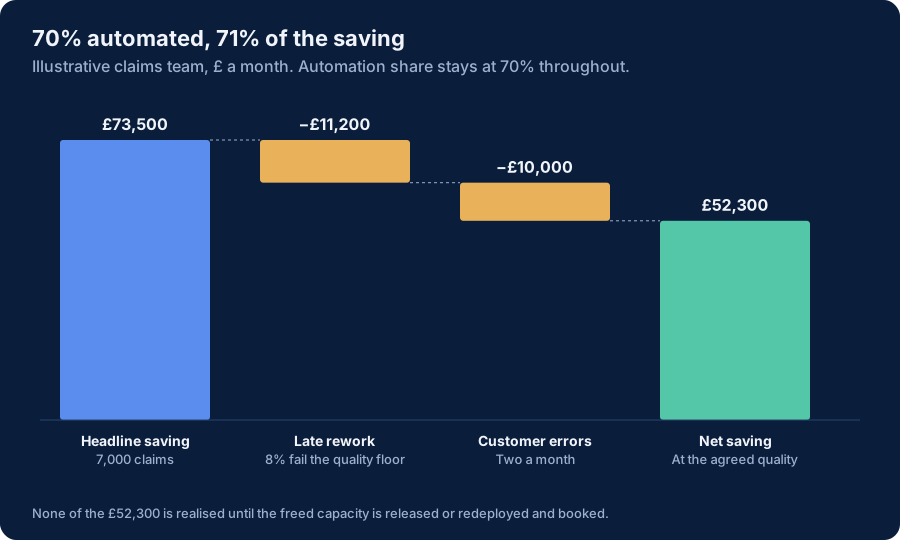
Illustrative figures, not survey data. A claims team handles 10,000 claims a month. The manual process costs £12 a claim. An AI workflow now completes 7,000 claims a month without a person, at £1.50 a claim. Automation share is 70%.
| Per month | |
|---|---|
| Headline saving: 7,000 claims at £12 less £1.50 | £73,500 |
| Less: 8% of automated claims fail the quality floor and are reworked later, at £20 each because they are found late | −£11,200 |
| Less: two errors a month reach customers, at about £5,000 each to put right | −£10,000 |
| Net saving at the agreed quality | £52,300 |
The automation share is still 70%. The value-adjusted figure is about 71% of the headline saving, and none of it is realised until the freed capacity is released or redeployed and the change is booked. Drop the quality floor and the headline improves while the net falls.
What to report alongside it
This site suggests four companions to automation share, each already used elsewhere on the site:
- Quality-floor pass rate of automated work, sampled and checked independently of the system that did the work.
- Downstream correction cost: escalations, rework and complaints traced back to automated cases, priced as in The Cost of Verification.
- Evidence level for the comparison with the current process: a before-and-after comparison is weaker than a holdout group (see the evidence levels in The AI Abundance Paradox).
- Capture status of the freed capacity: released, redeployed to measured work, or not yet captured, as recorded in the AI Benefits Register.
Together they turn a count of work done without people into a claim about value that a finance team could accept. They are offered as comments on the Foundation's value-measurement work, which is at an early stage and open to contribution.
Status: Proposal, version 0.1. A comment from this publication on an emerging standard, not a standard. Change history: 0.1, 8 October 2026, first release.