

Key takeaways
- When generation is cheap, the cost of checking the output can exceed the cost of making it.
- Verification cost is usually hidden inside "people" or "governance" lines, so the model bill looks better than the workflow.
- Make it explicit, measure it per workflow, and test whether the review is actually working.
- This essay proposes a way to show it without changing the seven TCO layers.
The hidden line
Take a workflow where an AI system drafts work and a person checks it. The model invoice is easy to find. The reviewer's time is not. It sits in a salary line, in a governance budget or in nobody's budget at all.
As models get cheaper and faster, the invoice shrinks relative to the work around it. The cost of establishing that an output is right, safe and compliant does not fall at the same rate, because it depends on people, risk and process.
The pattern is now documented outside this site. Research on AI "workslop" estimated close to two hours of rework for each piece of AI-generated work that looked finished but was not, and put the cost at about US$186 per affected employee per month (Axios on the Stanford and BetterUp study). Economists Catalini, Hui and Wu argue that AI cuts the cost of execution much faster than the cost of verifying it (arXiv, February 2026).
Finance teams now put a figure on it. In a survey of 270 US CFOs and finance leaders, respondents said their teams spend 26% of the working week verifying or correcting AI output, and 8% said more than half. Only 5% would trust AI to produce a board-ready report without human review (Datarails, 6 October 2026). This is vendor research with self-reported time estimates, so treat the level as indicative. The direction matches the argument here.
What verification includes
- Review. A person checks the work against the evidence.
- Triage. Deciding which items need which level of attention.
- Rework. Correcting or redoing outputs that fail.
- Escalation. Routing hard cases to a senior or independent reviewer.
- Assurance tooling. Evaluations, policy checks and tests that reduce the human load.
- Failure. Remediation when something escapes.
Where it sits in the seven layers
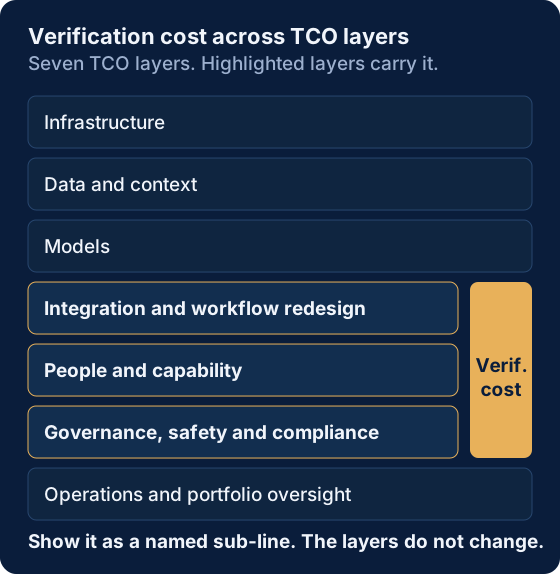
The AI TCO Framework has seven layers, from infrastructure to operations and portfolio oversight. Verification cost does not need an eighth. It spans three:
- Integration and workflow redesign, where review steps are designed in.
- People and capability, where reviewer time is spent.
- Governance, safety and compliance, where independent review and audit sit.
The proposal is to report it as a named sub-line across those layers: verification cost, shown in the TCO worksheet's Sheet 3 as its own subtotal. The layers stay as they are. Only the visibility changes. Whether it deserves a layer of its own is a fair question. We have kept it a sub-line so that existing users of the model are not disrupted.
Review is a control, so test it
Counting reviewer hours is not enough. A review step can look busy and catch little. Useful signals are review minutes per item, approval rates drifting towards 100 per cent, escaped defects, rework and the detection rate on seeded errors. A human in the loop is a control only if its detection rate is tested.
The cost of a review that does not work is the worst case: you pay for the review and still carry the risk.
Reduce it by design, not by removal
- Attach evidence before asking. Checks, sources, uncertainty and the decision needed.
- Review exceptions and samples. People look at failures, disagreements and a random sample of what passed.
- Prefer reversible work. Use monitoring and rollback instead of pre-approval where it is safe.
- Let queues age out. Unreviewed work expires rather than becoming permanent backlog.
- Tier by risk. Give Glance, Check or Scrutinise levels of attention rather than one standard.
What a CFO or CIO should do
- Ask for verification cost as a visible line in each AI business case.
- Ask for the test that shows review works, not only its volume.
- Add the cost to cost per verified outcome, not cost per token.
Status: Proposal, version 0.5. The only external figures are the workslop survey estimates in "The hidden line", cited to their source and labelled as survey estimates.