

Key takeaways
- A board needs one opening statement, a decision list and an honest account of evidence. Everything else is support.
- Report realised, avoided, released and estimated benefit separately. Merging them is the commonest way a pack overstates value.
- It is a proposal, version 0.5, supplied as a Word template.
The decision this helps make
Is the board, audit committee or executive team governing AI investment, or only hearing about AI activity? The pack gives a consistent structure for reporting cost, value, evidence, risk and the decisions needed, so the same questions are answered every period.
Best for: a CFO, CIO, CAIO or AI value lead preparing a quarterly paper for a board or committee.
Not for: a technical review of model performance, or a substitute for a company's statutory reporting.
The opening statement
Page one opens with a single paragraph. Everything after it explains or supports it.
The organisation has [number] material AI initiatives representing [amount] of annualised investment. [percentage]% is connected to a measured outcome at or above [evidence threshold]. Management recommends scaling [number], holding [number], redesigning [number] and stopping [number].
Completed with the invented portfolio in the portfolio review pack:
The organisation has 5 material AI initiatives representing £833k of annualised investment. 42% is connected to a measured outcome at or above evidence level E2. Management recommends scaling 1, holding 2, redesigning 1 and stopping 1.
That example is illustrative. Every figure is invented.
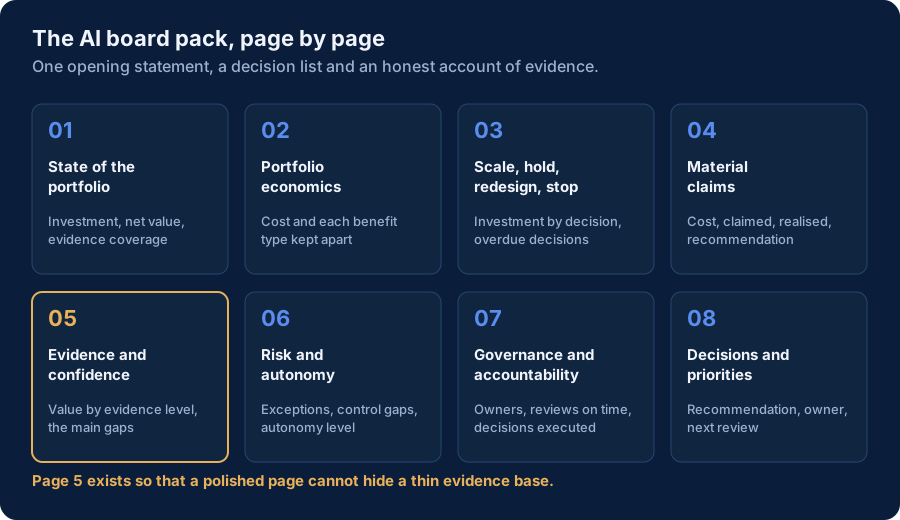
The eight pages
| Page | What it shows |
|---|---|
| 1. State of the AI portfolio | Annualised investment, measured net value, evidence coverage, material exceptions and decisions required. |
| 2. Portfolio economics | Cost lines and benefit lines kept separate: realised cost reduction, avoided cost, revenue or margin, risk loss avoided, released and absorbed capacity. |
| 3. Scale, hold, redesign or stop | Investment by decision, movement since last period, overdue decisions, capital and capacity released. |
| 4. Material investments and value claims | For the initiatives that matter most: cost, claimed value, realised value, evidence and recommendation. |
| 5. Evidence and confidence | Investment and value by evidence level E0 to E4, and the principal evidence gaps. |
| 6. Risk, control and autonomy | Material exceptions, control gaps, autonomy level, evaluation coverage, owner and due date. |
| 7. Governance and accountability | Named owners, current ledgers, reviews on time, controls current, decisions executed, supplier exit assessments. |
| 8. Decisions and priorities | For each decision: recommendation, timing, economic effect, evidence, risk, alternative, owner and next review. |
The one-page dashboard
For an executive team that will not read eight pages: annualised investment, measured net value, attribution coverage, forecast variance, investment by decision, evidence distribution, material exceptions, the top three decisions required, and one sentence of overall management judgement.
Audit committee supplement
An audit committee asks different questions. The supplement covers reporting integrity (how realised, avoided, released and estimated benefit are treated, and who validated them), controls and exceptions, third-party concentration and exit risk, and model and outcome monitoring.
Investment decision memorandum
For a new material request, seven headings: problem and intended outcome, economic baseline, full investment request, value claim with its evidence level, proof plan, exit criteria, and recommendation with the next gate. Write the exit criteria before the money is spent.
Board question bank
Economics
- What is the fully loaded cost?
- Which costs sit outside licences, tokens and cloud?
- What is realised, avoided, released or estimated?
- Which initiatives remain negative, and why?
Evidence
- What proportion of investment connects to measured outcomes?
- Which claims lack a baseline?
- Where are activity or self-reported productivity being used as proxies?
- Have quality, rework and verification been deducted?
Decisions
- What did we stop?
- What are we scaling, and why?
- What needs redesign rather than more funding?
- What capital or capacity has been released?
Risk and accountability
- Which systems can act?
- Does proof rise with autonomy and irreversibility?
- Who owns each outcome?
- Who validates material claims?
- Are decisions executed on time?
Limitations
- The pack reports what management has measured. It cannot make weak evidence strong, and a polished page can hide a thin evidence base. Page 5 exists to prevent that.
- Thresholds, such as what counts as material, are for each organisation to set. This publication does not propose figures.
- It is not a regulatory or statutory format. Check requirements that apply to you.
Status: Proposal, version 0.5. Hub proposals stay below 1.0 until they have survived outside challenge. A proposed operating artefact of this publication, not a standard. Change history: 0.5, 8 October 2026, first release.
Download: AI board reporting pack, version 0.5, 8 October 2026 (.docx). Square brackets mark text to replace.