

Key takeaways
- A decision memorandum asks for money against evidence and exit criteria, not against enthusiasm.
- Its two distinguishing sections are the proof plan, which says what the money will buy in evidence, and the exit criteria, which are written before the money is spent.
- It is a proposal, version 0.5, supplied as a Word template.
The decision this helps make
Should this material AI initiative be funded, and on what conditions? A short memorandum puts the problem, the baseline, the full cost, the value claim and the evidence behind it in one place for the person who approves the money.
Best for: a business owner asking for a material, recoverable or larger commitment. For small and reversible experiments, use a lighter record, as the lifecycle suggests.
Not for: a technical design document or a vendor selection paper.
The seven parts
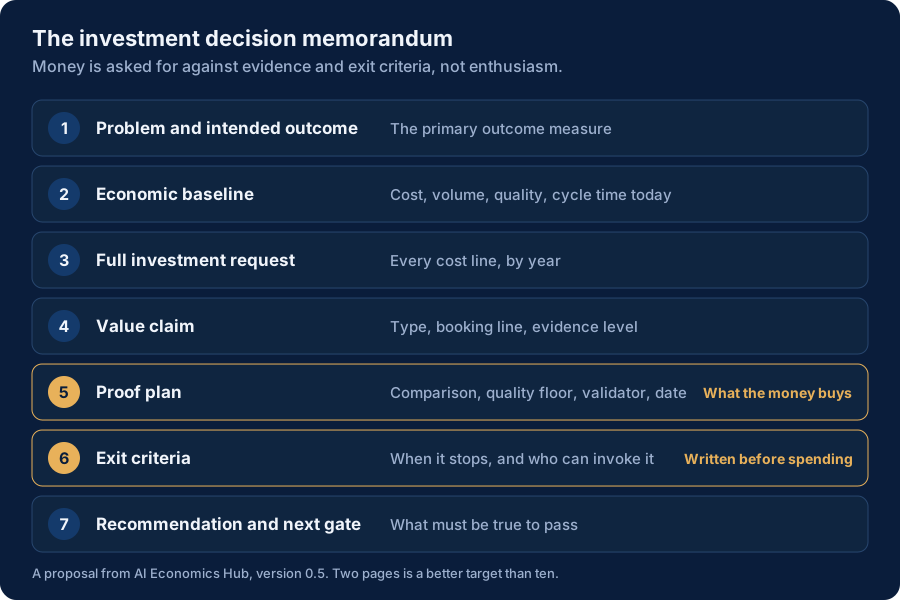
- Problem and intended outcome. What is being solved, for whom, and what operational change should result. State the primary outcome measure.
- Economic baseline. The current cost, volume, quality and cycle time of the workflow, and how they were measured. If there is no baseline, say how one will be built before money is committed.
- Full investment request. Every cost line, by year: model and consumption, platform, engineering, verification and review, governance, adoption and change, supplier, and shared-cost allocation. The AI TCO worksheet builds this.
- Value claim. Claimed annual value, the type of benefit, where it will be booked and the evidence level behind it. No monetised claim should rest on evidence below E2.
- Proof plan. The comparison to be run, the quality floor, the data source, who validates, the evidence level targeted and the date. If the claim is below E2, this section is what the money buys.
- Exit criteria. The conditions under which the initiative stops or is redesigned, who can invoke them and when the first check is.
- Recommendation and next gate. What is recommended, the alternative considered, and what must be true to pass the next gate.
The template adds a short block on risk tier, autonomy level, reversibility and required controls.
Matching proof to money
The proof a memorandum needs should rise with the size and reversibility of the commitment. This publication's default is in Scale, hold, redesign, stop: E2 for a material but recoverable commitment, and E3 or E4 for a large, hard-to-reverse or high-risk one. The threshold for "material" is for each organisation to set.
A short illustrative extract
This extract is invented, and describes no real organisation.
Value claim. £160k a year from first-pass contract review, booked as reduced outside-counsel spend. Current evidence is a two-quarter holdout comparison at E3. Proof plan. Keep a 10% audit sample and a small holdout, validated quarterly by internal audit. Exit criteria. The missed-deviation rate exceeds the 2.4% baseline for two consecutive quarters. Owner: General Counsel. First check: 31 March 2027.
The contract review case shows the full story behind this extract.
Limitations
- A memorandum is a claim, not evidence. Its value depends on someone challenging the baseline and the booking line.
- Long memoranda are rarely read. Two pages is a better target than ten.
- The template does not set approval thresholds or sign-off routes. Those belong to your own delegation of authority.
Status: Proposal, version 0.5. Hub proposals stay below 1.0 until they have survived outside challenge. A proposed operating artefact of this publication, not a standard. Change history: 0.5, 8 October 2026, first release.
Download: AI investment decision memorandum, version 0.5, 8 October 2026 (.docx). Square brackets mark text to replace.