

Key takeaways
- Every material AI workflow should end each review in one of four decisions: scale, hold, redesign or stop.
- Two tests decide it: return on the scarce capacity the workflow uses, and how strong the evidence is.
- The proof thresholds below are a proposed default. Organisations should set their own, and the materiality threshold is theirs to define.
The two tests
Return on scarce capacity is expected net value divided by the load on the binding constraint: review hours, change slots, risk capacity, compute or executive attention. It ranks work. It does not state a value.
Evidence level is how strongly the value is known, from E0 (anecdote) to E4 (controlled and independently validated). See The AI Abundance Paradox.
The four decisions
| Decision | When | What happens |
|---|---|---|
| Scale | High value, low load, and evidence at or above the level the commitment needs | Fund and extend. Keep measuring. |
| Hold | Promising but the evidence is below the level the commitment needs | Keep running at the current size. Name the evidence that would change the decision, and a date. |
| Redesign | High value, high load | Relieve the constraint first: automate checks, cut the load, change the workflow. Then decide again. |
| Stop | Low value, high load, or evidence that does not hold up | End it and release the capacity. Record why. |
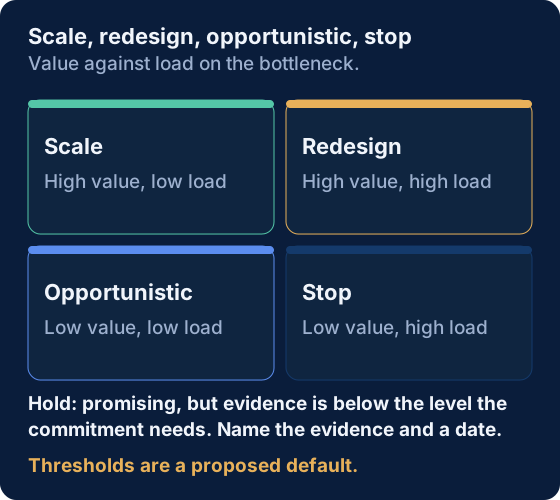
Low value, low load work is opportunistic. Let teams run it inside light guardrails and review it on a calendar.
Matching proof to money
The default below is this publication's proposed pairing. A stricter or lighter version suits organisations with a different risk appetite.
| Commitment | Proposed default | Stricter | Lighter |
|---|---|---|---|
| Small and reversible, under a materiality threshold | E0 or E1, with a cap, an owner and a review date | E1 | E0 |
| Material, recoverable | E2 | E3 | E1 |
| Large, hard to reverse or high risk | E3, with E4 for the highest-value claims | E4 | E2 |
Whatever is chosen, the rule that no monetised claim sits below E2 should hold.
Stop is a result, not a failure
Good governance does not only authorise investment. It moves resources away from weak investments. For every material initiative, ask what would cause it to stop. Write the stop rule before the money is spent, and name the owner who can invoke it.
A one-page version
For each workflow on one page: what it costs, what scarce capacity it uses, the outcome that should change, the evidence level and what it would take to raise it, the decision (scale, hold, redesign or stop), the owner and the review date.
Status: Proposal, version 0.5. Thresholds are a proposed default.