

Executive summary
A legal team gave its contract reviewers an assistant for first-pass review against the company's contract playbook. Over two quarters it ran a holdout comparison. The assistant cut first-pass time per contract from 3.0 to 1.75 hours without lowering the quality of review, and most of the saved time left the books as reduced outside-counsel spend. Fully loaded cost is £75k a year. Claimed value is £160k, realised value £120k, evidence level E3. Decision: scale, with a standing sample check and a written stop rule.
Situation and intended outcome
The team reviews about 2,000 inbound commercial contracts a year. Review capacity was the bottleneck, and overflow went to outside counsel. The intended outcome was a shorter first pass at the same quality, with the freed capacity used to cut outside-counsel overflow.
Economic baseline
| Measure | Before |
|---|---|
| Contracts reviewed a year | 2,000 |
| First-pass time per contract | 3.0 hours |
| Missed playbook deviations, in a 10% audit sample | 2.4% |
| Outside-counsel overflow | Paid per matter, tracked by the finance business partner |
AI investment and full cost
| Cost line | Annual (£k) |
|---|---|
| Licences and platform | 30 |
| Model consumption | 8 |
| Integration and engineering (amortised) | 14 |
| Legal verification and review of outputs | 15 |
| Governance and assurance | 5 |
| Change and training | 3 |
| Fully loaded cost | 75 |
The licence is the largest line but under half of the total. Verification, integration, governance and change make up the rest.
Consumption and workflow
The assistant reads an incoming contract, flags clauses that deviate from the playbook and drafts a first-pass note. A reviewer checks the note and the flagged clauses, then decides. Nothing is sent to a counterparty without a reviewer.
Outcome and quality floor
The quality floor was set before the trial: the missed-deviation rate in the audit sample must be no worse than the 2.4% baseline. During the trial it was 2.1%. First-pass time fell to 1.75 hours.
Evidence assessment
Contract types were split into two matched groups, one routed through the assistant and one not, for two quarters. This is a holdout comparison, which fits E3. It is not E4: nobody outside the legal and finance teams validated the result. The weaker points are that the groups were matched by hand and that a single reviewer pool handled both.
Net economic position
| Line | Calculation | Annual (£k) |
|---|---|---|
| Time released | 2,000 contracts × 1.25 hours = 2,500 hours at £64 | 160 |
| Claimed value | 160 | |
| Realised value (outside-counsel spend reduced, booked) | 120 | |
| Fully loaded cost | 75 | |
| Claimed net | 160 − 75 | +85 |
| Realised net | 120 − 75 | +45 |
Three-quarters of the claim, £120k of £160k, is booked. The remaining £40k of released time has not yet left the books and is not counted as realised.
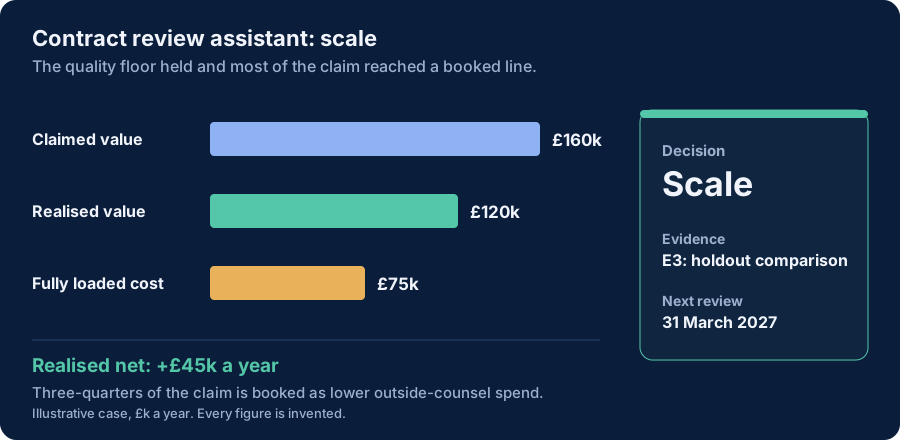
Decision: scale
Scale because the economics are positive on realised value alone, the quality floor held, and the evidence is at the level a material, recoverable commitment needs. The ledger entry:
| Field | Entry |
|---|---|
| Owner | General Counsel |
| Workflow | First-pass contract review against the playbook |
| Evidence level | E3: holdout comparison |
| Claimed / realised / cost (£k a year) | 160 / 120 / 75 |
| Decision | Scale to procurement and sales contracts of the same type |
| Conditions | Keep a 10% audit sample. Keep a small holdout so the comparison continues |
| Stop rule | Missed-deviation rate above the 2.4% baseline for two consecutive quarters |
| Review | 31 March 2027, or earlier if the stop rule is triggered |
Lessons, limitations and next review
- The decision depended on a quality floor that was agreed before the trial, not chosen afterwards.
- Realised value came from a specific booked line, outside-counsel spend, not from an hours estimate.
- E3 is not E4. If the scaled volume becomes a large commitment, independent validation would be the next step.
- A contract mix that changes, for example towards more bespoke terms, could erode the saving. The standing sample exists to catch that.
Status: Illustrative decision case, version 1.0, 8 October 2026.