

Executive summary
A company bought a general-purpose AI assistant for 2,000 employees. Adoption is strong: 65% use it weekly. A survey shows users believe they save time. But nothing else has changed that anyone can measure: no headcount, contractor, throughput or cycle-time figure has moved. Fully loaded cost is £420k a year. Claimed value is £300k, realised value is nil, evidence level is E1. Decision: hold, at the current licence count, while a matched-cohort comparison is run.
Situation and intended outcome
The rollout was driven by demand from staff and by a wish not to fall behind. The stated outcome was "productivity", with no single measure behind it and no named outcome owner below the COO.
Economic baseline
A before-and-after survey was taken: before rollout, and again six months in. There was no comparison group and no baseline for the output of any specific team.
AI investment and full cost
| Cost line | Annual (£k) |
|---|---|
| Licences (2,000 seats at £170) | 340 |
| Enablement and change | 45 |
| Security, legal and governance | 20 |
| Administration and support | 15 |
| Fully loaded cost | 420 |
Consumption and workflow
About 1,300 of the 2,000 licence holders use it in a typical week, and about 700 do not. Use is spread across drafting, summarising and search. There is no single workflow to measure, which is part of the problem.
Outcome and quality floor
No quality floor was set. Users report saving time. No one has measured whether work was done faster, better or in greater volume, or whether time spent checking AI output cancels the saving.
Evidence assessment
The evidence is E1 at best: a before-and-after survey of opinion, with no comparison and no output measure. Self-reported savings are a known weak proxy for realised value. Under this publication's rule that no monetised claim sits below E2, the £300k claim may be recorded but not counted.
Net economic position
| Line | Annual (£k) |
|---|---|
| Survey-implied value | about 400 |
| Claimed value after a 25% haircut by management | 300 |
| Realised value (booked) | 0 |
| Fully loaded cost | 420 |
| Claimed net | −120 |
| Realised net | −420 |
Even if every pound of the claim were accepted, the position is negative. The claim cannot be accepted at E1.
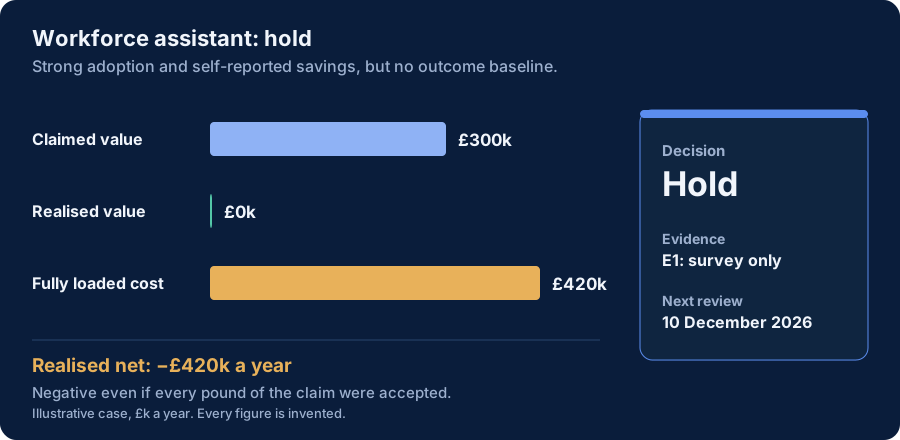
Decision: hold
Hold because the potential is plausible, usage is real, but the evidence is below the level a £420k commitment needs. Expanding would add cost without adding proof. Stopping would discard a tool that may be useful.
| Field | Entry |
|---|---|
| Owner | COO |
| Evidence level | E1: before-and-after survey |
| Claimed / realised / cost (£k a year) | 300 / 0 / 420 |
| Decision | Hold at the current licence count. No expansion |
| Evidence to gather | A matched-cohort comparison in three functions, using an output measure each function already tracks |
| By when | 10 December 2026 |
| Meanwhile | Reclaim licences unused for 60 days |
| If the evidence does not arrive | Redesign (a lower licence tier for light users) or stop |
Lessons, limitations and next review
- Adoption is activity, not value. A strong usage curve is a reason to measure, not a result.
- The missing piece was an outcome owner and a baseline for something other than opinion.
- The 700 inactive licences are a cost question that does not need the evidence trial to answer.
- The hold has a date and a named evidence plan. A hold without those is a drift.
Status: Illustrative decision case, version 1.0, 8 October 2026.