

Executive summary
A pilot of an autonomous customer-service agent was started after a vendor demonstration. Its sponsor then left in a reorganisation and nobody took it over. It has no baseline, no quality floor and no measured outcome. Fully loaded cost is £60k a year. Claimed value is £90k, a projection from the vendor's benchmark. Realised value is nil, evidence level E0. Decision: stop. The review that should have happened on 30 September is overdue.
Situation and intended outcome
The pilot was meant to resolve a share of customer chat contacts without a human. The stated aim was containment, but no target was agreed and no one was named to answer for it.
Economic baseline
None. Current resolution rate, cost per contact and customer satisfaction for chat were never recorded against the pilot's scope.
AI investment and full cost
| Cost line | Annual (£k) |
|---|---|
| Platform and model consumption | 22 |
| Engineering contractors | 25 |
| Security and legal review | 8 |
| Governance and assurance | 3 |
| Change and training | 2 |
| Fully loaded cost | 60 |
Consumption and workflow
The agent answers chat questions from a knowledge base and can issue limited account actions. During internal testing it quoted an outdated refund policy on several test conversations. No customer impact has been recorded, and the pilot's live volume is small.
Outcome and quality floor
No outcome was defined and no quality floor was set. Without either, it is not possible to say whether the agent is good enough to expand, or bad enough to end on its results alone.
Evidence assessment
E0. The only support for the £90k claim is the vendor's benchmark. It is an expert-style assertion about a different company's data. Under this publication's evidence rule, an agent should not act on its own without evidence that rises with its autonomy. Here the agent can take account actions with no evidence at all.
Net economic position
| Line | Annual (£k) |
|---|---|
| Claimed value (vendor-benchmark projection) | 90 |
| Realised value | 0 |
| Fully loaded cost | 60 |
| Claimed net | +30 (not monetisable below E2) |
| Realised net | −60 |
The apparent +£30k claimed net is a projection at E0 and cannot be counted.
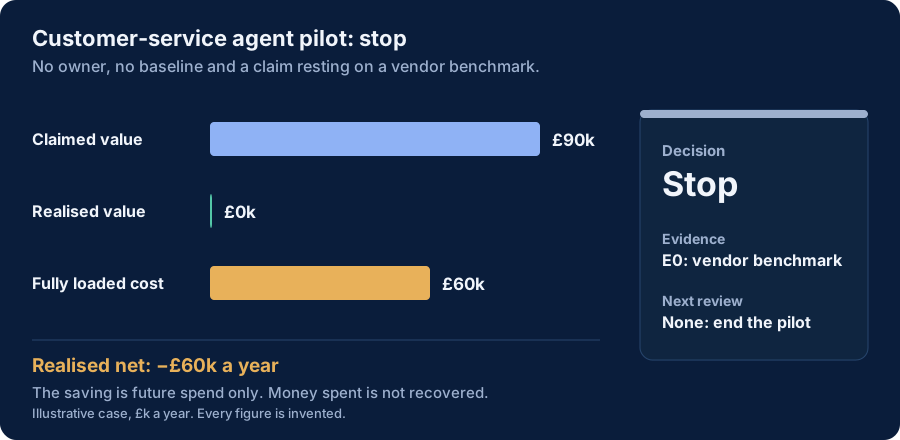
Decision: stop
Stop because no credible route to acceptable value and risk exists within the agreed period. There is no owner, no baseline and no outcome definition, and the agent can act on customer accounts. Restarting it properly would mean beginning again, with an owner, a baseline and a quality floor, not continuing.
| Field | Entry |
|---|---|
| Owner of the decision | CFO |
| Evidence level | E0: vendor benchmark |
| Claimed / realised / cost (£k a year) | 90 / 0 / 60 |
| Decision | Stop |
| Actions | Disable account actions now. End the pilot. Give notice on the platform renewal. Release the two contractors to other work |
| What is saved | Future spend only. Money already spent is not recovered and is not counted as a saving |
| What is kept | The cleaned knowledge base and the test conversations, which are reusable for any future attempt |
| Why it stopped | Recorded in an stopped initiative review: no owner, no baseline, no quality floor |
| Before any restart | A named outcome owner, a baseline, a quality floor, and an evidence plan that matches the autonomy requested |
Lessons, limitations and next review
- The stop rule was never written. Writing it before the money was spent would have forced the owner and baseline questions earlier.
- An orphaned initiative still costs money. The review date existed but nothing triggered it.
- Stopping released engineering capacity, which has a value beyond the £60k.
- Stopping this pilot is not a verdict on customer-service agents in general. It is a verdict on this pilot's lack of an owner and evidence.
Status: Illustrative decision case, version 1.0, 8 October 2026.