

Key takeaways
- Capability is necessary when choosing an AI supplier, but not sufficient. Four economic questions are worth asking of every material contract.
- Two numbers do most of the work: what the bill becomes if volume rises, and what it would cost to leave.
- It is a proposal, version 0.5, supplied as an Excel template and a twelve-term contract checklist.
The decision this helps make
Should we sign, renew or renegotiate this AI supplier contract, and on what terms? The review puts the economic and risk questions beside the capability assessment, before the commitment is made.
Best for: a procurement lead, finance partner or technology owner preparing a material AI contract or renewal.
Not for: a security or legal due-diligence review, or choosing between products on capability. Use this alongside them.
Four dimensions
1. Pricing risk. How variable is total cost as usage grows? What does the annual bill become at twice and five times today's volume? Is there a spend ceiling, a volume tier or a commitment structure available? Per-seat, consumption and committed pricing behave very differently here, which is why the workbook asks for the pricing model, the share of spend that rises with volume, any minimum commitment and any ceiling.
2. Lock-in depth. Four kinds are worth scoring separately, from 1 (easy to move) to 5 (very hard): model, platform, data and workflow. Then estimate what leaving would cost in five lines: integration rebuild, data migration, evaluation and prompt rework, a period of dual running, and other. Compare the total with a year of spend.
3. Consolidation exposure. What happens if the supplier is acquired, changes strategy or retires a model? Is there change-of-control protection, notice of model changes and a way to leave without penalty?
4. Governance fit. Do the supplier's data handling, audit rights, service levels and subprocessor terms meet your own obligations at the scale you intend to reach?
The twelve-term checklist
The workbook's Terms sheet lists twelve contract terms to look for and counts how many a contract has:
- Price protection at renewal.
- Volume tiers and a way to cap spend.
- Termination for convenience.
- Change-of-control rights.
- Data return and deletion.
- Notice of model retirement or material change.
- Audit rights.
- Service levels and credits.
- Subprocessor change notice.
- Usage reporting at the level you need to allocate cost.
- A scheduled price and benchmark review.
- Exit assistance.
A contract does not need all twelve. The checklist exists so that missing terms are a decision and not a surprise.
An illustrative review
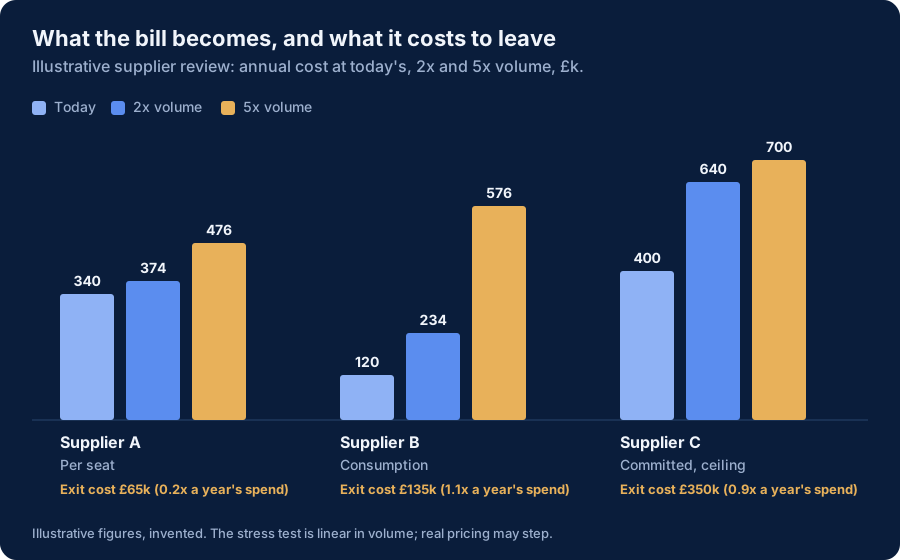
This example is hypothetical. The suppliers and every figure are invented. Money is in £ thousands.
| Supplier A | Supplier B | Supplier C | |
|---|---|---|---|
| Service and pricing | Packaged assistant, per seat | Model API, consumption | AI platform, committed spend |
| Annual spend | 340 | 120 | 400 |
| Annual cost at 2x volume | 374 | 234 | 640 |
| Annual cost at 5x volume | 476 | 576 | 700 (ceiling applies) |
| Average lock-in score | 2.5 | 2.8 | 4.3 |
| Estimated exit cost | 65 | 135 | 350 |
| Exit cost as a multiple of annual spend | 0.2 | 1.1 | 0.9 |
| Change-of-control protection | No | Partly | No |
What it shows: the per-seat contract barely moves with volume, the consumption contract more than quadruples at five times volume, and the committed platform is protected by a ceiling but is the hardest to leave. Only Supplier B's exit costs more than a year of spend. None of this says which supplier is better. It says what each choice commits you to.
Using the workbook
The Excel workbook has a Suppliers sheet (one row per contract), the Terms checklist, a Summary sheet and the version sheet. It rates nothing and applies no thresholds. Input cells are cream and formula cells are locked.
Limitations
- Exit cost estimates are judgement. Ask the engineers who would do the work, and revisit them each year.
- The stress test is linear in volume. Real pricing may have tiers, rate limits or step changes the sheet does not model.
- It does not value the benefit of staying. A supplier that is hard to leave may still be the right choice.
Status: Proposal, version 0.5. Hub proposals stay below 1.0 until they have survived outside challenge. Change history: 0.5, 8 October 2026, first release.
Download: AI supplier economics review, version 0.5, 8 October 2026 (.xlsx). Sample suppliers and data are invented.