

Key takeaways
- The AI Value Office is a small coordinating function, not a team that owns every AI decision. Business owners still own outcomes.
- Its job is to keep the record straight: portfolio, cost, evidence, review rhythm and reporting.
- It is a proposal, version 0.5, supplied as a Word template.
The decision this helps make
Who keeps the AI value system running once the first review has happened? Without an owner and a rhythm, ledgers go stale and reviews lapse. The charter writes down the mandate, scope, roles and decision rights so that does not depend on one enthusiast.
Best for: a CFO, CIO or CAIO setting up the function, or an existing FinOps, TBM or portfolio team taking on AI.
Not for: a large organisation that already has a working portfolio office and only needs AI added to its scope. Extend that instead.
Where it fits
The office sits alongside existing disciplines. FinOps contributes the practice of governing variable spend. TBM and ITFM contribute the cost model and the budget. SPM contributes the portfolio. The office connects them to evidence of outcomes. For the wider model, and a RACI for recurring decisions, see Who owns AI economics. The charter does not repeat that RACI.
Mission
Provide one decision-ready view of AI investment, and strengthen the organisation's ability to prove, improve and govern value.
Responsibilities
| Area | The office will |
|---|---|
| Portfolio | Maintain the inventory, lifecycle status and decision history. |
| Economics | Coordinate fully loaded cost views, value classification and forecast variance. |
| Evidence | Maintain the AI Value Ledger and the evidence standard. |
| Governance | Coordinate review cadence, exceptions, escalation and execution of decisions. |
| Reporting | Produce executive, board and audit views, such as the board reporting pack. |
Roles
Executive sponsor, AI value lead, finance partner, portfolio analyst, technology or AI platform lead, risk and assurance lead, and the business outcome owners. In a small organisation one person may hold several of these. The charter asks for a named holder and a time commitment for each, because an unnamed role is not a role.
Decision rights
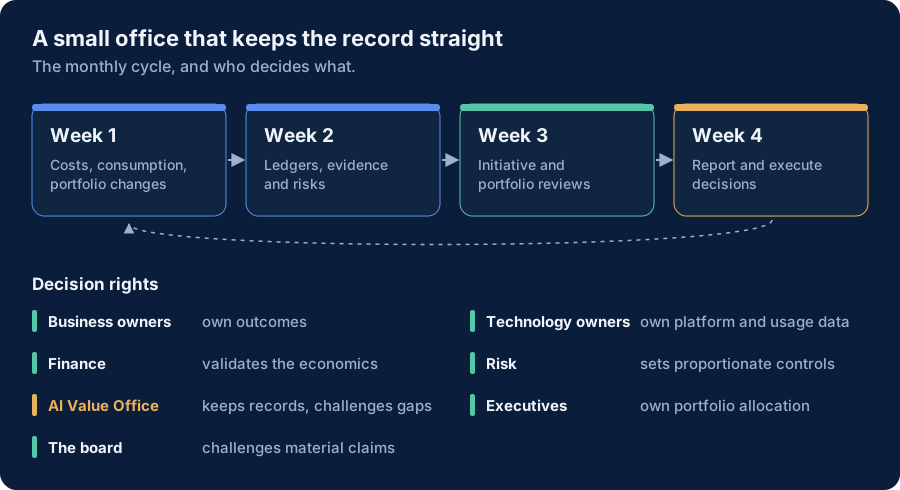
- Business owners own outcomes.
- Technology owners own platform operation and usage data.
- Finance validates the economic treatment.
- Risk defines proportionate control requirements.
- The AI Value Office maintains records and challenges gaps.
- Executive leadership owns portfolio allocation.
- The board challenges material claims and approves reserved decisions.
The office challenges and records. It does not make the allocation decision itself. That separation is deliberate.
Operating cadence
Monthly
- Week 1: update costs, consumption and portfolio changes.
- Week 2: update ledgers, evidence and risks.
- Week 3: run initiative and portfolio reviews, using the portfolio review pack.
- Week 4: issue management reporting and execute decisions.
Quarterly
- Full portfolio review and attribution review.
- Evidence progression.
- Board pack.
- Capital and capacity reallocation.
- Review of thresholds and methodology.
Measures of success
Share of material AI investment with a named owner, a baseline and an evidence level; share of spend at E2 or above; reviews and decisions on time; and capital and capacity released through stops and redesigns.
Limitations
- A new office can become a reporting layer that adds overhead without changing decisions. The test is whether stops and redesigns actually happen.
- The charter assumes an executive sponsor with authority over allocation. Without one, the office can only report.
- Time commitments depend on portfolio size. The template asks for them and does not propose figures.
Status: Proposal, version 0.5. Hub proposals stay below 1.0 until they have survived outside challenge. A proposed operating artefact of this publication, not a standard. Change history: 0.5, 8 October 2026, first release.
Download: AI Value Office charter, version 0.5, 8 October 2026 (.docx). Square brackets mark text to replace.