

The question "who owns AI economics?" usually gets one of three answers: FinOps, because it already owns cloud cost; a chief AI officer, because AI needs a single owner; or Finance, because it owns the money. Each answer creates a bottleneck. FinOps can see cost but cannot judge whether a contact-centre outcome is good. A central AI office becomes the place every business unit sends its unproven cases. Finance can book value but cannot tell a platform engineer which model to route to.
The more useful answer is that AI economics is already owned, in pieces, by people who hold different parts of the chain. The job of an operating model is to connect them, not to replace them.
The chain, and who holds each part
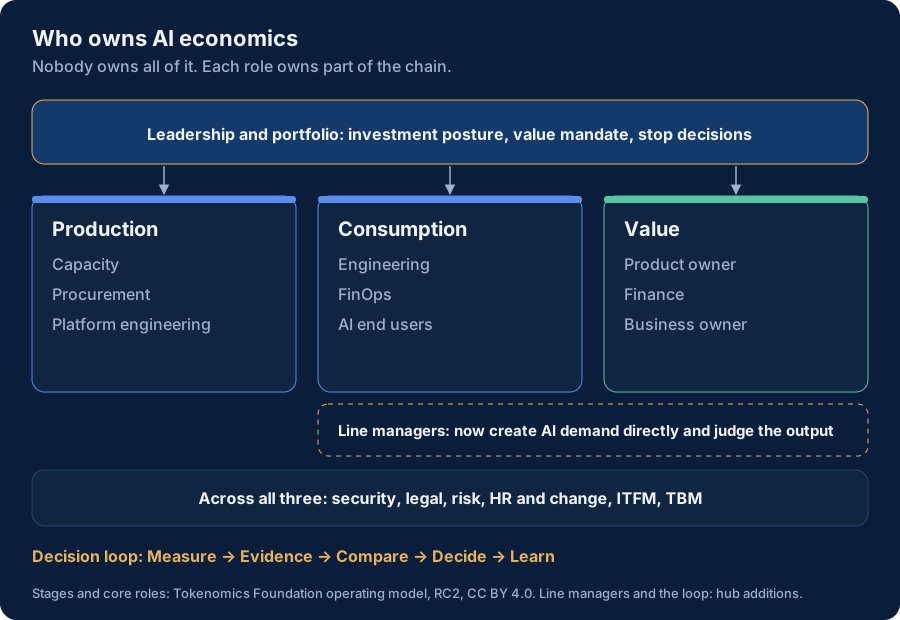
The Tokenomics Foundation's personas and operating model (Release Candidate 2, 4 September 2026, CC BY 4.0) organises AI economics into three stages and eight core roles: Engineering, FinOps practitioner, AI end user, Finance, Product, Procurement, Leadership and Capacity. The table groups those roles by the stage each is most involved in; the grouping is this site's reading, and several roles span stages.
| Stage | What it covers (Foundation description, paraphrased) | Roles most involved |
|---|---|---|
| Production | The supply side: energy, capital and the cost of running AI | Capacity, Procurement, Engineering, Leadership |
| Consumption | Delivering AI services: how much is used, by whom, where waste sits | Engineering, FinOps practitioner, AI end user |
| Value | Measuring the business value AI produces | Product, Finance, Leadership |
Two of those roles are absent from most cloud-era operating models. Capacity secures physical supply before anyone can consume it. The AI end user is treated as an economic actor, because users and the agents acting for them generate the demand.
Two additions
Line managers. As AI moves from centrally bought licences to usage-based assistants, agents and user-built workflows, the person who decides how much AI a team consumes is increasingly the team's manager. They choose the tools, approve the higher-capability tier, decide how much autonomous work is acceptable and whether the output can be absorbed. That makes them a practical control point that neither FinOps nor procurement can replace. See when every manager can create AI spend.
A decision loop. Roles that each own a stage still need a shared cadence in which cost and value meet: measure, assemble the evidence, compare workloads, decide, and check later whether the decision was right. Without that loop, each role optimises its own stage. FinOps cuts unit cost on a workload nobody should be running; product scales a feature whose verification cost nobody counted.
A proposed RACI
This is a starting point, not a standard. It is this site's proposal, informed by the Foundation's role definitions, and every organisation will move some letters. R is responsible for doing the work, A accountable for the outcome, C consulted, I informed.
Columns: Lead leadership and portfolio, Fin finance, Owner business or product owner, Plat platform engineering, FinOps, Proc procurement, Mgr line manager, Cap capacity.
| Decision | Lead | Fin | Owner | Plat | FinOps | Proc | Mgr | Cap |
|---|---|---|---|---|---|---|---|---|
| Capacity planning and commitments | A | C | I | C | C | R | I | R |
| Model and provider sourcing | I | C | C | R | C | A | I | C |
| Platform architecture | I | I | C | A/R | C | I | I | C |
| Model routing policy | I | I | C | A/R | C | I | C | I |
| Cost attribution to workloads | I | C | I | C | A/R | I | I | I |
| Budget envelopes | A | R | C | I | C | I | C | I |
| Spend anomaly response | I | I | C | R | A | I | R | I |
| Workload quality floor | I | I | A | C | I | I | R | I |
| Value measurement | I | C | A | C | C | I | R | I |
| Value booking | I | A/R | C | I | C | I | I | I |
| Agent autonomy level | C | I | A | R | I | I | C | I |
| Supplier renegotiation | I | C | C | C | C | A/R | I | C |
| Portfolio funding | A | R | C | I | C | I | I | I |
| Stop decisions | A | C | R | C | C | I | C | I |
Three patterns are worth noticing.
- Value is accountable to the business owner, not to IT or FinOps. The people who own the outcome own the claim. The CIO can orchestrate value without owning it.
- Line managers carry as many responsibilities as Finance. In licence-era AI they would have carried almost none. That is the shift.
- Stop decisions are accountable to leadership but proposed by the business owner. If stopping is only ever a leadership intervention, it happens too late.
Where the existing disciplines fit
The established disciplines do not disappear. They each run part of the chain.
| Discipline | Where it applies |
|---|---|
| FinOps | Consumption: cost visibility, allocation, unit cost, anomaly response, rate optimisation. |
| TBM | The cost model that places AI platforms and services inside total technology cost. |
| ITFM | Budgeting and forecasting for variable AI demand. See how to budget for AI. |
| SPM | Portfolio cadence, funding and stop decisions. |
| Security, legal, risk | Autonomy limits, error consequences, regulatory exposure. |
| HR and change | Adoption, role redesign, and the capacity that AI output has to be absorbed into. |
A minimum operating model for the first quarter
- Name a business owner for every material workload. Not a sponsor, an owner of the outcome.
- Give every workload an identity that cost data and outcome data can both carry. See the instrumentation blueprint.
- Agree the RACI for five rows first: cost attribution, budget envelopes, quality floor, value measurement and stop decisions.
- Hold one monthly review in which cost and value for the same workloads appear on the same page, and each ends with scale, hold, redesign or stop.
What would change this view
- If a single platform comes to own both consumption telemetry and outcome measurement end to end, a more centralised model becomes viable.
- If usage-based AI spend stays a small share of total AI spend, the line-manager role matters less than this piece argues.
- If the Tokenomics Foundation's operating model reaches a stable release with a RACI that differs from this one, readers should prefer theirs where they conflict.