

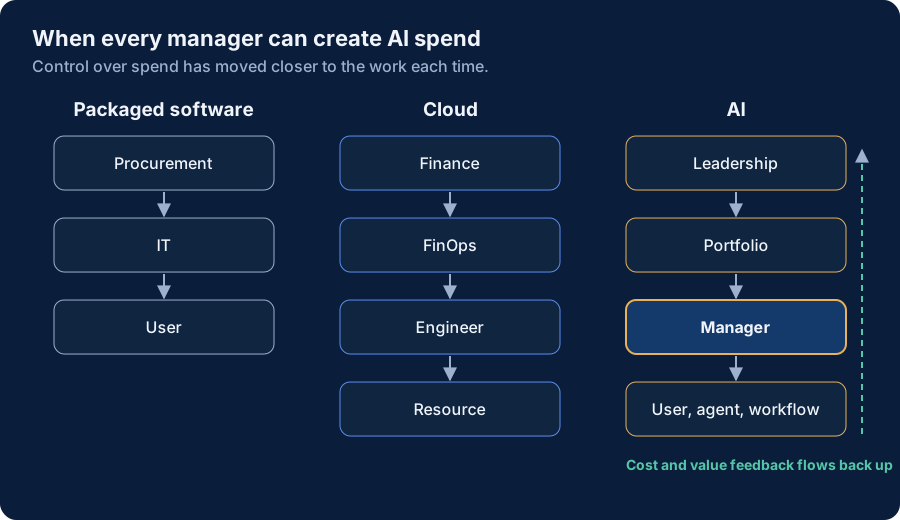
For most of the history of enterprise software, spend was committed in a small number of places. Procurement negotiated the contract, IT provisioned the seats, and users used what they were given. Cloud moved part of that control to engineers, who could create cost by launching a resource, and FinOps grew up to manage the consequences.
Usage-based AI moves control again, further from the centre. A manager can now raise their team's AI spend without signing anything, by:
- adding people to an assistant with usage-based pricing;
- encouraging heavier use, or setting targets for it;
- moving the team to a more capable model tier;
- building a workflow that calls a model at every step;
- letting an agent run on a schedule, or loop until it succeeds;
- approving generated code that itself calls AI services.
None of these needs a purchase order. Several of them can multiply cost within a month.
Vendors are making this the default. New Microsoft 365 Copilot Business licences bought through Microsoft's partner channel will have usage-based billing switched on from 1 December 2026, with a default limit of 4,000 credits per user per month that an admin can raise (Microsoft Partner Center, 1 October 2026). The spend ceiling is set when the licence is bought, not when a budget is approved.
Why central controls are not enough
Central teams still matter. Procurement sets the commercial terms, platform engineering sets routing and model policy, and FinOps allocates the cost. But none of them can answer the question that decides whether the spend is worth it: did this team's work get better, faster or cheaper in a way that matters?
The person best placed to answer that is the manager who owns the work. That is also the person now creating much of the demand. A control system that only asks "how much did the team spend?" will either clamp down on useful work or wave through waste. The better question is: which outcomes justified that spend, which work should get more capable models, and which should be constrained?
What managers need
A budget envelope, not a hard cap. An envelope set per team or workload, with thresholds that trigger a conversation rather than a shutdown. Hard caps on customer-facing work stop service at the worst moment.
Model tiers by workload. A short list of which capability tier is the default for which kind of work, with a simple route to justify a stronger one. Most work does not need the most capable model. See the economics of model selection.
Autonomy tiers. Clear limits on what an agent may do without a person approving it, tied to how reversible and costly its mistakes are. See proof for autonomy.
Local showback. Spend by workload, visible to the manager weekly, next to whatever outcome measure the team already uses. Showback before chargeback: the aim is a better decision, not a cross-charge.
Anomaly alerts that go to the manager. An agent stuck in a retry loop is first a team problem, and the manager is the person who can switch it off.
A short upward report. Once a month: spend by workload, the outcome measure, the evidence level, and a proposed decision. Aggregated, these become the portfolio view that leadership needs.
What the centre still owns
| Central role | What it keeps |
|---|---|
| Leadership and portfolio | The overall envelope, strategic priorities, stop decisions on large workloads |
| Procurement | Contracts, commitments, renegotiation |
| Platform engineering | The gateway, routing policy, model catalogue, security controls |
| FinOps | Allocation, anomaly detection, unit cost reporting |
| Finance | Booking value, reconciling the envelope to the budget |
The centre sets the rails. Managers decide how fast to go on them, and report what it bought.
A worked example
Illustrative. A 30-person finance operations team is given an envelope of £4,000 a month for AI.
- In month one it uses £1,800, mostly an assistant for drafting reconciliation notes.
- In month two a team lead builds a workflow that checks every invoice exception with a model and drafts a response. Spend rises to £6,200 and crosses the threshold.
- The threshold triggers a review, not a block. The manager shows that exceptions now close in two days instead of five, and that the team has absorbed a 20% rise in volume without overtime. The evidence is a before-and-after comparison.
- The decision: raise the envelope to £7,000, route the simpler exceptions to a smaller model to bring the unit cost down, and sample 50 exceptions a month to check quality.
Without the envelope, the same workflow would either have been invisible until the quarterly bill, or blocked by a hard cap in its second week.
Risks of pushing control down
- Fragmentation. Thirty teams building thirty versions of the same workflow. The platform team's catalogue and a shared library of workflows are the counterweight.
- Gaming. If envelopes are judged on spend alone, managers under-use useful AI. If they are judged on usage, they over-use it. Judge them on outcomes and evidence.
- Hidden spend. AI bought on expense cards or embedded in other tools escapes the envelope. The instrumentation blueprint covers how to bring it into view.
What would change this view
- If AI spend consolidates into a few enterprise-wide contracts with fixed pricing, managers create less spend and the case for local envelopes weakens.
- If agents become cheap enough per task that spend stops mattering at team level, the control question shifts from cost to risk and quality.
- This piece is an argument about direction. How much AI spend is already usage-based and team-controlled varies widely between organisations, and there is little good data on it yet.