

Operate
Who owns each part, how often is it reviewed, and what reaches the board?
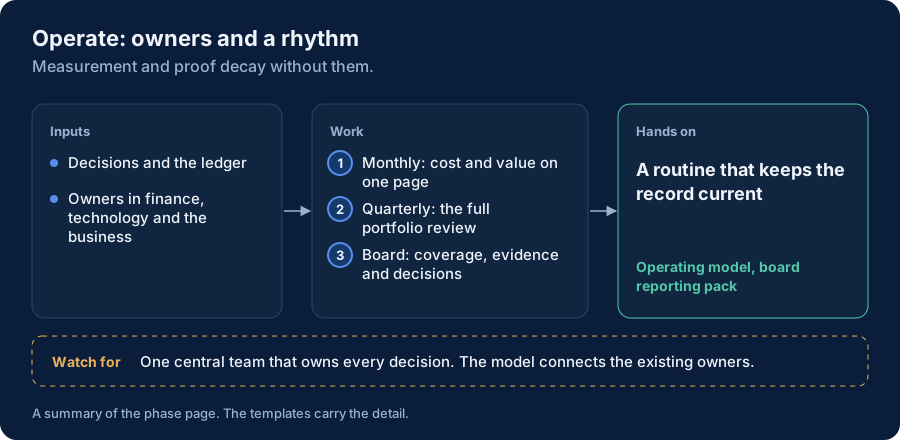
Measurement and proof decay without owners and a rhythm. Operate covers who is accountable for cost, consumption, value and portfolio decisions, how FinOps, TBM, ITFM and SPM contribute, and how results reach executives and the board. The model is federated: it connects the people who already own parts of the chain rather than creating one team that owns every decision.
Do this
Templates, guides and methods for this phase, in a sensible order.
Word template, v0.5
AI Board Reporting Pack
An eight-page board pack, one-page dashboard, audit committee supplement, decision memorandum and question bank.
Word template, v0.5
AI Value Office Charter
Mandate, scope, roles, decision rights and a monthly and quarterly cycle for the team that keeps the system running.
Excel template, v0.5
AI Economics Maturity Assessment
Score ten dimensions against the five maturity levels, answer twelve readiness questions and see the largest gaps to target.
Hub proposal, v0.1
The AI value lifecycle
Seven stages from funding to decision, each with an owner and a gate, and a separate path for bought AI.
Guide
Who Owns AI Economics? A Federated Operating Model for Cost, Value and Control
Nobody owns all of AI economics. A federated operating model that connects the roles already holding each part, with a RACI for fourteen recurring decisions.
Guide
How to Budget for AI When Unit Prices Fall and Total Spend Rises
A driver-based method for forecasting AI spend, splitting variance into price, volume, mix and agent-depth effects, and seven scenarios to run first.
Guide
What Boards and Audit Committees Should Actually Ask About AI
Board AI conversations are often too strategic or too tactical. What economic oversight needs: capital discipline, value proof and investment accountability.
Guide
The First 100 Days of AI Value Management
How to start AI value management: a week-by-week first month, then a plan to a first portfolio review, board pack and operating model in 100 days.
Related pages
Practical pages that sit alongside the templates.
Operating model
Operating model overview
Who owns which part of AI economics, and how the parts connect.
Operating model
ITFM and AI
Budgeting and forecasting for variable AI demand.
Operating model
SPM and AI
Portfolio sequencing, capital allocation and stop-or-scale decisions.
The thinking behind it
The models and evidence that explain why this phase works as it does, in the Understand section.
Hub proposal, v0.5
AI Value Management Layers
How the discipline stacks, from usage visibility to portfolio decisions.
Adapted concept
AI Economics Maturity Model
Five levels from fragmented spend to governed, provable value.
Essay
When Every Manager Can Create AI Spend
Usage-based AI moves control of technology spend from procurement and IT to line managers, teams and their agents. What that means for budgets and guardrails.
Essay
The CIO Can Orchestrate AI Value, but Cannot Own It
AI value needs a federated operating model. Technology leaders can orchestrate evidence and platforms, but business executives must own outcomes.
Essay
Proportionate AI Governance: Paying for Control Without Consuming the Portfolio
Under-governed AI is costly, and so is over-governed AI. How to size AI governance to each use's risk and autonomy, and spot governance that changes nothing.
Back to the start
Operating the system produces the cost and evidence for the next cycle.