

The model
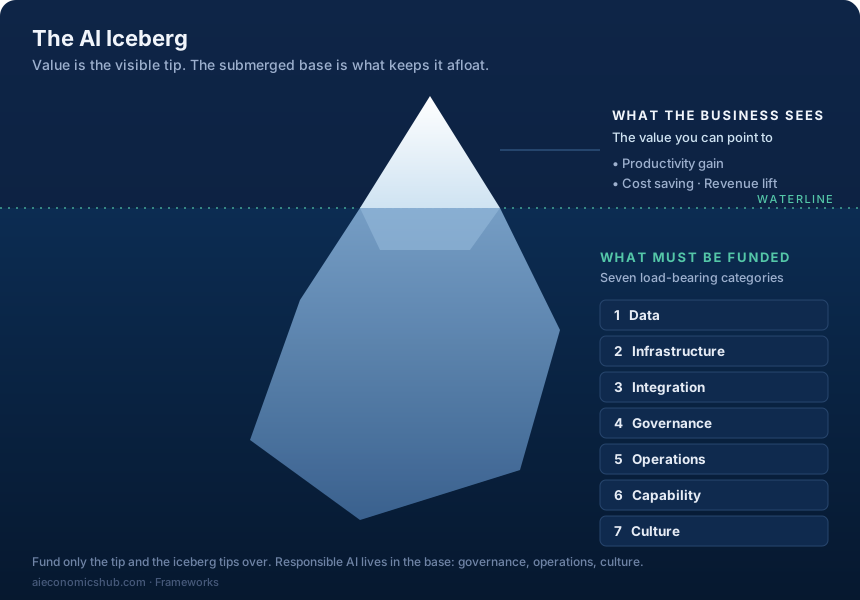
An iceberg floats because most of its mass sits below the waterline. The visible tip is what you see. The submerged base is what keeps it stable.
AI value works the same way. The value you can point to, the productivity gain, the cost saving, the revenue lift, that is the tip. It floats because of seven categories of work underneath: data, infrastructure, integration, governance, operations, capability and culture. Most AI programmes fund the tip and starve the base. Then they wonder why nothing scales.
The seven base components
- Data: pipelines, quality, lineage, access control, the work that makes AI input trustworthy
- Infrastructure: compute, storage, orchestration, the platform layer that runs the models
- Integration: APIs, workflows, system connections, the work that embeds AI into operations
- Governance: risk, compliance, audit, the controls that make AI defensible
- Operations: monitoring, incident response, cost management, the work that keeps AI running
- Capability: training, documentation, support, the work that makes AI usable
- Culture: change management, adoption support, the work that makes AI accepted
The tip is what the business sees. The base is what technology, risk, finance and operations have to fund. If you only fund the tip, the iceberg tips over.
Responsible AI positioning
Responsible AI is not a separate workstream. It is part of the base. Specifically, it sits in governance, operations and culture.
Governance covers risk assessment, bias testing, explainability requirements, the controls that make AI defensible in an audit or a regulator conversation. Operations covers monitoring for drift, incident response when a model misbehaves, the work that keeps AI safe in production. Culture covers training on ethical use, adoption support that respects human judgement, the work that makes AI trustworthy to the people who use it.
Many responsible AI programmes fail because they are positioned as a separate initiative, not as a necessary component of the base. When budget pressure arrives, they get cut first, because they are not seen as load-bearing. The iceberg model makes them load-bearing by design.
Trustworthy AI at scale
Trustworthy AI is what happens when the base is funded properly and responsible AI is embedded in it. It is not a certification or a badge. It is an operating state: AI that can be audited, explained, monitored and governed at the scale the business actually needs.
The test is simple: can you answer these questions without a special project?
- Which models are in production, and who owns them?
- What data are they trained on, and where did it come from?
- What decisions do they influence, and who is accountable?
- How do you know if they are drifting or misbehaving?
- What happens when they fail, and who responds?
- How do you prove they are compliant, and to whom?
If you can answer those questions from your normal operating systems, you have trustworthy AI at scale. If you need a special project to answer them, you have a base problem.
Two ways to sink
Value without base
This is the common failure mode. A team builds a high-value use case, proves ROI, gets executive attention. Then they try to scale it. The data pipelines break. The infrastructure cannot handle the load. The integration work was never scoped. Governance blocks it because risk was never assessed. Operations cannot support it. Users do not trust it. The value case was real, but the base was not there to hold it up.
The iceberg tips over. The programme stalls. The business loses confidence. The next AI proposal gets harder to fund.
Base without value
This is the rarer failure mode, but it happens. A team builds a beautiful platform: data pipelines, governance frameworks, monitoring dashboards, training programmes. Everything is production-ready. But no one builds anything valuable on it. The base is there, but the tip never forms.
The iceberg never floats. The platform becomes a cost centre. The business asks why they funded it. The programme gets cut.
The right sequence is: prove value small, fund the base, scale value on the base. Most programmes try to scale value before funding the base. Some fund the base before proving value. Both fail.
The third way: the iceberg that never forms
There is a third failure mode that does not fit the iceberg model: the AI programme that never gets past pilots. No value tip forms. No base gets funded. Just a queue of experiments that never ship.
This is not an iceberg problem. This is a portfolio governance problem. The iceberg model assumes you have something worth scaling. If you do not, the model does not help you. You need a different framework: the distinction ladder, the J-curve, or the five levels maturity model.
Worked example: financial services
A retail bank builds an AI-powered fraud detection model. It works. It catches fraud the old rules missed. The value case is clear: £12m in prevented losses in the first year. The business wants to scale it to all transaction types.
The team tries to scale. The data pipelines cannot handle the volume. The infrastructure was sized for a pilot. The integration work was never scoped: the model needs to connect to six different transaction systems, and each one has different data formats. Governance blocks it because the model was never assessed for bias, and the regulator is asking questions. Operations cannot support it because there is no monitoring for model drift. Users do not trust it because they were never trained on how it works.
The value tip was real. The base was not there. The iceberg tipped over.
The fix: fund the base. Build the data pipelines. Size the infrastructure. Scope the integration work. Assess the model for bias. Build the monitoring. Train the users. Then scale the value. The base costs £4m. The value case is still £12m. The ROI is still positive. But now it scales.
Argue both sides
For the model
The iceberg model is useful because it names the work that gets forgotten. Most AI business cases only cost the tip: the model, the inference, the direct labour saving. They do not cost the base: the data work, the infrastructure, the integration, the governance, the operations, the capability, the culture. Then they wonder why the ROI does not materialise. The iceberg model forces you to cost the base before you scale the tip.
It also positions responsible AI correctly: not as a separate initiative, but as a necessary component of the base. This makes it harder to cut when budget pressure arrives.
Against the model
The iceberg model is a metaphor, not a methodology. It does not tell you how to size the base, or how to sequence the work, or how to govern the trade-offs. It just tells you the base exists and you need to fund it. That is useful, but it is not sufficient.
It also assumes the value tip is real and measurable. If the value case is weak, funding the base does not fix it. You just end up with an expensive platform that no one uses. The iceberg model does not help you judge whether the value case is worth funding in the first place.
Finally, the seven-category base is arbitrary. Different organisations will need different categories, or different weightings. The model is a starting point, not a prescription.
Related reading