

The shape and why it happens
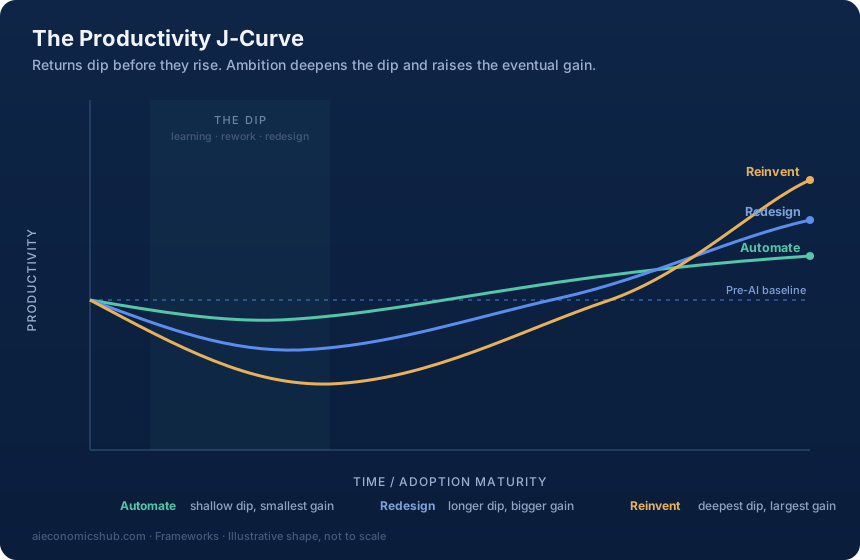
The J-curve is a pattern: productivity falls before it rises. You invest in AI. Productivity drops. People are learning the tool, reorganising workflows, debugging integrations, managing exceptions. The work is slower, not faster. Then, after some time, productivity recovers. Then it rises above the baseline. The curve looks like a J: down, flat, up.
Erik Brynjolfsson and colleagues at MIT documented this pattern in their research on AI and productivity. The dip is real, measurable, and predictable. It is not a sign of failure. It is a sign of learning.
The dip happens because AI changes how work is done, not just how fast it is done. People need to learn new tools. Processes need to be redesigned. Systems need to be integrated. Exceptions need to be handled. All of that takes time, and during that time, productivity is lower than it was before.
The dip is deeper and longer when:
- The AI requires significant process redesign
- The workforce has low digital literacy
- The integration work is complex
- The change management is weak
- The organisation is risk-averse and moves slowly
The dip is shorter and shallower when:
- The AI automates a well-defined task
- The workforce is digitally fluent
- The integration work is minimal
- The change management is strong
- The organisation is comfortable with iteration
The electrification precedent
The J-curve is not new. It happened with electrification. Factories installed electric motors in the early 1900s. Productivity did not rise immediately. It fell. Why? Because the factories were still organised around steam power: centralised shafts, belt drives, fixed layouts. Electric motors were just replacing steam engines in the same old system.
Productivity only rose when factories reorganised around electricity: decentralised motors, flexible layouts, unit drive. That took decades. The dip lasted 20-30 years. The eventual productivity gain was enormous, but it required redesign, not just replacement.
AI is following the same pattern. Organisations that just replace human tasks with AI tasks are in the dip. Organisations that redesign workflows around AI are climbing out of it. Organisations that reinvent their operating model around AI are on the upward slope.
Three responses: automate, redesign, reinvent
There are three ways to respond to the J-curve, and they correspond to three levels of ambition:
Automate
Replace a human task with an AI task. Keep the process the same. This is the fastest path out of the dip, but it delivers the smallest gain. You get efficiency, not transformation.
Example: Use AI to summarise meeting notes instead of having a human do it. The meeting structure does not change. The note-taking process does not change. You just save time on summarisation.
Redesign
Change the process to take advantage of what AI can do. This takes longer and requires more change management, but it delivers a bigger gain. You get new capability, not just efficiency.
Example: Use AI to generate meeting agendas based on previous decisions and outstanding actions. The meeting structure changes. The preparation process changes. You get better meetings, not just faster notes.
Reinvent
Rethink the operating model around what AI makes possible. This takes the longest and requires the most organisational change, but it delivers the largest gain. You get strategic advantage, not just new capability.
Example: Use AI to eliminate most meetings by maintaining a continuous shared context that everyone can query. The meeting structure disappears. The collaboration model changes. You get a different way of working, not just better meetings.
Most organisations start with automate, move to redesign, and only a few reach reinvent. The J-curve is shortest for automate, longer for redesign, and longest for reinvent. But the eventual productivity gain follows the same order: smallest for automate, larger for redesign, largest for reinvent.
Two failure modes
Mistaking the dip for failure
The first failure mode is stopping during the dip. Productivity is down. The business loses confidence. The programme gets cut. The organisation never reaches the upward slope.
This happens when leadership does not understand the J-curve, or when the business case assumed immediate returns. The fix is to set expectations correctly: explain the dip, estimate its duration, and commit to measuring through it.
Staying in the dip too long
The second failure mode is staying in the dip when you should have climbed out. Productivity is still down after 6 months, 12 months, 18 months. The dip has become permanent. The programme is failing, but no one will admit it.
This happens when the AI is not fit for purpose, or when the change management is too weak, or when the organisation is not capable of the redesign required. The fix is to set exit criteria: if productivity has not recovered by X date, we stop.
The UK government's Copilot trial provides a rigorous example: it found no robust evidence that time savings translated to productivity gains. That is honest measurement through the dip—the kind that allows organisations to make informed decisions about whether to persist or exit.
The J-curve is a useful model because it names both failure modes. It tells you when to persist (during the expected dip) and when to stop (when the dip lasts too long). The hard part is judging which is which.
Using the curve
Sequencing: automate first, redesign second, reinvent third
The J-curve suggests a sequencing strategy: start with automation to prove value quickly, then move to redesign to scale it, then move to reinvent to transform the operating model. Each step has a longer dip and a bigger gain. Each step builds on the previous one.
Most organisations try to skip straight to reinvent. They fail because they have not learned how to automate or redesign first. The J-curve says: walk before you run.
Portfolio honesty: not everything will climb out
The J-curve also suggests a portfolio strategy: expect some initiatives to stay in the dip. Not every AI investment will deliver productivity gains. Some will fail. Some will deliver less than expected. The portfolio needs to be sized for that reality.
If you assume every initiative will climb out of the dip, you will over-invest and under-deliver. If you assume some will fail, you can size the portfolio correctly and set honest expectations. Even tier-1 enterprises struggle with this—Uber's experience of exhausting annual AI budgets in four months shows how consumption can outpace both planning and proof when portfolio assumptions prove optimistic.
Board conversation: explaining the dip
The J-curve is useful in board conversations because it explains why productivity is down without admitting failure. It sets the expectation that returns will lag investment, and it gives you a framework for judging when to persist and when to stop.
The conversation is: we are in the dip, we expected the dip, here is how long we think it will last, here is how we will know if we are wrong, here is when we will exit if it does not recover.
Sources
Related reading