

Key takeaways
- Consulting teams need AI economics frameworks because many clients have more AI activity than AI governance, and a growing number of those clients are beginning to sense the difference.
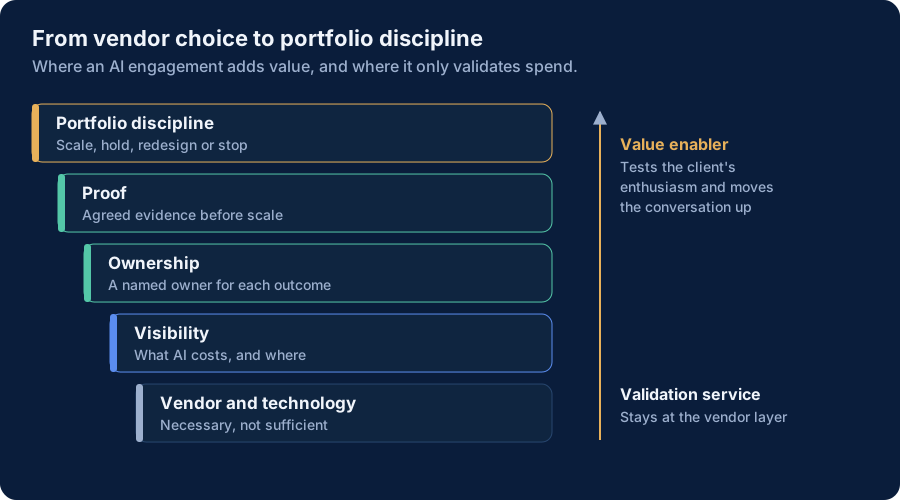
- The strongest advisory conversations move quickly from vendor or pilot enthusiasm to visibility, ownership, proof, and portfolio discipline. The weakest stay at the vendor and technology layer long enough for a competitor to own the economic governance conversation.
- There is a structural risk in how consulting firms engage with AI: firms that have preferred vendor relationships, embedded AI platform alliances, or commercial interests in AI adoption have an incentive to validate client AI spend rather than scrutinise it. Being genuinely vendor-neutral is a competitive differentiator in this environment, not just a positioning choice.
- The AI economics advisory opportunity is large and largely unclaimed. Most organisations have not yet had a conversation about AI governance that goes beyond reporting dashboards and portfolio inventories. The firm that frames this conversation at the level of capital discipline and operating-model accountability will own the relationship when the ROI scrutiny cycle arrives, and it will.
Why consulting firms need a stronger AI economics language
Many advisory teams are being asked to help clients with AI strategy, AI use-case pipelines, model selection, target operating models, and value realisation. Yet the client pattern is often the same: considerable executive ambition, growing spend, and weak economic legibility.
That is why AI economics matters to consulting firms. The issue is not only whether clients can launch AI. It is whether they can govern the cost structure, ownership model, and proof standards that decide whether AI survives scrutiny later.
External evidence reinforces the need. McKinsey's research suggests only a small minority of organisations are seeing clear financial ROI. Interpretation Deloitte's work points to longer-than-expected payback and underdeveloped operating models. Interpretation FinOps Foundation shows AI spend governance is becoming mainstream operational work. Interpretation Consulting partners who understand these patterns can frame more useful conversations than those who present AI mainly as a tooling or adoption problem.
How AI economics changes the client conversation
A useful advisory conversation usually starts by changing the question.
Instead of asking which model to use, ask what economic problem the client is actually trying to solve. Instead of asking how many pilots they have, ask whether they can state total AI cost, assign value ownership, and explain which initiatives deserve more capital than others.
This shift matters because many client organisations still have an editorial-skeleton version of AI strategy: strong themes, weak evidence. Consulting teams create disproportionate value when they can turn that skeleton into a management system.
The consulting opportunity in AI value realisation
There is a large advisory opportunity in helping clients close the gap between AI activity and economically credible value. Interpretation That includes:
- designing AI investment registers
- building proof standards and stage gates
- integrating FinOps, TBM, ITFM, and SPM disciplines
- improving AI cost visibility and planning
- helping executive teams compare AI bets at portfolio level
This is more durable work than one-off vendor selection support because it sits closer to the client's operating model and capital-allocation logic.
Real-world transformation challenges
Consulting partners regularly encounter value capture failures that reveal the need for stronger economic governance:
Unbudgeted AI spend at scale. In 2026, Marc Benioff said Salesforce expected to spend about $300 million on Anthropic tokens in 2026, largely for coding-related work Interpretation, illustrating how enterprise AI adoption can outrun financial planning. Consulting teams that help clients establish AI spend forecasting and budget governance before this pattern emerges deliver material value.
Subscription cancellations after initial enthusiasm. Market observations indicated significant cancellations of enterprise Copilot subscriptions after initial deployment Interpretation, suggesting that early adoption does not guarantee sustained value realisation. Advisory work that establishes proof standards and usage monitoring before broad rollout helps clients avoid this pattern.
Budget consumption without value proof. Uber consumed its entire annual AI budget in four months Interpretation, demonstrating how inference costs can exceed planning assumptions. Consulting engagements that integrate AI cost modelling into transformation programmes help clients maintain financial control.
Common client patterns partners should recognise
Several client patterns recur frequently.
The first is pilot abundance with weak portfolio logic. The client has many AI initiatives, but no comparative governance model.
The second is spend visibility without ownership. Reporting is improving, but no one is accountable for the economic result.
The third is local value claims without common proof standards. Each team can explain why its use case matters, but none can be compared rigorously with the rest.
The fourth is shared-platform optimism. Clients build common AI capability and assume future value will justify it without establishing enough discipline around reuse, demand, and stop decisions.
Consulting partners who can identify these patterns early will do better work than those who remain at the level of vendor enthusiasm or transformation narrative.
How to use the frameworks in client work
Different parts of this publication map naturally to common consulting needs.
- The AI Value Gap is useful for diagnosing why client AI ambition has outrun evidence.
- The AI Economics Maturity Model helps frame maturity without reducing the conversation to pilot counts.
- AI TCO Framework is useful in architecture, sourcing, and operating-model discussions.
- AI ROI Models helps structure value proof and benefits realisation.
- TBM & AI, FinOps & AI, ITFM & AI, and SPM & AI help explain which management disciplines need to evolve.
Used together, these frameworks allow consulting teams to move between boardroom language and operating-model detail without sounding fragmented.
Positioning AI cost governance as a strategic service
One of the most important advisory shifts is to stop presenting AI cost governance as a narrow optimisation service. Optimisation matters, but clients usually need something broader.
They need a view of total AI cost, not only cloud savings.
They need ownership models, not only spend dashboards.
They need proof thresholds, not only vendor promises.
They need portfolio governance, not only use-case pipelines.
That is why AI economics should be positioned as a strategic service at the intersection of finance, technology, operating model, and transformation governance.
What consulting firms often get wrong
Three patterns recur in advisory AI engagements that reduce the quality of client outcomes.
Leading with the vendor and staying there. Many AI advisory engagements begin with vendor evaluation: which model provider, which platform, which tooling stack. This is a necessary early conversation. It becomes a problem when it is the only conversation, or when vendor selection is the primary deliverable. Interpretation Clients who receive a vendor recommendation and implementation plan without a supporting economic governance model are being underserved. The vendor decision is months of useful life; the operating model is years.
Validating the client's enthusiasm rather than testing it. Advisory teams are under commercial pressure to maintain client relationships, and clients generally prefer advisors who share their enthusiasm for initiatives the client is excited about. This creates a structural drift toward validating AI business cases rather than stress-testing them. Interpretation The most valuable advisory service in the current AI environment is honest challenge (of baselines, of ROI claims, of operating model assumptions) delivered with enough skill that the client receives it as useful rather than obstructive. This is harder than validation and commercially riskier in the short term. It is also what separates the advisors clients return to from the ones they use once.
Treating AI economics as a reporting exercise. There is a version of AI economics advisory that produces dashboards, cost inventories, and KPI frameworks without materially changing any investment decision or operating behaviour. This is governance theater delivered as advisory work. Interpretation The standard to hold advisory work to is: has this engagement changed a decision? Has a case been stopped or redesigned because of the analysis? Has a budget been reallocated, a proof standard strengthened, an ownership model clarified? If the answer is no, the engagement has produced artefacts rather than outcomes.
The consultant's role: value enabler or validation service?
The optimist's case
Consulting firms are uniquely positioned to accelerate AI value realisation. They bring cross-industry pattern recognition, implementation expertise, and change management capability that most organisations lack internally. The best consulting engagements help clients move from ambition to execution faster than they could alone, establishing governance frameworks and operating models that deliver sustained value. Consultants who challenge client assumptions and stress-test business cases provide essential strategic value.
The sceptic's case
Consulting firms face structural conflicts of interest in AI advisory work. Many have vendor partnerships, platform alliances, or commercial incentives tied to AI adoption volume rather than value realisation. This creates pressure to validate client enthusiasm rather than scrutinise it. The consulting model rewards engagement expansion, not honest challenge. Clients who receive vendor recommendations without rigorous economic governance are being sold implementation services disguised as strategy. The firms that profit from AI adoption are poorly positioned to question whether that adoption makes economic sense.
Synthesis · house view
The value of consulting advisory depends on the firm's willingness to challenge client assumptions rather than validate them. Firms with genuine vendor neutrality and economic governance expertise deliver material value. Those with structural conflicts (vendor partnerships, platform alliances, or adoption-volume incentives) risk becoming validation services. The test is whether the engagement changes decisions: has a case been stopped, a budget reallocated, a proof standard strengthened? If not, the engagement has produced artefacts rather than outcomes. Clients should select advisors based on their track record of honest challenge, not their enthusiasm for AI adoption.
The practical conclusion
Consulting firms have an opportunity to be genuinely useful in AI if they help clients move from ambition to governability, and are willing to say things clients do not necessarily want to hear in order to do so. Interpretation The firms that do this well will be the ones that frame AI cost and value in business terms, connect strategy to operating discipline, and build management systems that remain useful after the first enthusiasm cycle passes.
The firms that do it poorly will be the ones that stay at the vendor and technology layer, validate spend rather than scrutinise it, and find themselves renegotiating their AI engagement scope when the ROI scrutiny cycle arrives and the client is looking for someone to explain why the returns have not appeared. SpeculationFurther reading
Related reading
Research on the growing gap between AI investment and realised value, with implications for consulting advisory work
Analysis of why most organisations struggle to capture AI value and what separates successful implementations
Framework for AI cost governance, useful for structuring client engagements around AI economics
Framework for AI governance and risk management, relevant for regulated industry consulting work