

Key takeaways
- The standard AI TCO framework places governance, safety, and compliance at 8-15% of total cost. In regulated industries, this layer routinely accounts for 25-45% of total operating cost - and can be higher in specific regulatory contexts.
- Regulatory risk creates a tail-cost exposure that does not appear in any standard TCO model. A single model failure in a regulated workflow can cost multiples of the annual operating budget for that capability.
- Build-versus-buy decisions look fundamentally different once regulatory approval timelines, data residency requirements, and model explainability obligations are included as real constraints.
- The Deloitte finding that AI payback typically takes two to four years is based predominantly on less-regulated industries. In financial services, healthcare, and government, three to six years is a more realistic baseline - and some use cases should not be pursued at standard commercial ROI expectations at all.
The framework assumption nobody states out loud
Most AI economics frameworks were built on a certain implicit picture of the enterprise deploying AI. The organisation has meaningful engineering autonomy. It can select vendors on primarily technical and commercial criteria. It can deploy and iterate relatively quickly. Governance overhead is real but manageable. The compliance layer creates friction, but not at a scale that restructures the entire economics.
This picture describes a mature technology company reasonably well. It describes a pharmaceutical company, a retail bank, a regional health system, or a defence contractor very poorly.
In regulated industries, the compliance layer is not an overhead item. It is a structural constraint that changes what capabilities can be deployed, how they can be evaluated, what evidence is required to approve their use, and what happens if they fail. This is not an obstacle to be managed out of a governance framework. It is the dominant economic fact.
Treating regulated-industry AI with the same frameworks used for less-regulated tech deployment systematically underestimates cost, overestimates return, and misleads investment decisions.
The governance layer is not 8-15% - a closer look at the actual numbers
The AI TCO Framework places governance, safety, and compliance at 8-15% of total cost for a typical enterprise deployment. That estimate reflects real-world patterns in technology companies and less-regulated enterprises. Interpretation In financial services, healthcare, and regulated government, a different cost structure applies. The governance and compliance layer in these environments typically includes: Interpretation- Model validation and independent review - many financial regulators require independent validation of any model used in a credit, pricing, or risk decision. In a major bank, an AI model cannot go live without passing an internal model risk management process that can take three to twelve months and cost hundreds of thousands of pounds in specialist time. Interpretation
- Explainability obligations - consumer credit legislation, insurance regulation, and parts of healthcare delivery require that automated decisions be explainable to affected individuals. This is not a theoretical obligation. It has specific technical consequences: some high-performing models cannot be deployed because their outputs cannot be explained in the required form. Interpretation
- Audit trail requirements - financial services, healthcare, and government all require that AI-assisted decisions be traceable. Logging, versioning, and provenance tracking are not optional features. They are regulatory minimums that create ongoing operating costs. Interpretation
- Data sovereignty and residency - regulated industries often have strict limits on where patient data, client data, or government data can reside. Cloud deployment patterns that are economically optimal in less-regulated contexts may be prohibited outright or require expensive sovereign-cloud configurations. Interpretation
- Stress testing and ongoing monitoring obligations - risk models in banks must be regularly stress-tested and recalibrated. Clinical decision support systems may require ongoing monitoring for performance drift. These are not one-time implementation costs; they are recurring obligations that sit outside most initial TCO models. Interpretation
Illustrative case: the same capability, very different economics
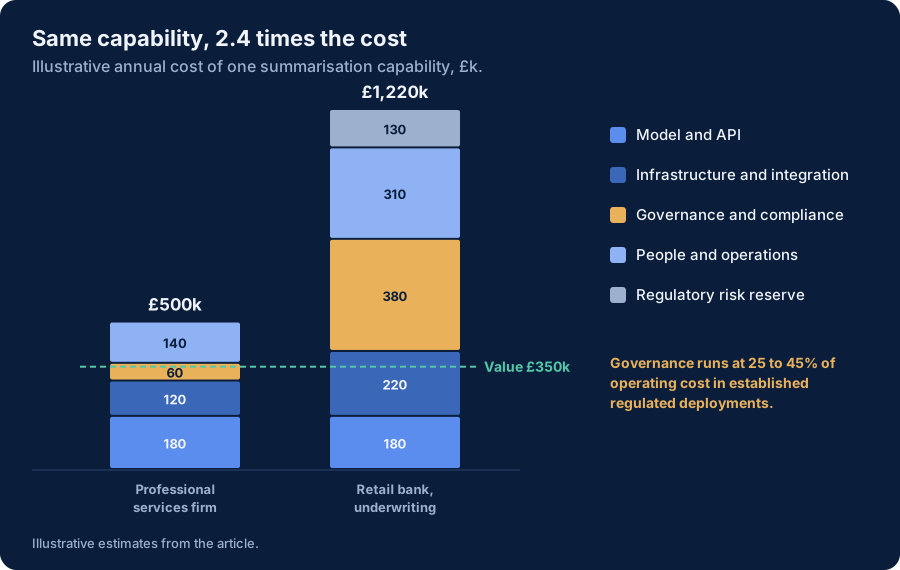
Consider a document summarisation capability deployed in two different organisations. The first is a professional services firm with no material regulatory obligations for this use case. The second is a major retail bank deploying the same capability within its mortgage underwriting process.
Professional services firm:
- Annual model and API cost: £180,000
- Infrastructure and integration: £120,000
- Governance overhead (quality review, basic policy controls): £60,000
- People and operating support: £140,000
- Estimated total annual cost: £500,000
Retail bank (mortgage underwriting context):
- Annual model and API cost: £180,000
- Infrastructure and integration (including data residency configuration): £220,000
- Governance overhead - model validation, MRM process, explainability tooling, audit logging, ongoing monitoring: £380,000
- People and operating support (including specialist compliance and risk oversight): £310,000
- Regulatory risk reserve (estimated expected value of potential compliance action, adjusted for probability): £130,000
- Estimated total annual cost: £1,220,000
These estimates are illustrative, but the ratio reflects patterns observable in regulated-industry deployments. The same capability, serving a broadly similar business function, costs roughly 2.4 times as much in the regulated context. A standard TCO model - applied uniformly - would produce an estimate much closer to the professional services figure and fundamentally misrepresent the bank's actual operating burden.
The ROI calculation follows directly. If the summarisation capability saves analysts roughly the same amount of time in both organisations - say, £350,000 in annual productivity value - the professional services firm has a plausible return case. The bank does not.
Industry profiles: three different flavours of regulatory economics
Financial services
The dominant regulatory dimensions in financial services AI economics are model risk management, consumer protection obligations, and increasingly, systemic risk oversight as AI becomes more embedded in core processes. Interpretation Model risk management frameworks - most major jurisdictions operate variants of guidance requiring that models used in material decisions be independently validated, documented, and monitored - create a persistent overhead that is architecturally independent of the AI capability itself. A well-performing model does not reduce its MRM cost. A more complex model typically increases it. Interpretation Consumer credit specifically imposes explainability obligations that have technical consequences. A gradient-boosted model that outperforms logistic regression on predictive accuracy may be unusable in certain lending contexts if it cannot produce explanations that satisfy regulatory expectations. The economics of "best model available" are not the economics of "best model deployable." InterpretationReal-world example: Klarna's AI assistant, which handles customer service interactions, operates under financial services regulations that require explainability and audit trails for customer-facing decisions. The compliance overhead for such systems in regulated contexts adds 30-40% to the base operating cost compared to equivalent customer service AI in non-regulated sectors. Interpretation
The emerging supervisory posture in financial services - with regulators increasingly examining AI use in trading, lending, and insurance - adds a further layer. Organisations that cannot demonstrate governance maturity in AI are exposed to enhanced scrutiny costs: more frequent examinations, remediation obligations, and in serious cases, capital buffer requirements. These are not costs that appear in any standard AI TCO model, but they are real contingent costs that a genuinely complete financial analysis should acknowledge. InterpretationHealthcare
Healthcare AI economics is shaped by a different regulatory logic: patient safety rather than financial conduct. The regulatory cost structure in healthcare is less about transaction-level explainability and more about clinical validation, liability, and the professional accountability of the clinicians who use AI-assisted tools. Interpretation Clinical decision support systems that inform diagnosis, treatment planning, or medication decisions typically require clinical validation studies before deployment. These studies are expensive, time-consuming, and represent a category of pre-deployment cost that has no equivalent in technology-company AI deployment. A model that performs well on retrospective data requires separate demonstration that it performs safely and effectively in the clinical workflow - with real patients, under supervision, with appropriate monitoring. Interpretation Liability allocation also changes the economics. In a technology company, the cost of a model failure is typically a product incident. In a healthcare system, the cost of a clinically harmful AI output may involve regulatory action, litigation, and reputational damage at a scale that dwarfs the operating cost of the capability itself. This tail-cost exposure is routinely excluded from standard TCO models, but it is the correct denominator for risk-adjusted ROI calculations in clinical contexts. InterpretationGovernment and defence
Government and defence environments present a third variant of regulated-industry AI economics, organised primarily around security classification, sovereignty, and the political accountability of decisions made with AI assistance. Interpretation Data classification requirements in defence create deployment constraints that are effectively absolute. A model that processes classified information cannot run on commercial cloud infrastructure. The economics of sovereign or on-premises AI deployment - higher infrastructure capital, smaller talent pools, reduced access to model improvements - are a fixed feature of the environment. Interpretation Procurement timelines in government add another dimension. The contract cycles that govern major technology deployments in government are measured in years, not months. An AI capability that reaches its technical potential in 18 months of development may take five years to be contractually deployed at scale. The returns expected from technology company timelines cannot be reasonably applied to a government deployment schedule. Interpretation Political accountability creates a specific form of governance overhead that has no private-sector equivalent: the obligation to be able to explain every consequential AI-assisted decision to a ministerial or legislative audience, at any time, in plain language, with full supporting documentation. This is not an abstract concern. It is an operating requirement that shapes architecture, logging, and governance practice throughout the lifecycle. InterpretationWhat build-versus-buy actually means in regulated contexts
The standard build-versus-buy analysis in AI compares development cost, time to market, vendor lock-in, and customisation requirements. In regulated industries, this analysis is incomplete unless it also addresses:
Regulatory approval of the vendor. Some regulated industries require that AI vendors used in material processes be reviewed, approved, or registered with the regulator. This is not a one-time cost; approved vendor relationships require ongoing management and can be disrupted by regulatory action against the vendor that is entirely outside the buyer's control.
Contractual obligations for audit access. Regulators may require that an organisation provide access to the model, its training data, its evaluation results, and its governance processes. This right of access must be contractually secured from a vendor before deployment - and many vendor standard terms do not provide it. Negotiating bespoke regulatory-access provisions is a procurement cost with no standard benchmark.
Portability on regulatory demand. If a regulator requires that a system be migrated or shut down, the organisation needs to be able to comply. Vendor lock-in in a regulated context is not just an economic risk - it is a compliance risk. The cost of building with portability in mind, or of negotiating portability rights with a vendor, belongs in the TCO model.
Change management on regulatory timelines. When regulation changes - and in AI, it is changing - the organisation must be able to adapt its deployed systems. Vendor-controlled SaaS AI creates dependency on the vendor's change roadmap, which may not be aligned with regulatory deadlines. Building with sufficient internal control to make regulatory-driven changes on regulatory timelines adds cost but reduces a significant class of compliance risk.
A note on ROI expectations in regulated environments
The Deloitte finding that satisfactory AI ROI typically takes two to four years reflects predominantly less-regulated enterprise contexts. Interpretation Based on the cost structure described above, a more calibrated expectation for regulated industries is: Interpretation- Financial services (non-core-decisioning use cases): three to five years for a credible return case Interpretation
- Financial services (credit, risk, or pricing decisioning): four to seven years, subject to the MRM approval timeline and ongoing monitoring costs Interpretation
- Healthcare (clinical decision support): five to eight years, with significant variance based on clinical validation requirements Interpretation
- Government (core service delivery): often not meaningfully analysable on commercial ROI terms at all - the appropriate evaluation framework is public value, not private return Interpretation
The optimist's case
Regulation creates competitive advantage for organisations that invest in compliance infrastructure early. The governance overhead becomes a moat that prevents less-committed competitors from entering the market. Over time, regulatory maturity in AI becomes a strategic asset that enables faster deployment of new capabilities within established frameworks.
The sceptic's case
Regulation fundamentally constrains AI economics in ways that make many use cases unviable. The compliance overhead doesn't create competitive advantage - it creates a tax that all regulated players must pay, reducing the total addressable value pool. In many cases, the regulatory burden means AI capabilities that work brilliantly in tech companies simply cannot achieve positive ROI in regulated contexts, regardless of how well they're implemented.
What this means for practice
For finance leaders in regulated industries, the most important immediate step is to build a sector-specific version of the AI TCO model that includes the regulatory and compliance layer at a realistic cost level. Generic TCO frameworks will systematically understate your cost base.
For technology and AI leaders, the build-versus-buy question deserves a different decision framework than the one used in less-regulated contexts. Vendor selection must include regulatory due diligence, audit access rights, and portability provisions. These are not procurement niceties - they are operational requirements.
For portfolio and governance leaders, the return expectations applied to AI investments should be calibrated to the regulatory context of each use case. A single enterprise-wide ROI standard that treats a customer-analytics capability and a credit-decisioning model as equivalent creates systematic misallocation.
For boards and audit committees in regulated industries, the critical question is whether management's AI investment and governance reports are using a TCO and ROI framework appropriate to your regulatory environment - or whether they are applying a technology-company framework that makes the economics look materially better than they are.
Further reading on regulated AI economics
Token Economics: The Atomic Unit of AI Value
FinOps Foundation analysis of AI cost measurement in enterprise contexts
State of Generative AI in the Enterprise
Deloitte research on AI ROI timelines and enterprise adoption patterns
The Consumer Data Opportunity and the Privacy Imperative
McKinsey analysis of regulatory constraints on data-driven capabilities