

Key takeaways
- Most AI vendor selection decisions are made on capability grounds. The economic risks - pricing model exposure, lock-in depth, and exit cost - are typically under-assessed at purchase time and fully understood only when it is expensive to act on them.
- Per-token and consumption-based pricing creates a fundamentally different budget risk profile than seat-based or platform licensing. Volume growth can produce non-linear cost increases that were not modelled at purchase.
- Lock-in in enterprise AI is multi-dimensional: model lock-in, platform lock-in, data format lock-in, and workflow dependency lock-in do not all move together and are not all equally reversible.
- Exit cost estimation is a legitimate procurement exercise, not a sign of distrust. Vendors that cannot support a clean exit should price their contracts accordingly.
The vendor selection problem
The standard AI vendor evaluation process optimises for capability: which model performs best on the relevant tasks, which platform integrates most cleanly, which vendor has the best support model. These are legitimate questions. They are also incomplete ones. Interpretation The economic conditions of an AI vendor relationship are different from conventional enterprise software in ways that matter at scale. Pricing can be variable and exposure to cost growth is hard to predict. The market is consolidating rapidly, which means vendor risk profiles change faster than procurement cycles. And the technical lock-in created by AI deployments is subtler than conventional software lock-in - it does not always appear in a single integration layer, and it accumulates over time. Interpretation A mature AI vendor selection process evaluates economic and risk characteristics alongside capability. The questions are not complex, but they require deliberate effort to answer at purchase time. InterpretationPricing model risk
Enterprise software procurement is largely built around predictable cost: seat licences, platform fees, and annual true-ups. AI vendor pricing introduces a different risk structure. Interpretation Consumption-based pricing (per token, per API call, per task) creates direct exposure to volume growth. If AI adoption expands - which is the intended outcome of most AI programmes - the cost grows with it. This is rational, but it means that a vendor contract that looks affordable at proof-of-concept scale can become a significant budget line at enterprise scale without any change in the agreed price per unit. InterpretationPricing risk example: A European financial services company deployed an AI-powered customer service chatbot using a consumption-based API pricing model. Initial proof-of-concept costs were £2,000 monthly at 50,000 queries. After successful rollout to all customer channels, query volume reached 2 million monthly within six months, driving costs to £75,000 monthly - a 37x increase. The per-query price had not changed, but the absence of volume discounts or pricing caps meant the budget impact was far larger than procurement had modelled. The company renegotiated for tiered pricing with volume commitments.
Questions to ask at procurement:
- What does total cost look like at 2x and 5x current usage?
- Are there volume discounts at scale, and what triggers them?
- What notice is required before pricing changes, and what is the cap on annual increases?
- Is there a spend commitment that triggers a different pricing tier?
Lock-in dimensions
Lock-in in enterprise AI is not a single condition. It is a combination of factors that accrue over time and that do not all move together. Understanding which dimensions apply to a specific vendor relationship helps prioritise exit risk and mitigation strategies. Interpretation Model lock-in occurs when outputs, evaluations, and fine-tuning are built around a specific model's characteristics. An enterprise that has fine-tuned a model, built evaluation frameworks around its specific output format, or accumulated significant prompt libraries optimised for its behaviour has invested in that model in a way that does not transfer. Switching models, even within the same provider, can require significant re-evaluation and re-optimisation. Interpretation Platform lock-in is the most visible dimension. It occurs when AI capabilities are embedded in a platform that also manages other enterprise functions - CRM, ERP, productivity suites - and separating the AI layer from the platform becomes costly or impractical. This is increasingly common as Microsoft, Salesforce, ServiceNow, and similar platforms embed AI deeply into their core product. The capability integration is a genuine benefit; the lock-in is a genuine cost. Both should be assessed. Interpretation Data format and pipeline lock-in occurs when AI workflows are built around a provider's data infrastructure: vector databases, embedding models, knowledge base formats, or proprietary retrieval systems. If migrating AI capability requires rebuilding the data layer, the migration cost is substantially higher than it appears when only the model API is considered. Interpretation Workflow dependency lock-in is the least visible but often the most durable. It occurs when human workflows - the way people actually do their jobs - adapt around an AI tool's capabilities and limitations. When users build their work patterns around specific AI behaviours, replacing the AI creates disruption that is not measured in integration costs. It appears in productivity dip, user resistance, and retraining expense. InterpretationConsolidation and acquisition risk
The AI vendor market is consolidating rapidly. Point solutions that exist independently today may be acquired, discontinued, or meaningfully changed within a two to three year investment horizon. Interpretation The consolidation risk is asymmetric. Consolidation into a stronger acquirer can be a positive outcome: better support, deeper integration, more durable investment. Consolidation into a distracted or strategically misaligned acquirer can mean reduced investment in the product, changed pricing, or eventual discontinuation. Interpretation The categories at highest consolidation risk are typically small pure-play vendors addressing specific AI cost visibility, optimisation, or governance functions. These products are acquiring customers and demonstrating value in areas where larger platforms have identified gaps - which makes them attractive acquisition targets. Buyers should assess whether they are comfortable with the range of plausible acquirers, not just the current vendor. InterpretationThe optimist's case
Vendor consolidation in AI is a sign of market maturity and creates better outcomes for enterprise buyers. When specialised AI tools are acquired by major platforms like Microsoft, Salesforce, or AWS, customers gain deeper integration, better support, and more durable investment. The FinOps Foundation's guidance on AI vendor management emphasises that consolidation reduces the number of vendor relationships to manage and creates clearer accountability. Enterprise buyers benefit from dealing with established vendors with proven track records.
The sceptic's case
Consolidation creates concentration risk and reduces buyer leverage. When independent AI vendors are acquired, customers lose negotiating power, face potential price increases, and may see product investment decline if the capability becomes a minor feature in a larger platform. KPMG's procurement guidance warns that over-reliance on a small number of large AI platform vendors creates systemic risk. The most innovative AI capabilities often come from independent vendors who are later acquired and deprioritised.
Synthesis · house view
The right approach depends on the specific vendor category and buyer risk tolerance. For core AI infrastructure (model APIs, platform services), consolidation into major cloud providers often improves stability and integration. For specialised AI governance or optimisation tools, maintaining vendor diversity may be worth the additional management overhead. Procurement should assess change-of-control provisions in contracts and maintain abstraction layers that reduce switching costs regardless of consolidation outcomes.
Questions to ask:
- Has the vendor raised venture capital, and at what valuation relative to its current revenue? (High multiples create acquisition pressure.)
- Is the vendor's core function something a larger platform would absorb?
- What happens to your data, your integrations, and your contract terms in a change of control?
Estimating exit costs
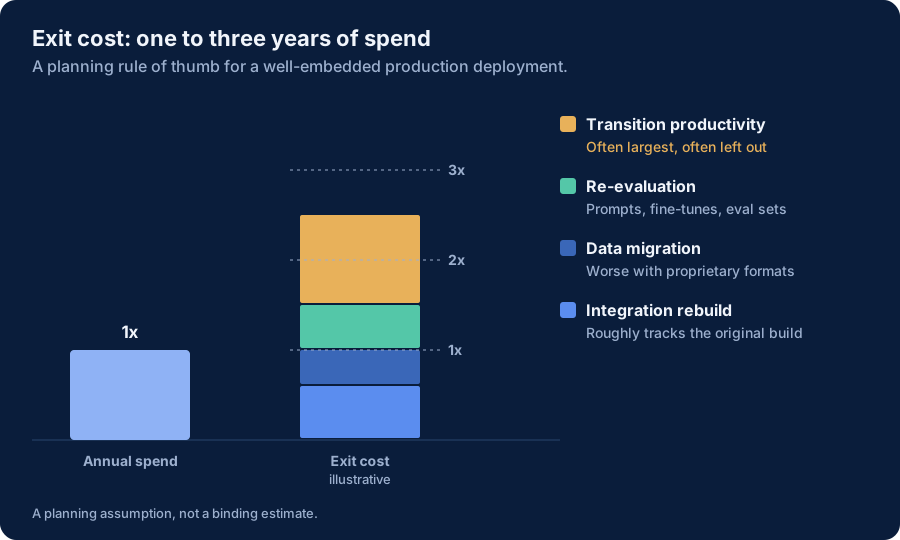
Exit cost estimation is a legitimate procurement exercise. It produces a clearer understanding of the real cost of the vendor relationship and creates a negotiating basis for contract terms that reduce exit risk. Interpretation Integration rebuild cost: the engineering effort required to rebuild the integration between your workflows and an alternative vendor. This is the most tractable exit cost to estimate - it is roughly proportional to the initial build cost, subject to the quality of the abstraction layer. Interpretation Data migration cost: the effort required to export, reformat, and re-ingest data from the vendor's storage and retrieval systems. Proprietary formats significantly increase this cost. Open, documented formats significantly reduce it. Ask at procurement how data is exported, in what format, and what the migration tooling looks like. Interpretation Re-evaluation and re-optimisation: if the vendor relationship has produced fine-tuned models, specialised prompts, or evaluation frameworks, these may not transfer. The cost of rebuilding this intellectual work is real but hard to estimate in advance. It can be partially mitigated by maintaining provider-agnostic abstractions. Interpretation Transition productivity cost: the period during which teams are operating on a reduced AI capability or adapting to a different tool. This is often the largest real cost of AI vendor transition, and the one most consistently excluded from exit cost estimates. InterpretationExit cost benchmark: A US technology company evaluated switching from one major cloud AI provider to another for its document processing pipeline. The analysis revealed: integration rebuild (3 months engineering, £180k), data migration (reformatting 2.5 million documents, £45k), prompt re-optimisation (6 weeks, £60k), and estimated productivity impact during transition (15% throughput reduction for 2 months, £120k opportunity cost). Total exit cost: £405k against annual vendor spend of £240k - a 1.7x multiple. The company negotiated improved pricing with the incumbent vendor instead of switching.
Contract terms that reduce economic risk
Several contract provisions materially reduce the economic risk of an AI vendor relationship. Many are negotiable, particularly for significant spend levels. Interpretation Pricing caps and commitment tiers: a cap on annual price increases and a defined discount structure at volume thresholds converts variable pricing risk into a managed cost envelope. Interpretation Data portability commitments: a contractual obligation to provide data in documented, open formats on request. This is increasingly standard for credible enterprise AI vendors; its absence is a risk signal. Interpretation Change of control provisions: a right to exit the contract or renegotiate terms in the event of a material change of ownership. This provision is common in enterprise software and increasingly available in AI vendor contracts. Interpretation Model version stability: a commitment to support a specific model version for a defined period, with advance notice before deprecation. This reduces the risk of a silent capability change disrupting a production deployment. Interpretation Audit rights: the right to inspect the vendor's use of your data, model behaviour logs, and billing calculations. Particularly important in regulated industries where data governance obligations extend to third-party processors. InterpretationA framework for economic risk assessment
A structured approach to AI vendor economic risk assessment covers four dimensions: Interpretation Pricing risk: how variable is total cost as usage grows? What are the worst-case scenarios at 2x and 5x current volume? Is there a spend ceiling or commitment structure available? Interpretation Lock-in depth: which lock-in dimensions apply - model, platform, data, workflow - and how reversible is each? What is the estimated exit cost at a planning horizon of two and four years? Interpretation Consolidation exposure: what are the plausible acquirer scenarios? Are any of those scenarios unacceptable? What contract provisions address change of control? Interpretation Governance alignment: does the vendor's data handling, audit capability, and SLA structure align with your compliance obligations? Can they support the governance requirements that will apply to production AI at scale? Interpretation Capability is necessary. Economics and risk are also necessary. The organisations that evaluate AI vendors on all four dimensions consistently make fewer expensive mistakes. InterpretationReferences and further reading
Related reading
Framework for evaluating and managing AI vendor relationships with focus on cost visibility and optimisation
Enterprise guidance on AI vendor selection, contract negotiation, and risk management
Documentation of consumption-based pricing structures and cost optimisation strategies for cloud AI services
Best practices for evaluating AI vendors including lock-in assessment and exit planning