
Key takeaways
- AI TCO models usually fail because they price the visible commercial layer and stop before describing the operating system around it.
- IDC, FinOps Foundation, and broader enterprise research all suggest that hidden platform, governance, and shadow-spend layers are still materially under-modelled.
- The most common TCO failure is not incorrect arithmetic. It is incorrect scope.
- A stronger TCO model separates shared capability investment from local demand and remains dynamic as a service moves from pilot to production.
The recurring mistake
Most AI TCO models fail in the same way: they begin with what is easy to price and stop before they have described what the organisation is actually building. That usually means the commercial surface gets most of the attention. Leaders compare API rates, SaaS licence premiums, or projected hosting cost and feel they have the outline of the economic decision. In practice, they have only priced one visible edge of a larger operating model. Interpretation IDC's research is useful context here. It suggests a large share of AI tool spending still sits outside formal IT budgets and warns that major enterprises may materially underestimate AI infrastructure burden as estates scale. FinOps Foundation also shows that AI spend management has become mainstream operational work faster than many governance models have matured. Those signals tell the same story: the visible invoice is only part of the cost picture. InterpretationWhere the model usually breaks
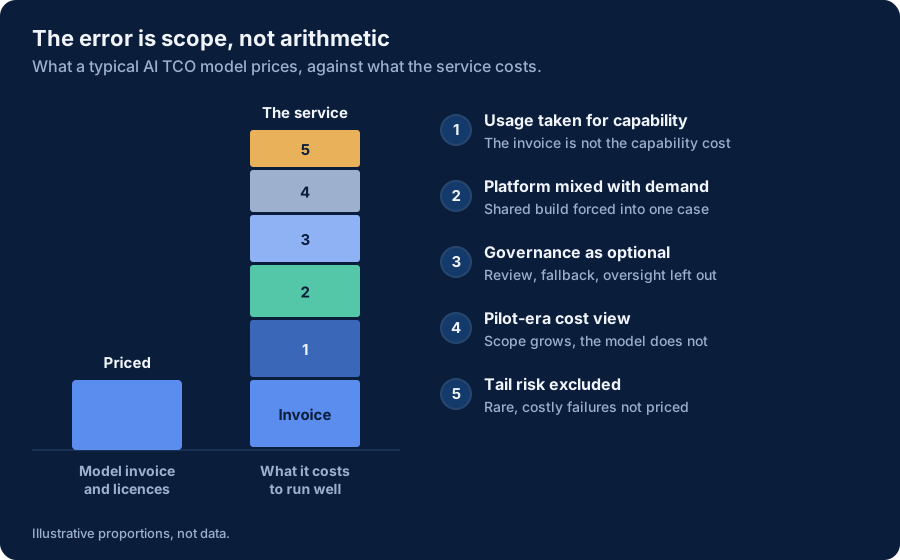
The first break happens when leaders confuse direct usage cost with total capability cost. A model invoice is variable and visible, which makes it feel like the natural starting point. But many of the costs that determine whether AI remains viable at enterprise scale are indirect, shared, and slower to emerge.
The second break happens when foundational platform investment is mixed together with local use-case demand. An enterprise may establish shared orchestration, evaluation, security, and model-management capability to support many teams. If those costs are forced too early into individual use-case business cases, the economics look distorted. If they are not separated at all, leaders lose sight of what is platform investment and what is demand expansion.
The third break happens when governance and operating support are treated as optional overhead instead of part of the service. In low-risk demonstrations, controls can be light. In enterprise use, they cannot. Review, fallback handling, observability, policy controls, vendor management, and human oversight are not incidental to AI economics. They are part of what the organisation is paying for when it wants a service to be dependable.
The fourth break is a failure of timing. Early TCO models are often prepared at the point of exploration, when leaders have not yet decided how much resilience, control, or integration they will eventually require. Once expectations rise, the cost stack expands. If the model is not reframed, the organisation continues governing a production service with a pilot-era cost view.
The hidden categories leaders underestimate
Three categories are especially easy to underweight.
The first is context infrastructure. Retrieval, indexing, data refresh, metadata quality, and provenance control can become a substantial share of the economic burden in retrieval-heavy AI systems. The model may look efficient, while the context layer quietly absorbs budget and operating attention.
The second is workflow integration. AI that is not embedded into business process is often a demonstration rather than a capability. Once teams integrate AI into core systems, identity, access, policy enforcement, interface design, and change-management effort begin to matter as much as model selection.
The third is portfolio assurance. Once multiple teams use AI, leaders need a management layer that can explain which services are consuming cost, which business capabilities are benefiting, and where shared investment is or is not earning the right to scale. This is where AI TCO Framework, TBM & AI, ITFM & AI, and FinOps & AI begin to intersect. TCO without service and portfolio structure rarely remains decision-useful for long.
Why this matters for enterprise decisions
Weak TCO models create two types of failure.
The first is false confidence. A programme is approved on the assumption that the model layer is the main cost driver, only for leaders to discover that governance, support, and context systems are growing faster than expected.
The second is false caution. A use case with a viable long-run economic case is rejected because leaders force too much shared platform cost into its local business case or compare it to a cheaper but less governable deployment path.
Both failures reduce the quality of AI investment decisions. They also widen the gap between technical progress and economic understanding described in The AI Value Gap.
A better standard for AI TCO
A stronger TCO model does five things.
- It separates direct usage cost from enabling platform cost.
- It distinguishes shared foundational capability from use-case-specific demand.
- It includes governance and operating burden as part of the service, not as optional overhead.
- It is updated as the service matures from pilot to scaled dependency.
- It is reviewed alongside expected return and portfolio consequence rather than as a stand-alone cost note.
Those are not accounting refinements. They are governance requirements. Without them, leaders are not really comparing AI strategies. They are comparing invoices while missing the operating model behind them.
The fifth break: tail-risk costs are excluded entirely
The four failure modes above address TCO errors of omission - costs that are real and recurring but not captured. There is a fifth failure mode that is categorically different: the complete exclusion of tail-risk economics from AI cost models. Interpretation Tail-risk in AI refers to the potential financial consequence of a significant system failure. Most TCO models are built around the expected operating cost - what the system will cost when it is working as designed. They do not include any estimate of the expected cost of failure events: model hallucinations that produce incorrect outputs in high-stakes contexts, agentic systems that take actions outside their intended scope, data handling failures that trigger regulatory action, or AI-assisted processes that produce systematic errors before the problem is detected. Interpretation For low-stakes AI use cases - content drafting, internal knowledge search, personal productivity assistance - tail-risk is low and its exclusion from the TCO model is defensible. For higher-stakes applications - credit decisioning, clinical support, customer-facing commitments, autonomous financial processes, regulatory reporting - tail-risk costs can be material relative to the expected operating budget. Interpretation Consider a financial services organisation running an AI-assisted lending decisioning process. The expected annual operating cost of the capability is £1.4M. If the model produces systematically biased decisions across a class of applicants for six months before the problem is detected, the potential cost - regulatory remediation, customer redress, supervisory investigation, enhanced audit requirements - could be multiples of the annual operating budget. That exposure is not captured in any standard TCO model. Interpretation This is not an argument against deploying AI in high-stakes contexts. It is an argument for making the risk adjustment explicit. The expected value of a capability's contribution should be weighed against the expected value of failure consequences, adjusted for probability. In many cases, the answer is still clearly positive. In some cases, it changes the investment decision. In all cases, it produces a more honest and complete economic model. Interpretation Incorporating tail-risk into AI TCO requires three practical steps. First, categorise AI use cases by consequence severity - what is the maximum plausible cost of a significant failure? Second, estimate the probability distribution over failure modes given the current control environment. Third, weight the expected failure cost and include it as a line in the TCO model, even if it is presented as a risk-adjusted range rather than a point estimate. Most organisations do not do this. The ones that do find that it changes their prioritisation of AI governance investment and their view of which use cases require the most stringent control environment. InterpretationWhat to do next
For CIOs and Heads of Engineering:
- Rework business cases so they separate pilot assumptions from production obligations.
- Expose integration, support, and governance cost explicitly before moving high-value workflows to production.
- Compare deployment paths on full-service economics, not only on model access price.
- For higher-stakes applications, include a tail-risk assessment alongside the operational cost model.
For CFOs and ITFM leaders:
- Ask whether shared platform cost has been separated from local demand in the TCO model.
- Require management reports that show forecast movement as AI capabilities become more widely adopted.
- Use a common TCO template across major AI initiatives so local optimism is easier to challenge.
- For material AI use cases, ask whether the cost model includes any estimate of failure-consequence exposure, and be sceptical of cases where the answer is no.
For FinOps and TBM leaders:
- Connect live usage data to the wider seven-layer cost stack.
- Make allocation assumptions explicit where costs remain shared or difficult to attribute.
- Feed TCO learning back into portfolio reviews so weak cases are redesigned earlier.
- Work with risk and compliance functions to develop a standard tail-risk classification that applies consistently across the AI portfolio.
Further reading on AI TCO and cost management
Token Economics: The Atomic Unit of AI Value
FinOps Foundation analysis of AI cost measurement and TCO frameworks
IDC: AI Infrastructure and Cost Management
IDC research on enterprise AI infrastructure costs and governance
Gartner on Cloud and AI Economics
Gartner analysis of cloud and AI cost trends through 2030