

Who Owns the Means of Intelligence?
The AI economy is not built by models alone. Power belongs to those who can produce, allocate, distribute and apply intelligence at scale.
The market beneath the model
The visible AI product is an answer, prediction, generated asset or automated action.
Beneath it sits a chain:
energy → semiconductors → data centres → networks and storage → models → orchestration → applications → workflows → economic outcomes
Each layer can capture value and constrain the next.
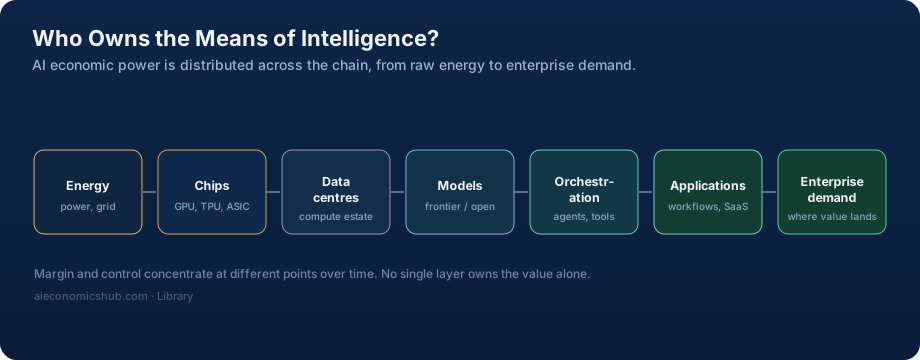
Sources of power
Energy and sites
AI capacity requires power, cooling, land, grid connection and permits.
Scarcity can shift bargaining power upstream.
Chips and memory
Accelerators and high-bandwidth memory determine cost, throughput and access.
Data centres and cloud
Facilities aggregate capital, procurement and operational expertise.
Models
Model providers control capability, price, policy and access.
Orchestration
Routing, tools, memory, evaluation and agent frameworks determine how efficiently models become useful work.
Applications and distribution
Vendors own user relationships, workflow integration and data context.
Enterprises
Buyers own domain knowledge, customers, operating processes and the ability to capture value.
Two possible markets
Concentrated intelligence
A small number of firms control:
- frontier models
- infrastructure
- distribution
- pricing
- standards
- data access
Benefits:
- scale
- rapid innovation
- integrated services
Risks:
- dependency
- price power
- opaque allocation
- political influence
- limited enterprise optionality
More open intelligence
A competitive mix of:
- open models
- public and regional capacity
- neoclouds
- interoperable standards
- edge inference
- portable orchestration
Benefits:
- buyer choice
- regional capability
- lower barriers
- innovation
Risks:
- fragmentation
- security and quality variation
- operational burden
- duplicated investment
Sovereignty is not autarky
Enterprise sovereignty should not mean owning every layer.
A useful definition is:
The ability to make material AI decisions without unacceptable dependency on a single provider, jurisdiction, architecture or commercial term.
It includes:
- visibility
- portability
- substitutability
- data control
- workload placement
- commercial leverage
- operational fallback
- skills
An enterprise can use external APIs and retain meaningful sovereignty if it has options and evidence.
It can own hardware and remain dependent on one chip vendor, model stack or scarce skill set.
Europe as an economic case
This supports a broader thesis: Europe cannot treat AI only as a regulatory object. It also needs productive capacity.
The unresolved question is not simply how many factories exist. It is whether capacity becomes:
- accessible to firms
- connected to high-value use cases
- economically competitive
- supported by skills
- converted into European products and productivity
Infrastructure is necessary. Conversion determines value.
Physical AI
As models control machines, the chain becomes more direct:
- token to instruction
- instruction to motion
- motion to production
- production to quality, output or safety
Physical AI can make value attribution easier in some cases because outcomes are observable:
- defect avoided
- energy reduced
- unit produced
- downtime prevented
- route improved
It also raises the consequence of error and the need for authority, resilience and safety.
Who captures declining cost?
When model or compute cost falls, savings may go to:
- infrastructure provider margin
- model-provider margin
- application vendor margin
- lower customer prices
- higher enterprise margin
- more consumption
- better quality
- new entrants
Enterprise strategy
Leaders should map:
- critical workloads
- provider concentration
- model and infrastructure dependencies
- data and jurisdiction
- price and contract exposure
- migration cost
- internal skills
- fallback options
- strategic value of speed versus control
The aim is not maximal ownership.
It is deliberate optionality.
Conclusion
The means of intelligence are not one asset.
They are a chain of productive capabilities and control points.
The organisations and regions that matter will not only generate tokens. They will convert energy and capital into intelligence, then convert intelligence into worthwhile economic action.
Sources
- Luigi Gambardella, "The token economy: the new unit of value in Artificial Intelligence"
- European Commission, "AI Continent Action Plan"
- European Commission, "AI Factories"
- Deloitte, The pivot to tokenomics: Navigating AI's new spend dynamics