
Key takeaways
- Mid-market companies face the same fundamental AI economics problems as large enterprises - cost visibility, proof of return, and governance - but without the infrastructure, specialist teams, or institutional gravity to solve them the same way.
- The biggest risk for mid-market AI investment is not overspending. It is accumulating committed cost in tools and licences whose value is not being captured, while the people who might use them more effectively are too busy to do so.
- Shared platforms and vendor AI-augmented seats are typically the right starting point, not custom builds. The cost of custom integration engineering is hard to justify without significant scale.
- A mid-market organisation at AI governance maturity level 2 - where spending is visible and someone owns it - is in a better operating position than a large enterprise at level 1 that has AI everywhere and accountability nowhere.
Defining the mid-market AI position
Mid-market, for the purposes of this piece, means organisations with annual revenues in the range of $50m to $1b, with technology and finance functions that have genuine capability but not the scale that supports dedicated specialist roles for every discipline. This includes privately held companies, regional operators, divisions of larger groups, and publicly traded companies outside the large-cap tier. Interpretation The reason the distinction matters is that most published AI economics guidance - including most of what appears in this publication - is written with enterprise-scale conditions in mind. Dedicated FinOps practitioners, AI governance committees, TBM infrastructure, and centralised AI platforms are assumptions that underpin a lot of the advice. None of these are standard features of mid-market organisations. Interpretation This does not mean the underlying frameworks are wrong for mid-market. It means the implementation path is different, and the priorities look different. InterpretationThe structural differences
Several conditions common to enterprise AI deployments are absent or materially different in mid-market: InterpretationNo shared AI platform team. In enterprises, shared AI infrastructure - model gateways, RAG pipelines, evaluation tooling, governance dashboards - is typically built and maintained by a dedicated platform engineering function. In mid-market, these functions are usually distributed across a small IT or engineering team whose primary obligation is keeping existing systems running. Custom AI platform builds compete directly with operational priorities and usually lose. Interpretation
No dedicated AI governance or FinOps function. Responsibility for AI cost visibility, usage oversight, and value measurement sits with whoever is closest to the spending - typically a head of technology, CTO, or occasionally a CFO who has noticed the bills growing. This is not a failure; it is the appropriate organisational response to the scale of the problem. But it means governance operates through individual attention rather than institutional process, which creates fragility. Interpretation
Smaller user populations limit the law of large numbers. Productivity claims for AI in enterprise are often justified by aggregate statistics across large user populations. A mid-market company deploying an AI writing assistant to fifty knowledge workers cannot rely on the same statistical confidence. The variance is higher, the signal takes longer to emerge, and a small number of enthusiastic or disengaged users can skew the picture. Interpretation
Vendor relationships are less negotiable. Enterprise customers can negotiate pricing floors, data portability commitments, and contractual protections that mid-market customers typically cannot. This does not change the questions to ask - see AI Vendor Selection Economics - but it does change the answers that are available. Interpretation
Budget cycles are less forgiving. Enterprise AI investment can survive a bad year and continue building infrastructure. Mid-market investment that does not show clear returns in year one or two creates direct pressure on the overall technology budget. The tolerance for long-horizon platform investment is lower, which means the case for AI spending has to land faster. Interpretation
Where mid-market organisations get it wrong
The most common mistake is not underinvesting in AI. It is committing to AI licences and tools before the organisational conditions for capturing value are in place. Interpretation This produces a familiar pattern: the company purchases an AI-augmented suite (Copilot, Salesforce Einstein, equivalent), adoption is partial and uneven, the tools sit largely unused by most of the team while a small number of enthusiasts find them valuable, and the licence renewal decision arrives twelve months later with no clear evidence of return. InterpretationMid-market pattern observed: A UK-based professional services firm with 200 employees deployed Microsoft 365 Copilot to all knowledge workers. After six months, utilisation data showed 15% of seats were actively used weekly, 40% had tried it once or twice, and 45% had never activated it. The firm reduced seat count by 60% at renewal, focusing licences on the teams showing measurable productivity gains. Total AI spend decreased while measured value per active user increased.
What works at mid-market scale
Embedded AI features in tools already in use. The highest-return AI investment for most mid-market companies is activating AI capabilities in software they already pay for: CRM AI features, productivity suite AI assistants, ERP automation, customer service AI within existing ticketing platforms. The marginal cost is lower, the integration is handled by the vendor, and the user population is already in the tool. The governance challenge is simpler because usage is centralised in a platform that already has billing and access management. Interpretation
One problem, one person, one quarter. The mid-market AI governance equivalent of a large FinOps function is a single person - often the IT lead, CTO, or an engaged finance leader - who takes personal ownership of one specific AI cost or value question for a defined period. That question might be: what are we actually spending on AI tools this quarter, across all licences and usage? Or: which three teams are getting the most value from our AI investments, and what specifically are they doing? The specificity creates accountability without requiring institutional infrastructure. Interpretation
Measurement before expansion. The temptation after activating AI features or deploying an AI tool is to focus on the next use case before the first one has produced clear evidence. At mid-market scale, where the margin for learning is smaller, the evidence from the first deployment is more valuable than speed to the second. A company that knows precisely why its first AI use case worked or did not work is in a much stronger position to make the second investment than one that deployed broadly and accumulated only anecdote. Interpretation
Vendor AI seats with explicit utilisation tracking. If the company purchases AI-augmented seats - whether for productivity, CRM, or another function - the first governance act is measuring utilisation. What percentage of the licensed population is actively using the AI features? What does active use look like? This is not a complex measurement. Most enterprise SaaS platforms provide it in their admin dashboards. But many mid-market organisations do not look at it, which means they are renewing licences for capabilities that are largely unused. Interpretation
The maturity model at mid-market scale
The AI Economics Maturity Model describes a progression from fragmented activity (Level 1) through visible and accountable operations to optimised portfolio management (Level 5). Most mid-market organisations are at Level 1 or early Level 2: spending is happening, visibility is incomplete, and ownership is informal. Interpretation The goal for most mid-market companies is not to reach Level 5. It is to get to Level 2 in a way that creates a stable foundation. Level 2 means: we know what we are spending on AI across all tools and licences, someone owns that number, and we have a basic view of which spending is actively being used. Interpretation Level 2 does not require a dedicated governance function. It requires that someone spends a few hours a month on the problem and that the information needed to answer the basic questions is actually being collected. Interpretation Getting from Level 1 to Level 2 is the highest-return AI governance investment most mid-market companies can make. Everything above Level 2 builds on that foundation; without it, further AI investment accumulates risk rather than reducing it. InterpretationThe optimist's case
Enterprise AI patterns do transfer to mid-market when adapted appropriately. The FinOps Foundation's AI cost management framework, AWS's Well-Architected AI guidance, and KPMG's AI governance models all scale down effectively. Mid-market companies that adopt simplified versions of enterprise practices - basic cost tracking, quarterly reviews, utilisation metrics - achieve better outcomes than those that reject structure entirely. The discipline matters more than the scale.
The sceptic's case
Enterprise frameworks assume resources mid-market companies do not have: dedicated teams, specialist tools, institutional processes. Attempting to implement enterprise AI governance at mid-market scale creates overhead that consumes the capacity needed for actual AI adoption. Mid-market companies succeed by being pragmatic and lightweight, not by implementing scaled-down enterprise bureaucracy. The best mid-market AI governance is often informal, personal, and adaptive.
Synthesis · house view
The right balance depends on organisational maturity and AI investment scale. Basic visibility and accountability (Level 2) benefits every mid-market company and requires minimal overhead. Advanced portfolio optimisation (Level 4-5) may not justify the governance cost at mid-market scale. The key is matching governance investment to AI investment: a company spending £50k annually on AI tools needs different governance than one spending £500k. Start lightweight, add structure only when the cost of not having it becomes visible.
Practical starting point
For a mid-market company that wants a concrete starting point: Interpretation Spend one day doing a complete AI tool audit. List every AI-related licence, subscription, and usage-based service the organisation is currently paying for. Include embedded AI features in major platform licences. Record the owner, the cost, and whether the cost is a fixed fee or consumption-based. Interpretation For each item in the list, record whether the tool is in active use, by whom, and whether there is any evidence - even informal - that it is producing value. Set aside the tools where the answer is uncertain. Interpretation The uncertain tools - the ones where no one is quite sure whether they are being used or what value they provide - are the highest-priority governance problem. Not because they are necessarily wasteful, but because uncommitted spending is easier to evaluate before than after the next renewal cycle. Interpretation This is not a FinOps programme. It is an afternoon's work that produces a clearer picture than most mid-market companies have. From that picture, the governance priorities become visible. Interpretation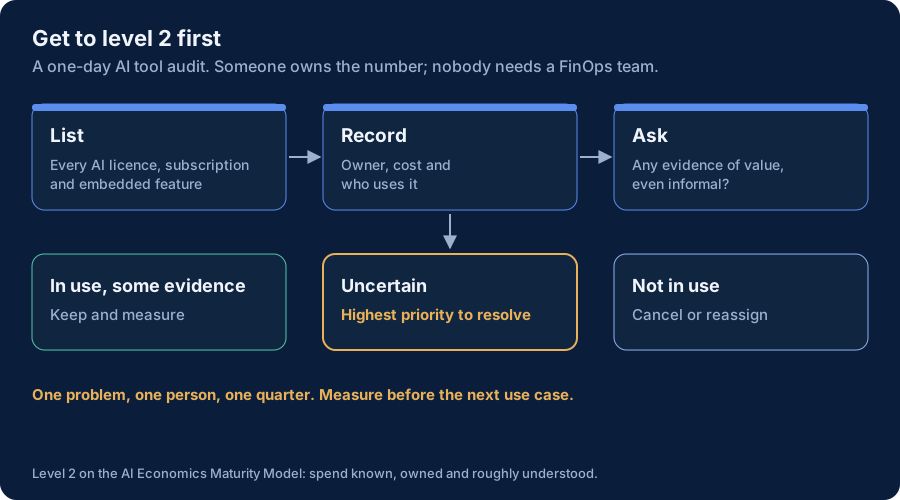
References and further reading
Related reading
Framework for AI cost management that scales from enterprise to mid-market with appropriate adaptation
Practical guidance on implementing AI governance without enterprise-scale resources
Cloud architecture guidance including cost optimisation patterns applicable at mid-market scale
Best practices for measuring and improving AI tool adoption in organisations of all sizes