

Key takeaways
- A new CAIO's credibility depends less on launching more pilots and more on installing the visibility, ownership, and proof systems the enterprise currently lacks.
- The first hundred days should produce an AI investment register, a shared proof standard, and a governance cadence across CIO, CFO, product, engineering, and risk leadership.
- The CAIO role works best when it clarifies economic accountability rather than becoming a loose coordination layer for every AI initiative.
- Early wins should make AI more governable, not only more visible.
The job beneath the title
Many newly appointed CAIOs inherit a mixed environment: high executive expectations, broad internal interest, uneven experimentation, and incomplete economics. Interpretation Some organisations already have active AI use cases. Others mostly have enthusiasm, vendor conversations, and pilot plans. In both cases, the first hundred days often determine whether the CAIO role becomes a strategic governance role or an elegant holding area for unresolved ownership. Interpretation
That is why the right opening focus is economic governance. Interpretation A CAIO does not need to know everything before acting, but they do need to make the organisation more capable of answering three questions: what are we spending, who owns the outcome, and what proof standard governs scale?
Real-world pattern: In 2026, Marc Benioff said Salesforce expected to spend about $300 million on Anthropic tokens in 2026, largely for coding-related work. This pattern-where the CAIO's first task is simply establishing what is already happening-is common across enterprises.
Days 1 to 30: build the first view of reality
The first task is not vision language. It is inventory and visibility. InterpretationBuild an AI investment register. List current and planned initiatives. Record sponsor, owner, workflow, model or tool path, current stage, spend surface, and intended benefit. The register does not need to be perfect before it becomes useful. It does need to exist. Interpretation
At the same time, identify where AI cost is already appearing. That includes model APIs, SaaS premiums, cloud workloads, data work, labour, and governance overhead. Interpretation Shadow AI matters here. A CAIO who only sees centrally sponsored initiatives is likely missing a material share of actual AI demand. Interpretation By the end of the first month, the CAIO should be able to tell the executive team where the estate is active, where spend is visible, and where governance is still mostly narrative. InterpretationDays 31 to 60: define proof and ownership
Once the inventory exists, the next task is to define a common proof standard. Interpretation Different initiatives may pursue different return dimensions, but they should not all be allowed to use different rules of evidence. InterpretationFor each material initiative, define:
- the primary return dimension
- the baseline
- the named value owner
- the expected timeline to proof
- the next stage-gate threshold
Proof standard in practice: The UK government's Microsoft 365 Copilot evaluations demonstrate the standard CAIOs should establish: task-level measurement, control groups where possible, quality scored, findings published even when unflattering. This rigour-applied consistently across all major AI initiatives-is what distinguishes governance from theatre.
This is also the period when the CAIO should work closely with the CFO and CIO. Interpretation The CFO needs to know how AI value claims will be evaluated. The CIO needs to know what shared platform and architecture assumptions are being made. Product and engineering leaders need to know what behaviour will be expected before a case is allowed to scale.
Days 61 to 100: establish the operating cadence
The final phase of the first hundred days is to create a governance rhythm that survives beyond the launch of the role itself. Interpretation That usually means a recurring AI portfolio review covering spend, demand, owner status, risk posture, and evidence quality. Interpretation The CAIO should also decide where each discipline fits: Interpretation- FinOps for live demand and unit-cost visibility
- TBM for service and capability translation
- ITFM for planning and reporting discipline
- SPM for portfolio sequencing and funding logic
- Engineering and product for workflow design and adoption
- Risk, security, and legal for control burden
Discipline integration example: The FinOps Foundation's 2025 guidance on AI scopes emphasises that AI cost management must extend beyond infrastructure to include model and inference costs, data and pipeline costs, and governance costs. A CAIO who positions FinOps as only an infrastructure concern will miss the majority of AI economics.
Methodology note on CAIO prevalence: IBM's 2025 CAIO report found that 26% of more than 2,300 contacted organisations had a CAIO. IBM's 2026 CEO Study reports 76% with a CAIO or equivalent. These figures should not be treated as a simple growth trend. The studies surveyed different populations, used different definitions (especially "or equivalent"), and may reflect rapid role creation, relabelling, or sampling differences. The useful insight is that AI accountability is moving higher in organisations, but title growth does not automatically mean clearer authority or better value governance.
The relationship with CIO, CFO, and CDO
The CAIO role often fails when it is positioned as a parallel executive domain rather than as a governance bridge. Interpretation With the CIO, the relationship is about architecture, operating model, and shared platform investment. Interpretation With the CFO, it is about capital discipline, proof standards, and economic comparability. Interpretation With the CDO or data leaders, it is about the quality and stewardship of the information layer AI depends on. Interpretation The CAIO's comparative advantage is not ownership of all AI work. It is stewardship of the economic and governance logic that connects these functions. InterpretationThe optimist's case
The CAIO role is essential for coordinating AI governance across fragmented functions. BCG's research on the AI value gap shows that organisations with dedicated AI leadership close the gap faster than those relying on distributed ownership. The role provides the executive mandate needed to enforce proof standards and economic discipline.
The sceptic's case
The CAIO role risks becoming another coordination layer that slows decisions without improving outcomes. Many organisations already have CIOs, CTOs, CDOs, and Chief Digital Officers-adding a CAIO creates overlap and confusion about who owns what. The risk is governance theatre: meetings, frameworks, and reporting that produce visibility without accountability.
Synthesis · house view
The CAIO role works when it clarifies accountability rather than diffusing it. The first hundred days should produce concrete governance artefacts-an investment register, proof standards, portfolio reviews-that make AI more governable. If the role becomes primarily about coordination meetings and strategy documents, it has failed. The test is whether the organisation can answer: what are we spending, who owns the outcome, and what proof standard governs scale?
What a good first hundred days produces
A strong first hundred days should leave the organisation with four concrete governance artefacts: Interpretation1. AI portfolio ledger
A structured register capturing for each initiative:
- use case and workflow
- named business and technology owners
- current stage (explore, prove, scale, operate, retire)
- spend surface and run cost
- value type and expected benefit
- risk tier and control requirements
- evidence quality and baseline confidence
- next decision date and threshold
2. C-suite decision-rights map
Explicit accountability across CEO, CAIO, CIO/CTO, CFO, CDO, business owners, risk, legal, and CHRO for:
- enterprise AI value thesis
- portfolio prioritisation and funding
- model and platform strategy
- use-case adoption and workflow integration
- stop, scale, and redesign decisions
- workforce capacity and reskilling
3. Impact measurement standard
A common framework defining:
- baseline confidence requirements
- benefit category (cost, capacity, quality, risk, revenue, strategic option)
- attribution method and coverage
- adoption and workflow-integration measures
- quality and control metrics
- net value calculation including incremental AI and change costs
4. Model and vendor portfolio view
An inventory showing:
- purpose and business owner
- model provider and commercial terms
- data exposure and jurisdiction
- cost structure and usage patterns
- performance and accuracy baselines
- control and observability requirements
- replacement or retirement plan
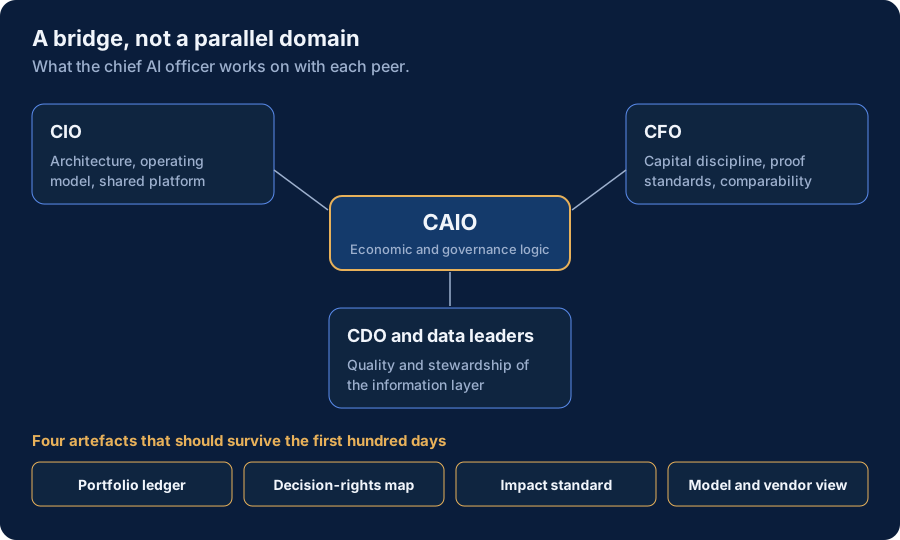
The practical conclusion
The first hundred days should not be judged by how many new AI ideas are announced. They should be judged by whether the organisation has become more capable of seeing, owning, and proving the value of the AI work it is already doing. Interpretation A CAIO who delivers that foundation will have done something more important than launching another set of pilots. They will have made enterprise AI more governable. InterpretationReferences and further reading
Related reading
2025 survey of 624 CAIOs showing how measurement, teamwork, and authority distinguish higher-impact CAIO organisations
Research on C-suite redesign for AI, including CAIO prevalence, decision rights, and workforce adoption gaps
Research on why organisations with dedicated AI leadership and measurement discipline close the value gap faster
Guidance on extending FinOps discipline to AI cost management, including model, inference, data, and governance costs
Cross-government evaluation demonstrating rigorous proof standards: task-level measurement, control groups, quality scoring
Framework treating economic sustainability as a governance concern, not just a finance concern
Case study of budget overrun when proof standards and ownership are unclear