

Summary
The independent evidence added this quarter points the same way as before: organisations are getting better at seeing what AI costs and no better at showing what it produced. The strongest new source is the Tokenomics Foundation's September survey. It adds something useful to the argument, which is who can show value. Those with a named owner and metered, attributable spend are far more likely to. We held both house positions and corrected several figures on the site that did not stand up to a primary check.
This is the first of a quarterly series. The next review is due in mid-January 2027.
What the new evidence says
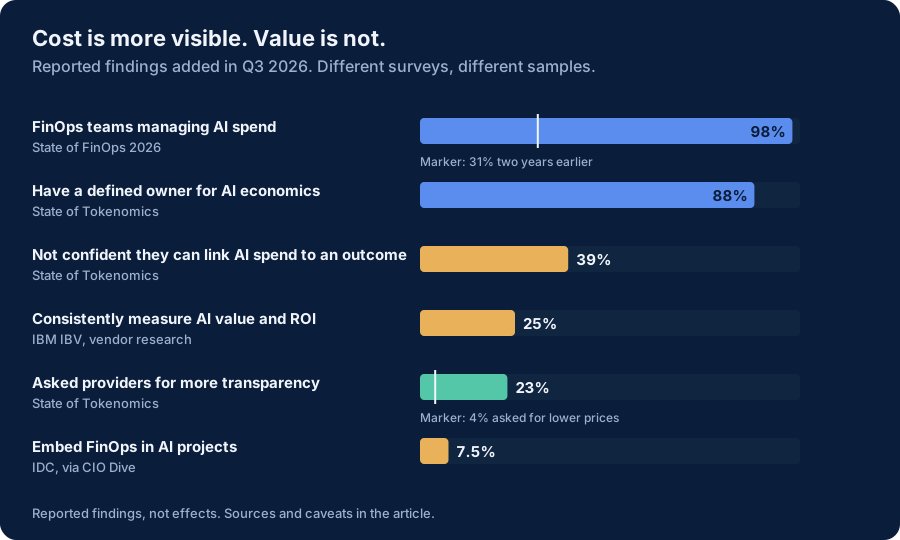
More organisations are being handed AI cost, and still cannot show value. The Tokenomics Foundation's State of Tokenomics (23 September 2026, Release Candidate 1.0, 472 responses across 11 industries) found 39% of respondents not confident they can connect AI spend to a measurable business outcome their CFO would accept. Only 25% of those with highly confident spend visibility could. 43% named proving value or ROI as their biggest challenge. The sample is self-selected, 40% technology and software, and the Foundation's members sell tooling.
Ownership and routing correlate with showing value. 88% have a defined owner for AI economics, and those that do were 3.7 times more likely to show value to the CFO. None of the 12% with no owner could. Those using a model router were four times more likely to show value. These are correlations, not effects.
Buyers want a bill they can explain, not a lower price. 23% asked providers for more transparency and granular data. 4% asked for cheaper prices.
FinOps scope has widened to AI. The State of FinOps 2026 (FinOps Foundation, 19 February 2026, 1,192 respondents) reports 98% now manage AI spend, up from 31% two years earlier, and many are asked to self-fund AI through optimisation savings. We had not cited its detail before.
Few are building FinOps into AI projects. IDC research reported by CIO Dive in April 2026 says only 7.5% of enterprises are embedding FinOps into AI projects.
Measurement of value is still rare. IBM's Institute for Business Value, an IBM-owned source, reports that 25% of executives say their organisations consistently measure business value and AI ROI.
Standards moved
- FOCUS 1.4 was ratified on 4 June 2026. It adds invoice reconciliation and commitment detail. Support for AI and token costs is planned for FOCUS 1.5, which the Tokenomics Foundation lists for December 2026. Plans can move.
- The Tokenomics Foundation's value classification reached Release Candidate 2 on 16 September 2026. It frames its output as value claims, not ROI, and sets no standard limit on how many estimation steps a claim may carry.
- The TBM Council's taxonomy is at version 5.0.1, with a solution type for AI.
The standards map sets out what each covers and where it stops.
What it means for our positions
| Position | Status | Assessment |
|---|---|---|
| The AI value gap is a governance failure, not a measurement impossibility | Holding | The ownership and metering findings are consistent with it. They are correlations and do not prove it. |
| Total AI invoices will rise for at least the next three years regardless of unit prices | Holding | No verified evidence on invoice totals either way. We have not used unverified token-volume figures. |
Both are on the position ledger.
What we changed on the site
Checking figures at their sources found problems in our own pages. We corrected them and logged each on the corrections page:
- A McKinsey figure had been described as "5 to 6% see clear financial ROI". The source says 39% report any EBIT impact and about 6% attribute 5% or more of EBIT to AI and report significant value. Corrected on four pages.
- An IBM figure of 29% could only be traced to a blog. It is replaced by the 25% figure above.
- A vendor's 30 to 50% inference forecast gap and 9x price spread had been presented as findings. The first is the vendor's own estimate and the second is a spread in list input prices for one model. Both are now described accurately.
- The five-level maturity chart carried a market distribution with no source. The percentages are removed.
- Token price ranges were out of date and are replaced with current list prices from two providers.
- The billing API reference had the wrong Anthropic endpoint and an outdated statement about Cursor.
What we are watching next quarter
- FOCUS 1.5 and what it says about AI and token costs.
- Whether the Tokenomics Foundation's value classification moves from Release Candidate to a final version, and whether it sets thresholds.
- Any verified series of enterprise AI invoices, which would test our second position.
- A second year of State of Tokenomics data, if published.