

Key takeaways
- Inference-era AI workloads make cost more sensitive to workflow design, model routing, context policy, and user behaviour than traditional cloud workloads were.
- FinOps Foundation shows AI has become a mainstream FinOps scope, but governance, forecasting, and organisational alignment still outrank optimisation as immediate priorities.
- Agentic systems can consume five to thirty times more tokens per task than simpler chat use cases, which makes workflow-level visibility essential.
- Strong AI FinOps starts with cost per inference, cost per action, and design-time estimation rather than invoice review alone.
A different cost environment
FinOps matured in an era when the main challenge was governing elastic cloud infrastructure. Inference-era AI workloads change that challenge rather than replacing it.
Cost is still variable, but now it is shaped by far more than compute selection or resource utilisation. Model choice, prompt design, context length, routing logic, caching, fallback behaviour, retrieval architecture, and user interaction patterns all become part of the economic system. In other words, service design itself becomes a major driver of cost.
This is why FinOps Foundation's 2026 findings matter so much. AI is now part of nearly every FinOps practice, yet optimisation is not the main concern in the way it is for cloud. Governance, forecasting, and organisational alignment rank higher. That should tell leaders something important: the discipline is still trying to make AI spend legible before it can fully optimise it.
Why inference-era workloads are harder to govern
Inference-heavy AI services create four challenges that cloud-era FinOps did not have to handle at the same depth.
The first is behavioural variability. Two users may interact with the same service in ways that generate very different cost profiles because prompt length, interaction depth, and retry behaviour vary materially.
The second is model variability. Routing between different model classes can change economics dramatically even when user experience appears similar. If the organisation cannot see which workflows are invoking which models under which conditions, optimisation becomes guesswork.
The third is orchestration complexity. Inference cost increasingly includes not just one model call, but retrieval, classification, safety checks, fallback calls, and workflow branching. A service may appear to have one AI feature while actually operating as a chain of cost-generating steps.
The fourth is accountability ambiguity. Shared AI services often sit between platform teams, product owners, and finance functions. Without deliberate ownership, everyone sees part of the cost and no one owns the unit economics end to end.
What FinOps needs to measure now
Inference-era FinOps needs a broader measurement model than classic cloud cost reporting.
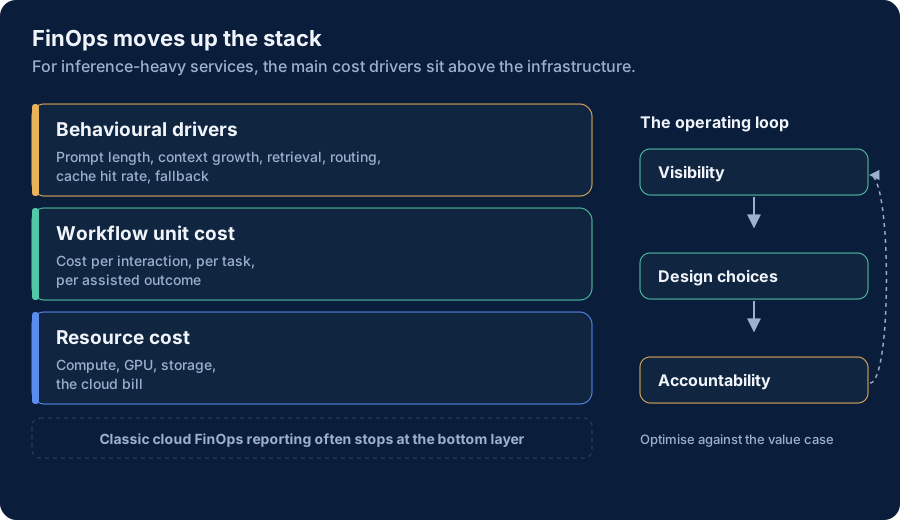
It still needs resource-level visibility, but it also needs workflow-level visibility. That means leaders need to understand cost per interaction, cost per task, cost per assisted outcome, or cost per business action, depending on the workflow. Infrastructure metrics alone do not tell the whole story.
It also needs to capture behavioural drivers. Prompt length, context growth, retrieval frequency, routing decisions, cache hit rates, and fallback patterns are not technical trivia. They are cost drivers.
And it needs to distinguish between productive demand and noisy demand. Some usage signals value. Some signals poor workflow design, weak controls, or uncontrolled experimentation. If those are not separated, the organisation may scale activity while misunderstanding its economics.
Where older FinOps habits fall short
A cloud-era FinOps posture often assumes that once cost is visible, teams can optimise from the infrastructure layer upward. In inference-era workloads, many of the highest-leverage choices happen further up the stack.
For example, a team may pursue infrastructure savings while leaving prompt inefficiency, poor model routing, or unnecessary context expansion untouched. The cloud bill may improve slightly, while the service remains economically weak at the workflow level.
Another common habit is to rely on monthly or quarterly reporting cadence. That is often too slow in AI. Inference demand can shift quickly as features spread, user behaviour changes, or teams reuse patterns across products. FinOps needs a tighter operating loop if it is going to influence the economics while demand is still forming.
Finally, many organisations still separate optimisation from business accountability too sharply. Platform teams optimise systems. Finance reviews spend. Product teams manage adoption. In inference-era workloads, those streams need to converge much earlier.
The new operating loop
Strong FinOps for inference-era workloads depends on a tighter loop between visibility, design, and governance.
First, teams need visibility into which workflows are generating demand and how that demand is being processed.
Second, they need the ability to connect cost back to service design choices such as model routing, context policy, and orchestration complexity.
Third, they need shared accountability for whether the resulting cost profile still supports the value case. This is where AI TCO Framework and AI ROI Models matter. Optimisation should not happen in a vacuum. It should happen in relation to the wider cost stack and the expected return.
What leaders should do now
Leaders do not need perfect measurement before they improve. But they do need a better operating standard.
They should start by identifying the most economically meaningful unit for the workflow they are governing. That might be a conversation, a resolved service request, an assisted knowledge task, or a completed business transaction.
They should then connect that unit to the technical drivers shaping inference cost. This includes model choice, context policy, retrieval intensity, and fallback logic.
They should also assign ownership more clearly. Someone must own the workflow economics from end to end, not just the infrastructure budget or the product experience in isolation.
And they should review inference-era demand often enough that optimisation remains timely. If the organisation waits until spend has already hardened into a large quarterly variance, the most important design choices have already been made.
What to do next
For FinOps leaders:
- Establish AI as a formal reporting scope and define a standard set of unit-economics metrics for major workflows.
- Build pre-deployment estimation into architecture and product review rather than relying on post-invoice analysis.
- Pair workflow-level observability with finance reporting so anomaly response is faster and more actionable.
For engineering and platform leaders:
- Instrument prompt, routing, context, and fallback behaviour so cost can be tied back to design choices.
- Decide when smaller models, caching, or batch patterns are sufficient before premium model usage becomes the default.
- Assign a clear owner for workflow economics where multiple teams influence service behaviour.
For CFOs, CIOs, and portfolio leaders:
- Ask whether current AI spend can be explained at workflow level, not only at provider level.
- Review agentic and high-growth workloads more frequently than traditional software cost categories.
- Connect inference-era cost governance to the broader proof and portfolio model before approving scale.