
Key takeaways
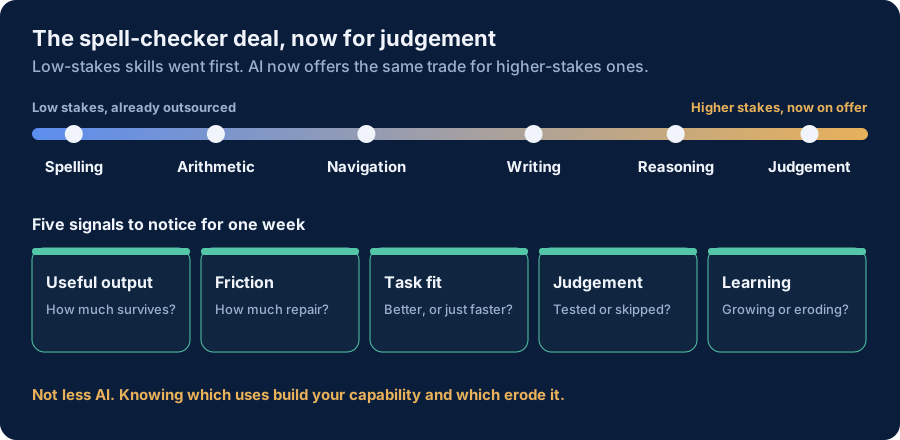
- Most people spell worse since spell-check arrived. We accepted that trade-off without much debate, because spelling is a low-stakes skill. AI is now proposing an equivalent trade-off for reasoning, writing, and judgment. The stakes are considerably higher.
- Dependency on AI is not inherently bad. Unexamined dependency - not knowing which capabilities you are quietly outsourcing - is the problem.
- Personal AI accountability is not about using less AI. It is about knowing which uses are building your capability and which are eroding it, and making that choice deliberately rather than by default.
- This is also a collective responsibility. How billions of individuals use AI - whether thoughtfully or carelessly, wastefully or efficiently, ethically or not - will shape AI's economic and social impact more than any governance framework designed in a boardroom.
The trade-off we accepted without noticing
Here is a fact about spell-check that most people have internalised without formally acknowledging: we all spell worse since it arrived. Interpretation This is not anecdotal. Research on cognitive offloading is consistent. When an external system reliably catches spelling errors, the brain deprioritises the neural maintenance of spelling. The mental resource is allocated elsewhere - more useful things, presumably. On balance, most people would accept this trade-off if asked directly. Spelling is a low-stakes skill. The cognitive overhead of maintaining accurate spelling competes with more valuable activities. Letting the software handle it is a reasonable choice. Interpretation But it was never really a choice. Nobody sat down and decided: "I will consciously allow my spelling capability to atrophy in exchange for error correction." It just happened, quietly, over years of autocorrect and red underlines and the progressive relaxation of effort in a domain where effort stopped being necessary. Interpretation AI is now proposing the same trade-off for a much longer list of cognitive activities: first drafts of written work, analysis of complex information, reasoning through ambiguous problems, formulation of arguments, synthesis of research, construction of recommendations, evaluation of options. In each of these domains, AI can now do a version of the task, and doing it yourself is increasingly optional in the immediate sense - the output exists either way. Interpretation The question that was never quite asked about spell-check - and is not yet being asked clearly enough about AI - is: which of these capabilities are you willing to let atrophy? Because the evidence from cognitive science is that you will let them atrophy, unless you make a deliberate choice not to. InterpretationThe cognitive outsourcing question
Companies think carefully about which capabilities to outsource. They outsource for efficiency - it is cheaper to use a specialist than to maintain the capability in-house. But they protect certain capabilities strategically, because losing them would create dangerous dependency, reduce competitive differentiation, or leave the organisation unable to evaluate the work of those it depends on.
A law firm outsources its office cleaning. It does not outsource its legal judgment. The distinction is not about cost - outsourcing legal judgment might be cheaper. It is about what defines the firm, what must remain internal to be trustworthy, and what disappears when the outsourcing relationship changes.
Knowledge workers now face the equivalent question at the individual level. Which cognitive capabilities are you keeping in-house - inside your own mind - and which are you allowing to migrate to AI dependence?
This question is harder than it looks, because the answer is not "use AI less." The answer requires distinguishing between:
Capabilities you are comfortable outsourcing because they are low-stakes, high-friction, or genuinely better done by a system than by you. Spell-checking is the archetype. Format conversion, rote summarisation of factual sources, boilerplate language generation - in these categories, dependency is probably fine.
Capabilities you need to keep sharp because they are high-stakes, require genuine judgment, or because you need to be able to evaluate whether the AI has done them well. Legal reasoning, financial analysis, clinical judgment, strategic assessment, original research synthesis, decisions that require you to account for context that no AI has - in these categories, outsourcing without deliberate maintenance of the underlying skill creates a slow-building liability.
Capabilities you need to maintain in order to know when AI is wrong. This is perhaps the most underappreciated category. If you routinely use AI to summarise complex documents, at what point can you no longer tell when the summary has missed something important? If you routinely use AI to draft arguments, at what point can you no longer identify when the argument has a logical flaw? The ability to evaluate AI output depends on maintaining enough of the underlying human capability to spot the failures. As that capability degrades, AI errors become harder to catch - precisely at the point when you are most dependent on AI being right.
The dependency trap
The dependency trap is not that AI will replace you. It is subtler than that: AI can gradually change what you are able to do, without you noticing, until a moment arrives when the capability you have been quietly outsourcing is suddenly needed and not there.
The aviation analogy is instructive, because it is one of the few domains where this dynamic has been formally studied and regulated. As aircraft became more automated, pilots flew less and less on manual control. The efficiency gains were real - autopilot is more precise, more consistent, and less tiring. But as manual flying time declined, something else declined too: the practiced reflexes and situational intuition that allow a pilot to respond effectively when the autopilot disengages unexpectedly. Several serious accidents have been partly attributed to the erosion of manual flying skills in pilots who had largely been managing automated systems rather than flying. Interpretation The response of the aviation profession was not to ban autopilot. It was to introduce currency requirements - minimum manual flying hours that every pilot must maintain, regardless of how good their automated systems are. The professional duty to maintain manual capability was formalised, because the consequences of losing it were too serious to leave to individual discretion. Interpretation Knowledge workers have no equivalent formal obligation. But the underlying logic applies. If you have used AI to draft every important document for the past two years, you have been reducing the currency of your writing capability in exactly the sense that a pilot reduces the currency of their manual flying skill. The question is not whether AI-assisted writing is good - often it is very good. The question is whether you have thought deliberately about maintaining enough underlying capability to function well without it, evaluate it critically, and recognise when it has failed. InterpretationReal-world example: Microsoft's research on Copilot usage patterns shows that developers who use AI coding assistants extensively report increased productivity but also acknowledge reduced confidence in their ability to write complex code from scratch. This mirrors the aviation pattern: efficiency gains coupled with skill erosion in domains where the AI becomes the default approach. Interpretation
Self-accountability: what this looks like in practice
Personal AI accountability is not about guilt, surveillance, or anti-AI sentiment. It is about the same professional self-awareness that good practitioners bring to any capability-development question: am I growing or eroding? Am I building judgment or offloading it? Are my decisions genuinely mine?
Five signals are worth building a habit of noticing:
Useful output. When you use AI to help produce work - a document, an analysis, a decision - what fraction of that output genuinely survives into the final product? If AI drafts are regularly copied with minor edits, you are outsourcing more than the friction. If they are regularly reworked substantially because you have a specific judgment that the AI did not capture, you are collaborating.
Friction. How much correction, revision, and repair do AI outputs require before they are usable? High friction may mean the AI is poorly matched to the task. It may also mean that your standards are being maintained actively, rather than quietly adjusted to what the AI can produce.
Task fit. For which specific tasks does AI use genuinely improve your work? For which does it make the work faster without making it better? For which does it produce outputs you would not have produced yourself - for better or worse? Most people who use AI extensively have not mapped this clearly.
Judgment. When you use AI, are you using it to sharpen and test your own thinking - presenting your reasoning to a system that can challenge it - or to avoid the reasoning step? The difference is not always obvious, but it is almost always meaningful.
Learning transfer. After a sustained period of AI use, has your underlying capability in the domains where you use it most improved, stayed the same, or declined? This is the hardest to measure but ultimately the most important signal.
These are not metrics to report to a manager. They are questions to ask yourself - the kind of deliberate self-examination that professionals in high-stakes domains practice as a matter of course, and that knowledge workers rarely apply to their own AI habits.
The wider responsibility
Individual AI habits aggregate into something larger. When billions of people outsource their first drafts, AI-generated content will increasingly define what passes as acceptable writing. When billions of people use AI to reason through problems, AI-assisted reasoning will become the baseline of what passes as good thinking. These are not small shifts - they are changes to the cognitive standards of knowledge work at civilisational scale. Speculation This does not mean AI is bad. It means the choices individuals make about how to use it are consequential beyond their own development. Interpretation Responsible AI use is sometimes framed as a compliance question - following rules about disclosure, bias, safety, privacy. Those rules matter. But there is a version of responsible AI use that sits before the rules: a disposition to think carefully about what you are doing, whether it is genuinely useful, whether it is honest, and whether it is building or eroding something valuable. Interpretation Using AI to generate work you will not read carefully is irresponsible - not because it violates a policy, but because it produces a world where important decisions are made on a foundation neither you nor anyone else has genuinely examined. Interpretation Using AI to produce outputs at a scale that would be impossible for any human to review is not efficiency. It is the creation of unaccountable output volume - and that is a problem whether the content is research, code, communications, legal analysis, or journalism. Interpretation Using AI to avoid the difficulty of a problem you should be engaging with directly is not saving time. It is trading your development for a marginal time saving on this task, in a way that will compound over years into a meaningful reduction in what you are capable of doing. Interpretation None of this argues for less AI use. It argues for more deliberate AI use - use that you have thought about, that you can account for, and that you would be comfortable explaining to the people affected by what you produce. InterpretationA practical starting point
You do not need tools, dashboards, or reporting structures to start. You need one week of deliberate observation.
For one week, notice the five signals described above in your own AI use. Do not change your behaviour - just observe it. At the end of the week, ask: which of my AI uses are making me better? Which are making the work better without making me better? Which am I doing reflexively, without having decided to?
That inventory is the beginning of a deliberate habit - which is all that personal AI accountability requires: not less AI, not more guilt, not a surveillance system, just enough self-awareness to be the author of your own choices rather than the accumulation of your defaults.
The optimist's case
AI augmentation makes knowledge workers more capable, not less. Just as calculators didn't make mathematicians worse at mathematics, AI tools won't erode core cognitive capabilities - they'll free people to focus on higher-order thinking, creativity, and judgment. The concern about skill atrophy assumes a zero-sum relationship between human and AI capability, when the reality is that AI enables people to tackle more complex problems than they could handle alone.
The sceptic's case
The calculator analogy fails because AI doesn't just handle computation - it handles reasoning, writing, and judgment, which are the core capabilities that define knowledge work. Unlike calculators, which augment a narrow skill, AI substitutes for the entire cognitive process. The risk isn't that people will lose trivial skills - it's that they'll lose the ability to think deeply, write clearly, and reason independently. Once those capabilities atrophy, there's no going back, and the dependency becomes permanent.
Further reading on AI and cognitive capability
Cognitive Offloading and Technology
Nature research on how external systems affect human cognitive capability
AI Is Changing How We Think
Harvard Business Review analysis of AI's impact on knowledge work
Generative AI and the Future of Work
McKinsey research on AI adoption patterns and workforce implications