
The difference between cost avoidance and cost reduction is one of the most practically important distinctions in AI ROI analysis, and it is routinely elided in AI business cases.
Cost reduction is a decrease in actual expenditure. If an AI capability reduces customer service handling time and the organisation reduces its contact centre headcount as a result, that is cost reduction - the operating cost line moves down. It is auditable and observable.
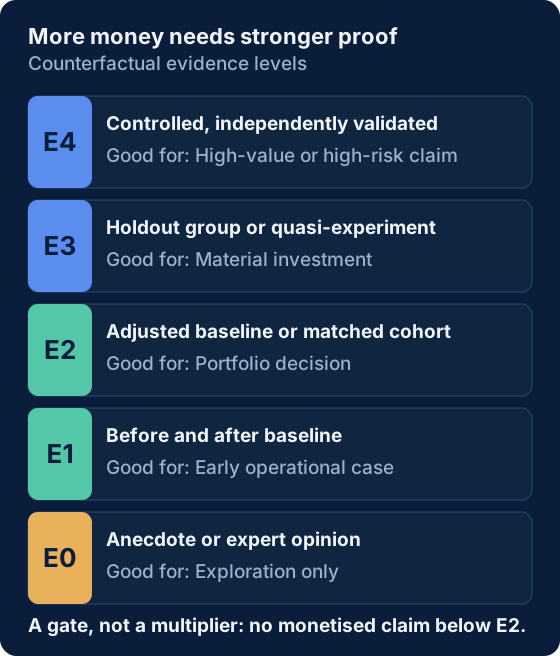
Cost avoidance is the prevention of cost that would otherwise have been incurred. If AI-assisted quality control prevents a product recall that would have cost £2M, that is cost avoidance - the £2M was never spent, but it also never appeared in the P&L as a saving. Cost avoidance is genuinely valuable, but it is inherently harder to verify than cost reduction because it depends on demonstrating what would have happened in the absence of the AI capability.
In AI business cases, cost avoidance claims are often presented with a specificity that the underlying counterfactual does not support. "AI will avoid X headcount additions over three years" is a cost avoidance claim that depends on a forecast of future business volume, a forecast of AI-driven productivity improvement, and a management commitment to not hire the avoided headcount. All three elements are uncertain, and the claim cannot be verified in the way that a demonstrated cost reduction can.
Finance leaders should apply different scrutiny standards to each type. Cost reduction claims should be supported by baseline measurement and verifiable outcome data. Cost avoidance claims should be supported by explicit counterfactual logic, sensitivity analysis on key assumptions, and clear ownership of the decision commitment that converts the avoidance from theoretical to actual.