

Most AI business cases arrive at finance with a single number: annual benefit divided by annual cost, or a percentage return. A finance committee reads it differently. It asks three questions the headline ratio does not answer. What is the case worth once the timing of the cash is priced in? How long until the money comes back? And how will the spend show up in the accounts?
None of this is specific to AI. What is specific is that AI cases tend to fail all three in the same way: costs arrive early and are certain, benefits arrive late and are not, and the unit price of the main input changes several times during the life of the project.
Test one: what is the case worth today?
A pound of benefit in year three is worth less than a pound of cost today. Finance prices that with a discount rate, usually the organisation's cost of capital or a hurdle rate set above it. The result is the net present value (NPV): the sum of each year's net cash flow, discounted back to today. A case with a positive NPV at the organisation's rate creates value; one with a negative NPV destroys it, however good its simple ratio looks.
The internal rate of return (IRR) is the discount rate at which NPV is exactly zero. If it is above the hurdle rate, the case passes.
Two practical points for AI cases:
- Ask finance for the rate; do not choose it. Most organisations publish one. Using a lower rate than finance will is the quickest way to lose credibility in the room.
- Price risk in the cash flows, not by stacking premiums on the rate. A higher rate penalises late benefits but says nothing about which risk you are pricing. A scenario with lower adoption, a later start or a higher token price is easier to discuss and easier to track afterwards.
Test two: how fast does the money come back?
Payback is the time until cumulative net cash turns positive. It ignores what happens afterwards, which is why finance does not use it alone. It earns its place for AI because the useful life of an AI design is short. Models, prices and vendor terms change within a year or two, so a case that only pays back in year four is betting on conditions that probably will not hold.
An illustrative case
| £ thousands | Year 0 | Year 1 | Year 2 | Year 3 | Total |
|---|---|---|---|---|---|
| Build | −400 | −400 | |||
| Running cost | −150 | −150 | −150 | −450 | |
| Booked benefit | 200 | 400 | 400 | 1,000 | |
| Net cash flow | −400 | 50 | 250 | 250 | 150 |
| Cumulative | −400 | −350 | −100 | 150 |
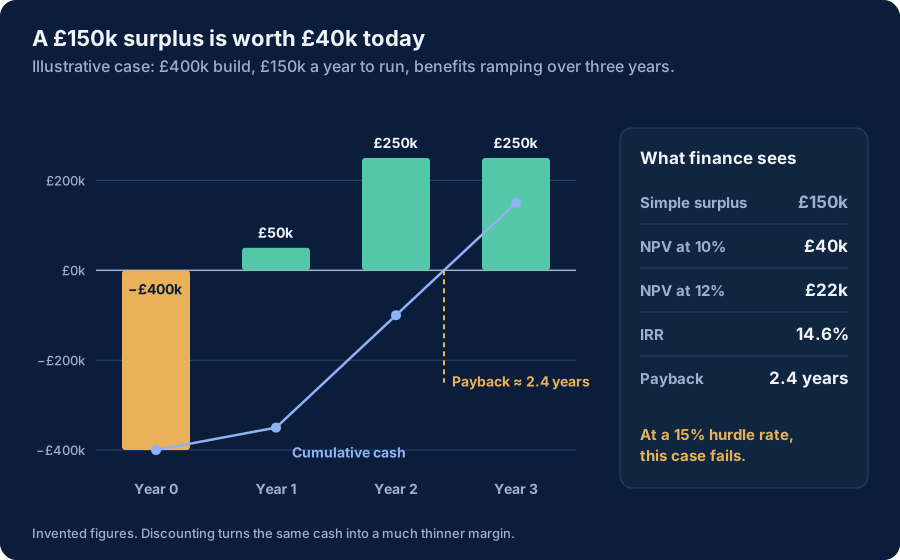
The simple view is a £150,000 surplus. The finance view:
- NPV at 10%: about £40,000. Positive, but a quarter of the simple surplus.
- NPV at 12%: about £22,000.
- IRR: about 14.6%. At a 15% hurdle, the case fails.
- Payback: about 2.4 years, late in a three-year life.
Now two things that commonly happen to AI cases:
| Scenario | NPV at 10% | Payback |
|---|---|---|
| As planned | £40k | 2.4 years |
| Benefits start a year late (costs do not) | −£307k | Not within three years |
| Running cost £30k a year higher, for example a token price rise or more usage than forecast | −£35k | 2.7 years |
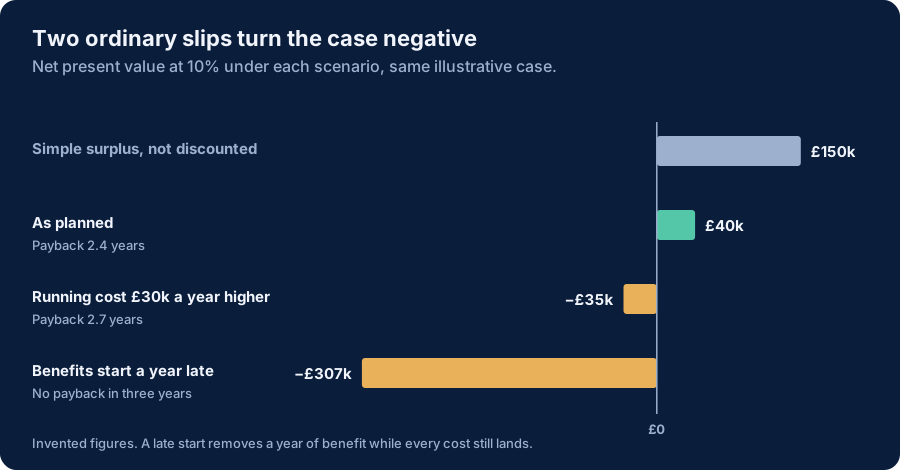
A one-year delay inside a three-year life removes a full year of benefit while every cost still lands. That is why the adoption plan matters more to the finance case than the model choice, and why the budget stress test is worth running before the case goes in. A modest rise in running cost is enough to turn this case negative, which is the practical meaning of a thin margin.
Test three: capex or opex?
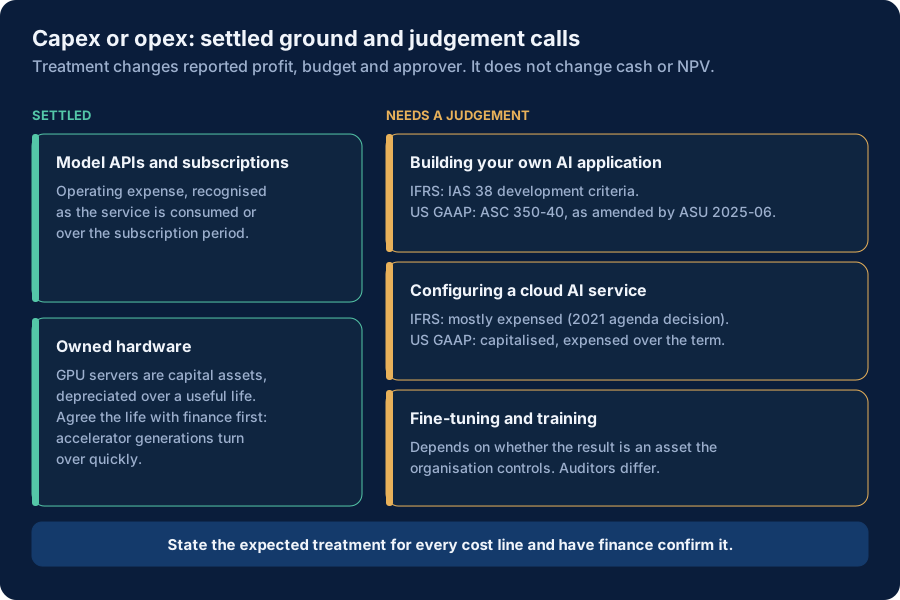
Accounting treatment does not change the cash, so it does not change NPV. It does change three things the sponsor cares about: when the cost hits reported profit, which budget pays for it, and which committee approves it. A case drafted as operating spend that finance classifies as capital, or the reverse, goes back to the start.
The settled ground:
- Pay-per-use model APIs and AI subscriptions are operating expenses, recognised as the service is consumed or over the subscription period.
- Hardware the organisation owns, such as GPU servers, is property, plant and equipment, depreciated over its useful life. The useful-life assumption is a material judgement for accelerators, because hardware generations turn over quickly; ask finance which life they will use before you put depreciation in the case.
Where judgement is needed:
- Building your own AI application. Under IFRS, IAS 38 requires research costs to be expensed and allows development costs to be capitalised only when specific criteria are met, including technical feasibility, the intention and ability to complete and use the asset, probable future economic benefit and reliable measurement. Under US GAAP, ASC 350-40 governs internal-use software. ASU 2025-06 removes its project stages: costs are capitalised once management has authorised and committed to funding the project and completion is probable, and not while significant development uncertainty remains. It applies to annual periods beginning after 15 December 2027 for public and private entities, with early adoption allowed.
- Configuring or customising a cloud AI service. Under IFRS, the IFRS Interpretations Committee's 2021 agenda decision on configuration and customisation in cloud computing arrangements means most such costs are expensed, unless they create an asset the organisation controls. Under US GAAP, implementation costs of a hosting arrangement that is a service contract can be capitalised and expensed over the term of the arrangement.
- Fine-tuning and training. Whether this spend creates an asset depends on whether the result is something the organisation controls and that meets the capitalisation criteria. Treatments vary, and auditors take different views. Agree it with finance before the case is written.
What to put in the case
- Cash flows by year for build, running cost and booked benefit, not one annual ratio.
- NPV and IRR at the rate finance gives you, and payback.
- Two or three named scenarios: a later start, lower adoption, a higher unit price. Show what each does to NPV and payback.
- The expected accounting treatment of each cost line, confirmed by finance.
- The horizon and why it is credible for a design that will be superseded.
- The review point at which the case will be checked against actuals, using the value ledger.
What would change this view
- If AI prices and models stabilise, longer horizons become defensible and payback matters less.
- If ASU 2025-06 or future IFRS guidance leads to more AI development spend being capitalised, reported profit will look better in the build year without any change in value. Finance teams will need to explain that difference to boards.
Sources
- IFRS Foundation, IAS 38 Intangible Assets: recognition of development costs.
- IFRS Interpretations Committee, agenda decision on configuration or customisation costs in a cloud computing arrangement (2021), summarised by Grant Thornton.
- FASB, ASU 2018-15 (implementation costs in a cloud computing arrangement that is a service contract) and ASU 2025-06 (internal-use software), summarised by EisnerAmper.