

Updated 5 November 2026. What changed
Key takeaways
- Most coverage of AI's capital spending is written for investors. Enterprise buyers face a different question: what happens to their prices, commitments and data if their suppliers' economics do not work out.
- Gartner estimates that more than $3.5 trillion of AI infrastructure spending could be exposed to impairment by the end of 2030, and expects more than 80% of specialist GPU cloud providers to stop operating independently by then. These are forecasts, not measurements.
- For most buyers the main exposure is price and terms, not supplier failure. Suppliers under pressure to earn a return have more reason to raise prices or withdraw discounts than to cut them.
- The direct failure risk sits with prepaid or committed capacity from smaller infrastructure providers. That is where contract terms matter most.
- None of this is a reason to stop buying AI. It is a reason to check counterparties, keep commitments shorter than the hardware generation, and keep a costed way out.
What has changed
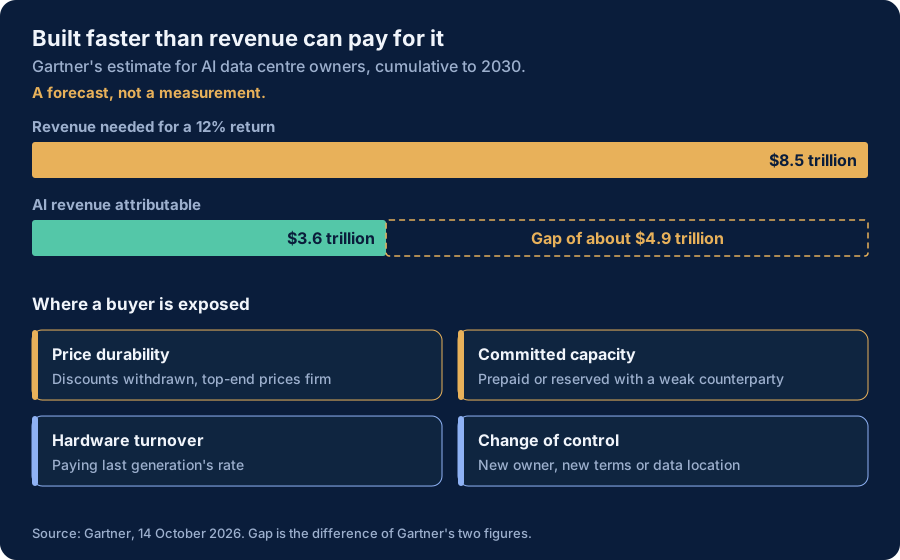
On 14 October 2026 Gartner published an estimate that AI data centre owners would need about $8.5 trillion of cumulative revenue through 2030 to cover announced capital spending, financing costs and a 12% return on invested capital. It forecasts no more than $3.6 trillion of enterprise and consumer AI revenue attributable to those data centres over the same period. On that basis it expects more than $3.5 trillion of AI infrastructure spending to be exposed to impairment by the end of 2030, and more than 80% of neocloud providers, the specialist GPU clouds, to cease independent operations by 2030. It expects the large cloud providers, with more diverse revenue, to sustain investment for longer (Gartner, 14 October 2026).
Lenders have started to act on the same concern. Axios reported on 16 October that banks were reducing their exposure to data centre loans, that roughly a third of AI capital spending is now funded by debt, and, citing the Financial Times, that global AI-related debt issuance fell from $113 billion in June to $23 billion in September 2026 (Axios, republished by Yahoo Finance).
Neither source says AI is failing to produce value for the organisations that use it. They say that the infrastructure may have been built faster than revenue can pay for it. That is a problem for suppliers and their lenders first. It becomes a buyer's problem through prices, contracts and continuity.
Four exposures for a buyer
1. Price durability
A supplier earning below its cost of capital has three levers: raise prices, reduce discounts, or cut its own costs. Buyers see the first two. Per-token list prices have so far moved both ways. In October 2026 one major provider cut its small-model price tenfold while leaving its most expensive model unchanged, and one widely used model has a scheduled price rise on 1 January 2027 (see the position ledger, P2). Expect more of that pattern: cheaper at the bottom of the range, where competition from open-weight models is strongest, and firmer at the top, where buyers have fewer alternatives.
What to do. Model the business case at today's price and at a higher one. The AI budget stress test does this. Seek price protection at renewal for the workloads that depend on a frontier model.
2. Counterparty risk on committed capacity
Pay-as-you-go usage carries little failure risk for the buyer: if a provider fails, the workload moves and the cost is the move. Commitments are different. Reserved GPU capacity, prepaid credits and multi-year minimums tie the buyer to the supplier's balance sheet for the term. If the supplier is acquired, the terms may change. If it fails, a prepaid balance becomes an unsecured claim, and reserved capacity may disappear at short notice.
This risk is concentrated in smaller infrastructure providers, which Gartner expects to be the most exposed. Capacity bought from the major clouds carries far less of it, though not none of the price risk above.
What to do. Know how each infrastructure supplier is funded and who owns it. Limit prepayment. Ask what happens to reserved capacity and stored data on a change of control or insolvency, and write the answer into the contract.
3. Commitments that outlast the hardware
Gartner's analysis rests partly on the speed at which AI chips are replaced. Providers that cannot recover their investment before the next generation arrives have to write it down. The buyer's version of the same risk is a multi-year commitment priced on today's hardware. When the next generation lowers the market price of capacity, a buyer locked into the old rate pays above market for the rest of the term.
What to do. Keep commitment terms shorter than the hardware generation where you can, or include a scheduled benchmark review. The committed capacity guidance sets out when commitment pays at all.
4. Change of control
If most neoclouds stop operating independently, many will be bought. An acquisition can be good for a buyer: stronger support, more durable investment. It can also bring new pricing, a changed model catalogue or a different data processing location. Contracts signed with an independent provider are then serviced by a company the buyer did not choose.
What to do. Include change-of-control rights, notice of material change and termination without penalty if the terms change.
What it does not mean
- It does not mean stopping AI investment. The case for an AI workload rests on its own value. A supplier's balance sheet changes the risk around the case, not the case itself.
- It does not mean avoiding smaller providers. They often offer better prices and specialist capacity. It means matching the commitment to the counterparty.
- It does not mean prices will rise across the board. Competition, open-weight models and new hardware all push the other way. The likely result is a wider spread of prices, not a uniform rise.
A buyer's checklist
The AI Supplier Economics Review already lists twelve contract terms. For infrastructure suppliers and any contract with a commitment, these questions come first.
| Question | Why it matters | Where it belongs |
|---|---|---|
| Who owns and funds the supplier? | Debt-funded providers are the most exposed to a credit squeeze | Supplier due diligence |
| How much have we prepaid or committed, and for how long? | Sets the size of the loss if the supplier fails | Commitment register |
| Is the term shorter than the hardware generation? | Avoids paying last generation's price for the next one | Commercial terms |
| Are prices fixed for the term and protected at renewal? | Protects the business case from repricing | Price protection clause |
| What happens on a change of control? | Terms, catalogue and data location can change | Change-of-control clause |
| What happens to our data and capacity on insolvency? | Recovery of data and continuity of service | Data return, step-in and exit assistance |
| Can the workload move, and what would moving cost? | A costed exit is the real protection | Exit plan, model abstraction |
| What share of AI spend sits with one infrastructure supplier? | Concentration turns one failure into a programme failure | Portfolio review |
What changed
Sources
- Gartner, "Gartner Says Over $3.5 Trillion of Artificial Intelligence Infrastructure Spending Could Be Exposed to Impairment by the End of 2030", press release, 14 October 2026.
- Axios, "Banks are pulling back as AI's massive debt pile disconnects from economic reality", 16 October 2026, republished by Yahoo Finance. Issuance figures attributed to the Financial Times.
- Third-quarter 2026 results: Meta (21 October), Microsoft (28 October), Amazon (29 October). Alphabet (28 October) via Univest and PrimeXBT, secondary.
- IG, "Amazon Q3 earnings preview", 28 October 2026, reporting Andy Jassy's remarks of 23 October. Secondary.
- Network World, "Gartner forecasts 15% global IT spending growth", 22 October 2026, reporting Gartner's forecast of 21 October. Secondary.
- Anthropic, "Anthropic files S-1 with the SEC", 26 October 2026.
- Fortune, "The AI boom is nearly $5 trillion short of paying for itself, Gartner says", 21 October 2026. Secondary account of the Gartner analysis.