

Anthropic's latest enterprise announcement deserves a serious answer from anyone who builds or buys AI economics tools. If the AI platform can explain what people used it for, what they produced, where they struggled and what that activity cost, how much of a separate measurement product does a customer still need?
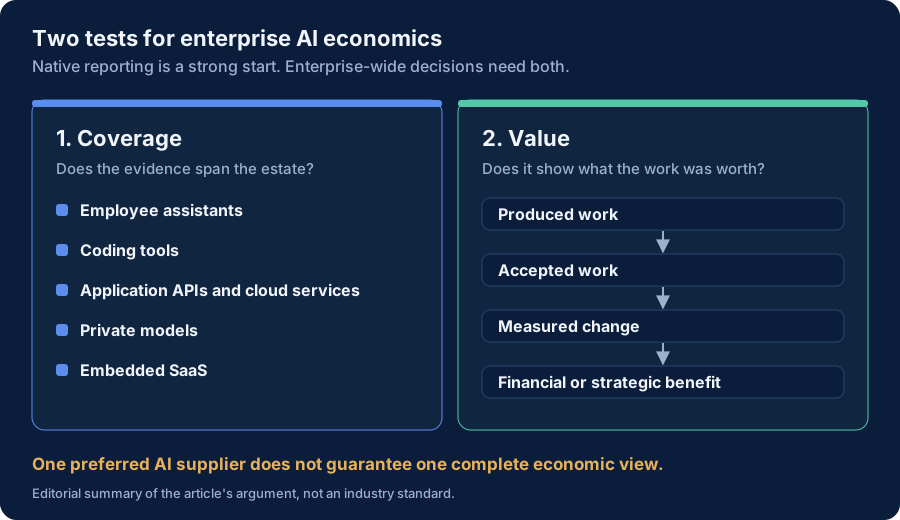
In short: provider reporting could become enough for a meaningful share of everyday AI management, and basic token dashboards face real pressure. Enterprise-wide decisions still have to pass two tests. Coverage: does the evidence span the material applications, model suppliers, contracts and deployment routes? Value: does it show accepted work and a credible business effect, with complete costs inside the same boundary? Who provides those capabilities is an open competitive question. The commercial threat to specialist tools is credible. The end of the FinOps discipline is a much larger claim.
What Anthropic has announced
On 28 October 2026 Anthropic announced smart reports, in-app surveys and pooled group budgets for Claude Enterprise. Smart reports read a sample of a team's transcripts, group the work into workstreams, and show each workstream's spend, the deliverables produced and common friction points, with a list of recommendations. Surveys ask members about the value of their recent work. Pooled budgets give a group one shared monthly limit, with individual limits kept as a guardrail.
This brings discovery, measurement and some management actions into the product where the work happens. The documentation also sets boundaries that matter when deciding how much of the enterprise picture the reports represent.
| Boundary | What the documentation says |
|---|---|
| Products | Chat, Claude Code and Claude Cowork. Claude Code drops out where it runs under zero data retention |
| Period and method | A sample of transcripts over a chosen range of up to the last 28 days |
| Plans | Claude Enterprise only. Not available to Claude Platform (API) organisations |
| Configurations | Not available with customer-managed encryption keys, a HIPAA configuration, or a hybrid deployment that runs inference on the customer's own cloud provider |
| Cost basis | Spend is attached to each workstream and shown as average spend per session by output type. The article does not say whether this is list price or the invoiced charge |
| Intended use | Adoption and investment planning, not evaluating individual performance or employment decisions |
Why this could be different from cloud FinOps
An infrastructure bill is several steps removed from the work it supports. A virtual machine might run a customer service, an internal process or an abandoned experiment, and its consumption record alone does not say which.
An AI assistant sits closer to the task. The interaction can contain the request, the source material, the iterations and the resulting document or code. That gives the provider of the work surface a real information advantage over a billing-only tool: it can interpret the work as well as meter it. The advantage is weaker where a model API sits deep inside another application and sees little of the workflow or its result.
The join between technology activity and business results is not new. Microsoft's unit economics guidance already connects cloud costs to business units, application telemetry and wider costs including labour. What AI applications may do is automate more of that join. That is a stronger starting position, not proof that the join is complete.
Multi-cloud added one reason for independent tools: a common financial view across providers. It was never a requirement for FinOps, or proof that several clouds were the better architecture. The FinOps Foundation describes third-party tools as filling gaps in native functionality as well as covering several clouds. The same needs-based test should apply to AI.
The strongest case against another platform
Consider a company whose employee AI use is concentrated in one assistant. Its immediate decisions concern access, adoption, team budgets and which useful workflows to spread. For those decisions, native reports, finance records and a business owner's review may be enough. Buying another system to repeat the same charts could add cost and reconciliation work without improving a single decision.
Independent vendors should take that seriously. "One place to see your tokens" is a weak proposition when the provider can explain the work behind them.
A tool becoming redundant does not make the discipline redundant. Token economics remains useful for engineering decisions about model choice, context, retries and serving efficiency. The FinOps Foundation already separates resource efficiency metrics, such as cost per token, from business unit metrics, and says AI measurement should expand from tokens towards outcomes. Provider reporting can feed that practice and perform some of its tasks. A product built mainly around displaying consumption has to show what it adds.
One preferred supplier can still leave a fragmented estate
There is no reason to buy several employee assistants just to be multi-provider. Standardising simplifies training, support, procurement and the sharing of workflows, and another tool should earn its place through a real difference in capability, economics or requirements.
But choosing one preferred assistant does not settle every other AI decision.
Fragmentation can follow business needs without any strategy of accumulating suppliers. Four things need to be kept apart: the application, the model, the commercial supplier and the hosting route. Several models can sit behind one cloud contract, and one model family can arrive through several applications and contracts. Multi-model, multi-provider, multi-cloud and hybrid are related, but they are not the same thing.
Amazon Bedrock shows why. Its catalogue lists models from 19 providers, Anthropic among them, all bought through AWS. A Claude model called through Bedrock by your own application is a different contract, bill and reporting scope from Claude Enterprise. Smart reports are documented for Enterprise chat, Claude Code and Cowork, and exclude API organisations, so that use should not be assumed to appear in them. This is a question of scope, not a claim that Anthropic has no telemetry anywhere. Neither one cloud nor one preferred model supplier guarantees one complete economic view.
Self-hosting changes the accounting too. An internal price per token can allocate usage fairly. It does not establish the full cost of reserved or owned capacity, which includes idle time, operations and support. The AI TCO framework sets out the full cost stack. Smaller models can suit bounded tasks, but compare them at the required quality and at realistic volume.
The practical requirement is coverage of material spending and workflows. Keep the model and the delivery route as separate fields, reconcile usage estimates to actual charges, and do not count a Bedrock charge again as a direct model-provider bill. Where a SaaS product hides the underlying model, record the limitation rather than inventing precision. The instrumentation blueprint shows how a stable workload identity joins cost, usage, quality and outcome records across these sources.
The gap between an output and its value
A generated proposal is an output. A proposal the sales team accepts is a usable deliverable. A higher win rate is a business outcome. Additional contribution after delivery costs is a financial result. Each is a different claim needing different evidence.
A transcript can show what was attempted and produced. The later claims may need approval records, CRM results, a comparison with previous performance and an account of other changes affecting the result. Time works the same way: a user's report that a task became faster is useful evidence, but it does not show that payroll fell, recruitment was avoided or the released capacity did more valuable work. How to measure AI value sets out the steps from observed change to a defensible claim.
An independent dashboard does not solve this automatically either. It needs access to the same evidence and an agreed method. Independence is a different commercial position. It does not confer causal knowledge or completeness.
Where independent capability can still earn its place
The case for something beyond native reporting gets stronger when a decision crosses boundaries the native product does not cover well.
| Decision | Evidence or capability to test for |
|---|---|
| Which delivery setup should handle this workflow? | Comparable quality, latency and completed-work cost across realistic alternatives |
| What does the workflow fully cost? | Actual charges, commitments, shared infrastructure, integration, review and operating effort |
| Did the investment improve performance? | Business-system outcomes, a credible baseline or comparison, quality checks |
| Which initiatives deserve the next budget? | Consistent evidence and cost boundaries across the portfolio |
| Would the findings survive a supplier change? | Exportable records, stable workload identities, inspectable calculations |
These are tests of capability, not a shopping list. Existing finance, data and engineering tools may meet them. A specialist product has to make the work materially easier or the decisions materially better.
Incentives deserve attention too. A supplier benefits when customers find more uses for its service, which can align with the customer's interest. Procurement still needs a credible way to assess using less, switching, consolidating or stopping. The protection that matters is transparent evidence and clear decision rights, whoever supplies the reporting.
Who is building across these boundaries
Examples exist at different layers. The table records what each supplier documents, checked on 29 October 2026. It is not a ranking, a test, or evidence that any one of them covers enterprise AI economics end to end.
| Supplier or project | Documented role | Boundary to test |
|---|---|---|
| LiteLLM (gateway) | Open-source gateway and SDK across model providers including Bedrock, with spend tracking and budgets by key, user and team, and support for self-hosted vLLM endpoints | Records only traffic that passes through it. Separately bought assistants, embedded SaaS and actual infrastructure cost need other evidence |
| Langfuse (application observability) | Usage and cost of each model call in an application, with custom price definitions, for example for self-hosted models | Instrumented application cost is not a reconciled enterprise bill, full self-hosting cost or realised benefit |
| Finout (financial aggregation) | States native ingestion of Anthropic, OpenAI, Bedrock, Vertex AI and Azure OpenAI, plus coding tools such as Cursor and GitHub Copilot | Confirm connector scope and allocation inputs. Aggregated spend still needs quality and outcome evidence |
These layers can complement each other. A gateway can control consumption, application telemetry can explain behaviour, and financial aggregation can reconcile expenditure. Employee productivity and embedded SaaS evidence may arrive by other routes again. Seeing more models is useful. Knowing which complete workflow to fund is the stronger test.
Could the providers close the gap?
Yes. Business-system connectors, execution records and customer-defined measures could bring providers closer to verified outcomes. Wider cost ingestion could widen their financial scope, and cross-provider support could reduce their coverage disadvantage. Today's limits are not permanent protection for anyone.
Start with the native report, then test the missing joins
First, map material AI use across assistants, coding tools, application APIs, cloud services, private hosting and embedded SaaS, and mark which parts the native reports actually cover.
Then take one material workflow from the provider's report and ask its business owner to establish three things: what was accepted and used, what changed against a credible comparison, and what the complete cost was within the same boundary.
Then identify which missing evidence would change the next funding decision. That is the requirement to solve, whether the answer is the provider's own reporting, existing finance processes or another tool.
The useful buying question is now: which decision can we make better with this additional capability than with the provider's own evidence?
To find out, use the attribution coverage calculator to see how much AI spend is connected to an owner, a baseline and a measured outcome. Coverage is not proof of return, but it makes the evidence gaps visible. The instrumentation blueprint then shows how to plan the missing joins.
Sources and scope
- Anthropic, "Smart reports, surveys, and pooled group budgets for Claude Enterprise", 28 October 2026. Read 29 October 2026.
- Anthropic Help Center, "Get started with smart reports", read 29 October 2026. Product boundaries reflect the page on that date.
- Microsoft Learn, "Unit economics", last updated 2 April 2025, read 29 October 2026.
- FinOps Foundation, "Unit Economics capability", read 29 October 2026. The distinction between resource efficiency and business unit metrics is the FinOps Foundation's; framework material licensed under CC BY 4.0.
- FinOps Foundation, "FinOps Tools and Services", read 29 October 2026.
- AWS, "Models at a glance", Amazon Bedrock User Guide, read 29 October 2026.
- LiteLLM, "Spend tracking", "Budgets, rate limits" and "vLLM", read 29 October 2026.
- Langfuse, "Model usage and cost tracking", read 29 October 2026.
- Finout, "AI cost management and observability", read 29 October 2026. Establishes the supplier's stated scope, not tested completeness or ROI attribution.
This essay separates documented product capabilities from its own assessment of what they imply. The market scenarios are hypotheses and the worked example is illustrative. It does not report a hands-on evaluation of smart reports, customer interviews or a comparative test of vendors.