

An AI use case can be promising before its return is known. The mistake is turning that uncertainty into a confident financial claim.
If the baseline is missing, the cost scope is incomplete or the outcome has not been measured, say so. The review can still explain the purpose, the known expenditure and the next commitment.
The question becomes: what is worth spending to learn whether this works?
Separate three situations
First, there may be no outcome measurement. Users like the tool, but nobody has measured what changed.
Second, there may be an observed improvement without a credible explanation of what caused it. Handling time fell, but staffing, demand or the workflow also changed.
Third, there may be a measured improvement whose financial conversion is unresolved. Time was released, but the organisation has not decided whether to use it for more output, better service or lower expenditure.
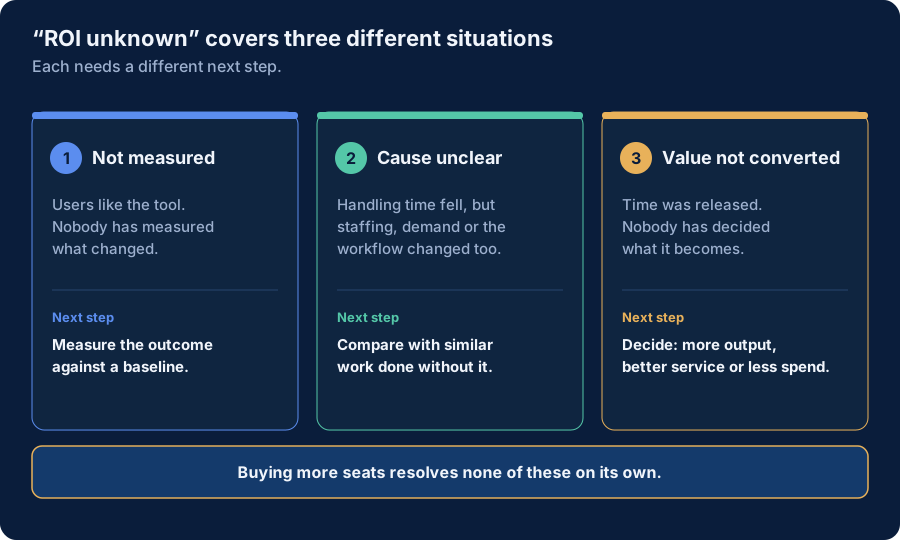
These situations need different actions. Buying more seats does not resolve any of them by itself.
Make the next commitment conditional
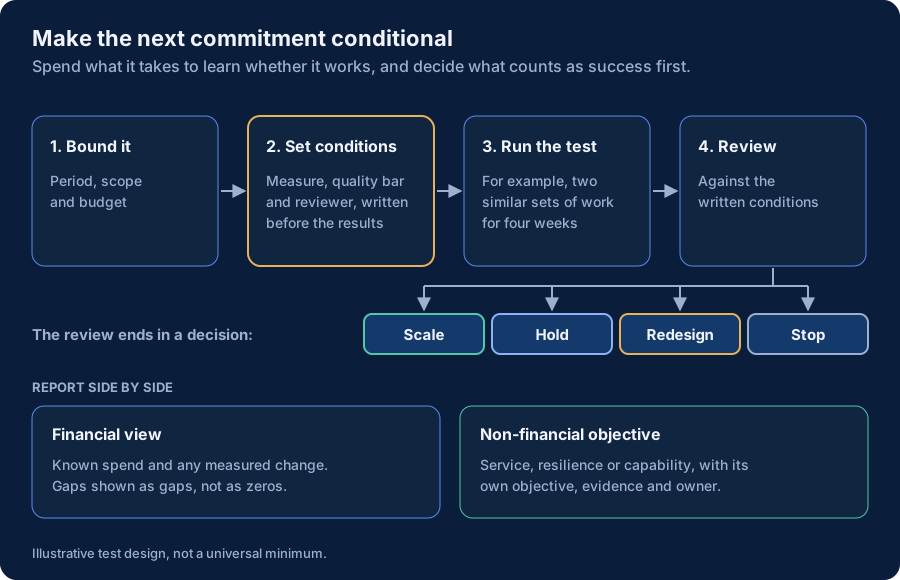
Define a bounded period or scope. State what will be measured, which quality requirement applies and who will review the result.
Write down the conditions before seeing the result. That makes it harder to keep changing the definition of success.
Report non-financial value honestly
Some initiatives improve service, resilience or strategic capability without producing an immediate cash saving.
Those outcomes can justify investment. They need their own objective, evidence and accountable owner. They should not be converted into a convenient salary saving just to populate a financial return field.
Show the financial view and the non-financial objective side by side. Let the decision owner explain the trade-off.
End with an action
"ROI unknown" is incomplete if nobody knows what happens next.
A useful review states the missing information, how it will be obtained, who owns the work and which commitment depends on the answer.
The purpose is not to delay every investment until certainty arrives. It is to make uncertainty explicit and avoid committing more than the current evidence supports.
Tools and templates
AI Investment Decision Memorandum
Word template. A seven-part memorandum for a material funding request, built around a proof plan and exit criteria written before the money is spent.
AI Benefits Register
Excel template. Track each benefit by type, owner and booking record, so only value that has reached an accepted record counts as realised.