

In 2025 and much of 2026, many large organisations asked their people to use more AI. Some ranked staff by usage. By the autumn of 2026 the same organisations were setting limits. Apple's per-person daily allowances, reported by Bloomberg on 4 November, are the clearest public example so far, and they will not be the last.
Limits are a reasonable response to a bill that has outrun its budget. They are not an answer to the question finance actually needs answered, which is which part of that bill earned its return.
In short: a usage cap is a cost control, not a value decision. A flat cap per person limits the total without looking at what the spend produced, so it tends to cut hardest where use is heaviest, which is often where the measured value is too, and to leave low-value use untouched. Budget by use case instead of by person. Read spend per person as a distribution. Tie exemptions to evidence of value, not to seniority. Route work to cheaper models before rationing it. Then measure cost per successful outcome and track how much of the spend is tied to an outcome at all, so the next budget conversation is about value rather than volume.
Key takeaways
- Overruns are now common. In Menlo Ventures' September survey of US enterprises, AI spend averaged about 2.5 times what companies planned. Accenture reports that one in three organisations had already exhausted its annual token budget.
- Visibility of the bill has run ahead of visibility of what drives it. Deloitte found 71% of organisations track total AI inference and API spend but only 44% track unit cost, and Accenture found fewer than one dollar in five of token spend traced to a quantified financial outcome.
- A flat per-person cap reduces spend without any reference to value. It hits the heaviest users first, and heavy use and measured value often sit with the same people.
- A cap that most people never reach saves little. Some Apple staff reportedly said few used the full allowance, so the signal a cap sends may be larger than the saving.
- The alternative is not "no limits". It is budgets set by use case, exemptions earned by evidence, routing before rationing, and two numbers reported every month: cost per successful outcome and the share of spend tied to an outcome.
The rationing has started
Apple is not alone in finding that usage outran the plan.
Menlo's own explanation is agents: they run in parallel and keep going after people step away, so spending scales with work rather than headcount. That matters for what follows. A limit set per person is a headcount control applied to a cost that no longer follows headcount.
A cap controls the bill, not the value
A usage cap answers one question: how much may this person spend? It does not ask what the spend produced. That is a sensible first move when an organisation cannot see what it is buying, and a poor one to keep once it can. InterpretationThe evidence suggests most organisations still cannot see it.
Put those together and the logic of the cap becomes clear. If you can see the total but not the unit cost, and cannot connect most of the spend to an outcome, the only lever you can pull with confidence is the total. A cap pulls it.
The trouble is what a cap does on its way to a lower total. It treats every pound of spend as equally discretionary. It does not distinguish a long agent session that migrated a service from one that was left running on an expensive model overnight. And it turns the budget conversation into one about permission rather than return. InterpretationWho a flat cap hits
Spend on AI tools is usually concentrated. In most teams a minority of people account for most of the bill. Managing Coding-Agent Spend shows an illustrative team where a tenth of engineers account for 39% of spend.
A flat per-person cap binds only on the people above it. Everyone below the line is unaffected, whatever their use is worth. Everyone above it is cut back, whatever their use is worth. Heavy users include people running wasteful sessions, but they also include the people who have found work where AI pays: migrations, test generation, long refactors, research that would otherwise take a week. A flat cap cannot tell them apart, so it cuts both. InterpretationTwo further effects follow.
- A cap that few people reach saves little. If, as some Apple staff reportedly said, few people used the full allowance, lowering it changes the bill only for those few. The saving is concentrated in exactly the group most likely to include high-value use.
- A cap sends a signal. After a period of being told to use more, being told to use less tells people the organisation is unsure what it is buying. Some will stop experimenting with work that might have paid off. That cost does not appear on any invoice.
An exemption route softens the first problem. Who grants the exemption decides whether it solves it. An exemption that depends on seniority, or on who knows whom, rewards access. One that depends on evidence of value rewards results.
A worked example
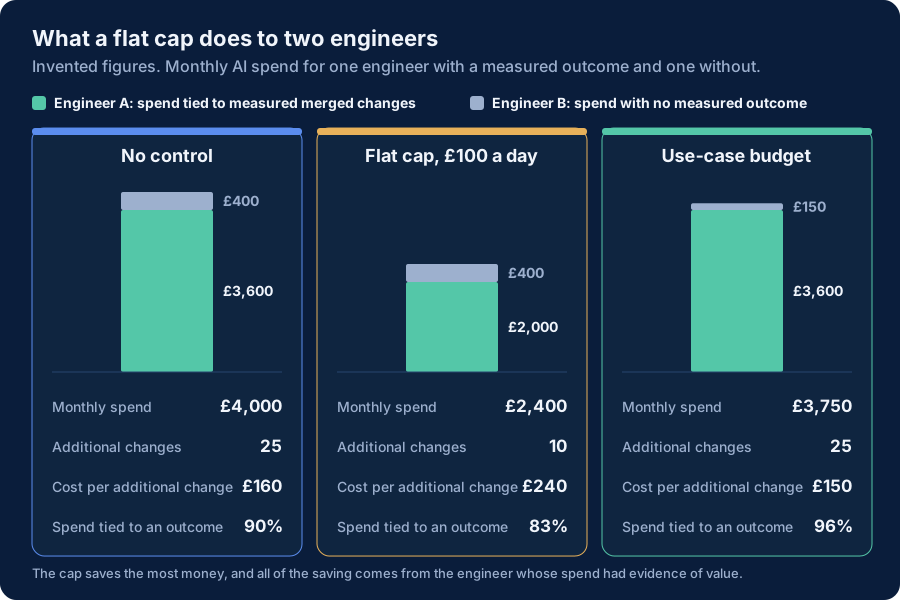
| No control | Flat cap, £100 a day | Use-case budget | |
|---|---|---|---|
| Engineer A spend | £3,600 | £2,000 | £3,600 |
| Engineer B spend | £400 | £400 | £150 |
| Monthly bill | £4,000 | £2,400 | £3,750 |
| Additional merged changes | 25 | 10 | 25 |
| Cost per additional change | £160 | £240 | £150 |
| Spend tied to an outcome | 90% | 83% | 96% |
The example is deliberately simple. In practice A's spend would include some waste worth removing, and B's general use may have value nobody has measured yet. Both are reasons to look at the spend, not to cap it blind.
What to do instead
None of this means removing limits. It means making the limit the last control, not the first.
- Budget by use case, not by person. A use case has an owner, an outcome and a reason to exist. A budget attached to it can be judged against what it produced. A budget attached to a person can only be judged against what other people spent. How to Budget for AI sets out the driver-based forecast that sits underneath.
- Read spend per person as a distribution. Look at the top of the distribution first, and look at what it produced before deciding whether it is waste. Managing Coding-Agent Spend shows how.
- Tie exemptions to evidence, not seniority. An engineer or team that can show merged changes, cases closed or hours returned to other work against a baseline should get more budget without needing a senior sponsor. One that cannot should be asked to measure before it asks for more.
- Route before you ration. Much of the bill comes from using a frontier model where a cheaper one would clear the quality floor. Accenture estimates that more than half of AI requests go to a more capable and more expensive model than the task needs. Set a capable lower-cost default and make premium models available when the task needs them. The Economics of Model Selection and Token Share Is Not Spend Share explain why this moves the bill more than per-head limits do.
- Measure cost per successful outcome. The unit cost finance needs is the cost of a piece of finished work that meets the quality bar, including the people who check and fix it. The cost per outcome calculator compares setups on that basis. The FinOps Foundation's guidance on FinOps for AI now recommends the same measure, reported as a range.
- Track attribution coverage. Report each month what share of AI spend is tied to a measured outcome. When spend is capped, the share tells finance how much of what remains is defended. The attribution coverage tool computes it, and The AI Value Gap explains why it is the headline number.
What a cap is still good for
A per-person or per-key limit has real uses, and they are worth keeping separate from budget policy.
- A backstop against runaway use. An agent stuck in a loop, or a script that calls a model millions of times, needs a hard stop. Set it well above normal use.
- Protection against abuse. Public-facing services need per-user and per-session limits as a defence against cost-exhaustion attacks.
- A holding control while reporting catches up. Where spend is rising fast and nobody can yet see by use case, a temporary cap buys time. It should come with a date by which use-case budgets replace it.
Questions readers ask
Should we cap AI usage per employee?
Use per-person limits as a high backstop, not as the main budget control. Set budgets by use case or team, with alerts at agreed thresholds and an exception route that depends on evidence of value. A per-person cap set near typical use cuts the heaviest users, who are often the ones getting the most from the tool.
How do we decide who gets a higher AI budget?
Ask for evidence against a baseline: work that cleared a quality bar, cycle time, cases resolved, or capacity moved to other work. Where nobody can yet provide it, fund a short measured trial rather than a standing exemption. Seniority is not evidence.
Do usage caps save money?
They reduce the bill, by definition. Whether they save money depends on what the capped spend was producing. If the spend above the cap was buying work that would cost more to do another way, the cap raises the cost of that work. Cost per successful outcome before and after the cap shows which.
Tools and templates
Cost per successful outcome calculator
Browser tool. Compare up to four model setups on what each successful outcome costs, including the people who fix failures. Runs in your browser; nothing is sent anywhere.
Attribution coverage calculator
Browser tool. Calculate what share of AI spend is connected to a measured outcome. Runs in your browser; nothing is sent anywhere.
AI budget stress test
Browser tool. Test whether an AI case still meets its hurdle if prices rise, demand grows, or both. Runs in your browser; nothing is sent anywhere.
Sources
- MacRumors, "Apple is Putting Employees on an AI Budget", 4 November 2026, reporting Bloomberg News. Reuters, "Apple cuts employee AI budgets in cost-control push, Bloomberg News reports", 4 November 2026, via MarketScreener.
- Menlo Ventures, "2026: The State of Enterprise AI", 3 November 2026. Menlo Ventures is an investor in Anthropic.
- Accenture, "The CIO's guide to AI tokenomics", 10 September 2026.
- Deloitte AI Institute, "The State of AI in the Enterprise", 29 October 2026.
- FinOps Foundation, "FinOps for AI Overview", read 5 November 2026.
- Uber's budget: press reports of May 2026, set out with sources in When AI Usage Outruns the Budget.